
Rapport sur les résultats du Paraguay 2022-2024
- Plan d'action: Plan d'action du Paraguay 2022-2024
- Dates à l'examen: 2022-2024
- Année de publication du rapport: 2026
Paraguay’s fifth plan d'actionLes plans d’action sont au cœur de la participation d’un gouvernement au PGO. Ils sont le fruit d’un processus de co-création dans lequel le gouvernement et la société civile élaborent conjointement des engagements en faveur d’un gouvernement ouvert… achieved limited results, with the main advances concentrated in marchés publicsLa transparence du processus de passation des marchés publics peut contribuer à lutter contre la corruption et le gaspillage qui pèsent sur une part importante des budgets des marchés publics à l’échelle mondiale. Spécifications techniques : Des engagements qui visent à... Autres and strengthening the statistical system. The change in government authorities in 2023 disrupted the open government agenda and dialogue with civil society within the OGP process. The country faces the challenge of rebuilding its institutional framework and restoring inclusive participation spaces within its open government agenda.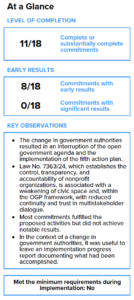
Mise en œuvre
Paraguay’s fifth action plan showed limited premiers résultatsLes premiers résultats font référence à des changements concrets dans les pratiques gouvernementales liées à la transparence, à la participation citoyenne et/ou à la responsabilité publique, suite à la mise en œuvre d'un engagement. L'initiative OGP... Autres. Notable achievements include EngagementLes engagements du PGO sont des promesses de réforme co-créées par les gouvernements et la société civile et soumises dans le cadre d'un plan d'action. Les engagements comprennent généralement une description du problème, des actions concrètes... 5, which developed a public red flags platform to detect risks in procurement processes, and Commitment 7, which strengthened coordination within the statistical system and the certification of records.
However, in most cases, the implementation of the commitments, as well as the open government agenda, was affected by the change in government authorities and the shift in the new government’s priorities from August 2023 onward. Although activities were completed for 11 of the 18 commitments, the IRM found no evidence that most of them had achieved early results. Some commitments were completed without evidence of use or impact, while others remained unfinished due to changes in political priorities. Compared with previous cycles, implementation of the plan reveals challenges in sustaining the level of political momentum and institutional capacity that had previously characterized Paraguay’s open government agenda.
Participation et co-création
The co-creation of the plan took place between July and December 2022 through public consultations and virtual workshops, with support from the United Nations Development Programme (UNDP). Although the virtual format facilitated the inclusion of previously excluded stakeholders, the process did not achieve sustained, iterative dialogue; instead, it combined a series of separate inputs. The plan ultimately reflected parallel agendas of the government and civil society, which weakened its strategic coherence[1].
The Open Government Directorate of the Technical Secretariat for Economic and Social Development Planning (STP) coordinated the OGP process during the plan’s design phase. During that phase, the Joint Working Group was established as a multistakeholder forum for coordinating and monitoring implementation[2]. During implementation of the plan, participation in the multistakeholder forum was interrupted. There is no documented evidence of open meetings, public consultations, or systematic feedback mechanisms during this phase.
Mise en œuvre en contexte
Paraguay’s fifth Open Government Action Plan had to navigate adverse circumstances both during its development and its implementation. The most influential factor was the change in government authorities following the 2023 des électionsAméliorer la transparence des élections et maintenir l'indépendance des commissions électorales est essentiel pour promouvoir la confiance dans le système électoral, prévenir la fraude électorale et défendre la démocratie. Autres. The government transition altered the institutional structure related to open government and made it difficult to maintain continuity in processes and follow-up on progress achieved. It also resulted in the interruption of dialogue with civil society and a shift in political priorities that affected specific commitments.
The electoral context had already affected the design of the plan, as it was anticipated that the change in government authorities could affect implementation. This expectation materialized more severely than anticipated. According to the civil society representatives interviewed who participated in the OGP process, the open government agenda has ceased to exist in the country[3].
Additionally, in October 2024, the Office of the Special Rapporteur for Freedom of Expression of the Inter-American Commission on Human Rights expressed concern over the approval of Law No. 7363/24, “which establishes the control, transparency, and accountability of nonprofit organizations,” on the grounds that it could hinder and restrict the functioning of these organizations in Paraguay[4]. One month later, in November 2024, OGP’s Rapid Response Protocol was activated[5].
The open government agenda within the OGP process was interrupted: there is no evidence of multistakeholder forum meetings, no updates have been posted on the website, and implementation of the commitments has been suspended. This situation contrasts with the country’s previous trajectory and represents a significant challenge for any effort to reactivate the OGP agenda.
[1] “Action Plan Review: Paraguay 2022–2024,” Independent Reporting Mechanism, https://www.opengovpartnership.org/es/documents/paraguay-action-plan-review-2022-2024/
[2] “Action Plan Review: Paraguay 2022–2024,” Independent Reporting Mechanism, https://www.opengovpartnership.org/es/documents/paraguay-action-plan-review-2022-2024/
[3] Interview with Raúl Quiñónez. CEAMSO. 28 January 2025, and interview with Francisco Samaniego. CIRD. 28 January 2025.
[4] “Special Rapporteurship on Freedom of Expression Warns about Bill Restricting Freedom of Association in Paraguay,” Inter-American Commission on Human Rights, 18 October 2024: https://www.oas.org/es/cidh/jsForm/?File=/es/cidh/expresion/prensa/comunicados/2024/255.asp&utm_content=country-pry
[5] “Paraguay – Rapid Response Request, November 2024,” https://www.opengovpartnership.org/documents/paraguay-letter-of-concern-november-2024/
Laissez un commentaire