
Informe de resultados de Túnez 2023-2025
- Plan de ACCION: Plan de acción de Túnez 2023-2025
- Fechas bajo revisión: 2023-2025
- Año de publicación del informe: 2026
quinto nacional de Túnez plan de acciónLos planes de acción son fundamentales para la participación de un gobierno en la Alianza para el Gobierno Abierto (AGP). Son el resultado de un proceso de cocreación en el que el gobierno y la sociedad civil desarrollan conjuntamente compromisos para un gobierno abierto... el Curso Advanced datos abiertosAl abrir los datos y hacerlos compartibles y reutilizables, los gobiernos pueden permitir un debate informado, una mejor toma de decisiones y el desarrollo de nuevos servicios innovadores. Especificaciones técnicas: Póliza... y presupuesto transparenciaSegún los Artículos de Gobernanza de la OGP, la transparencia se produce cuando “la información en poder del gobierno (incluidas las relativas a actividades y decisiones) es abierta, completa, oportuna y de libre acceso para el público,... Más. Un contexto desafiante, centrarse en las actividades técnicas internas, y la falta de validación gubernamental de alto nivel de elementos clave de la reforma limitada resultados tempranosLos primeros resultados se refieren a cambios concretos en la práctica gubernamental relacionados con la transparencia, la participación ciudadana y/o la rendición de cuentas pública como resultado de la implementación de un compromiso. El informe Independ... Más a pesar del alto nivel del plan de acción terminaciónLos implementadores deben cumplir con sus compromisos para lograr un impacto. Para cada compromiso, el Mecanismo de Informes Independientes (IRM) de la OGP evalúa el grado en que se han llevado a cabo las actividades descritas... MásAunque el proceso de la Alianza para el Gobierno Abierto (OGP) fue inicialmente colaborativo, la comunicación entre la sociedad civil y el gobierno disminuyó durante su implementación.
Implementación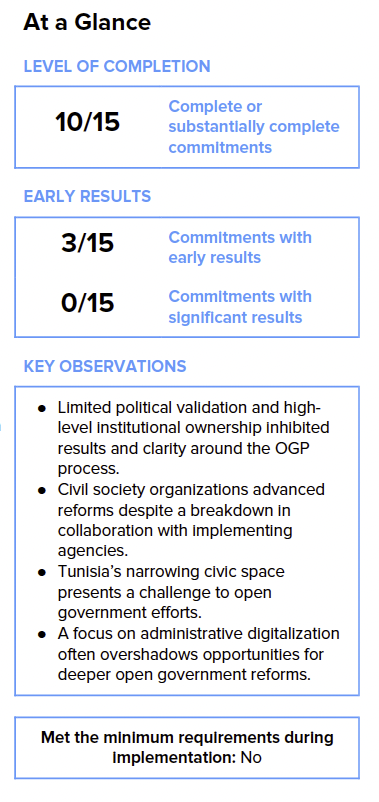
En el quinto plan de acción nacional de Túnez, 10 de los 15 compromisos se cumplieron total o sustancialmente.[ 1 ] El plan priorizó reformas relacionadas con el presupuesto abierto, los datos abiertos, la gobernanza de los recursos naturales y la digitalización de los servicios administrativos. A pesar de un alto grado de avance, muchas actividades fueron de carácter técnico e interno del gobierno. Por consiguiente, la mayoría de los compromisos (12) no lograron resultados significativos.
Los reformadores lograron resultados moderados en datos abiertos y transparencia presupuestaria. A través del Compromiso 1, el Ministerio de Finanzas lanzó un portal de presupuesto abierto revitalizado, Mizaniatouna,[ 2 ] que proporciona información presupuestaria detallada y actualizada. El Foro Civil Tunecino para la Alianza para el Gobierno Abierto (OGP) elaboró materiales presupuestarios simplificados para mejorar el acceso de las personas con discapacidad.
En virtud de los compromisos 6 y 7, la Unidad de Gobierno Electrónico impulsó las reformas de datos abiertos mediante la puesta en marcha de un registro nacional de datos públicos, que permite a los ciudadanos consultar y solicitar los datos inventariados.[ 3 ] El Ministerio de Medio Ambiente también tomó medidas para aumentar la publicación de datos ambientales. La colaboración entre ministerios gubernamentales, la sociedad civil local y socios internacionales facilitó el debate público sobre datos ambientales en cinco gobernaciones. Sin embargo, en los tres compromisos, la implementación se vio afectada por la disminución de la colaboración entre la sociedad civil y el gobierno.
La retirada o suspensión de actores clave en la implementación, los desafíos de coordinación y la falta de transparencia gubernamental. la relevanciaDe acuerdo con los Artículos de Gobernanza de OGP, los compromisos de OGP deben incluir una lente clara de gobierno abierto. Específicamente, deben promover al menos uno de los valores de OGP: transparencia, participación ciudadana... in compromisoLos compromisos de OGP son promesas de reforma creadas conjuntamente por los gobiernos y la sociedad civil y presentadas como parte de un plan de acción. Los compromisos suelen incluir una descripción del problema, una acción concreta... El diseño dificultó los resultados iniciales de los compromisos restantes. El compromiso 4, identificado como prometedor en la Revisión del Plan de Acción, no alcanzó los resultados esperados debido a la retirada de la organización de la sociedad civil ejecutora del proceso de la Alianza para el Gobierno Abierto (OGP). El compromiso 5 sobre acceso a la información se vio afectado por la suspensión continua de la Autoridad de Acceso a la Información. El compromiso 10 sobre participación electrónica perdió financiación tras la suspensión del apoyo de USAID en el país. Los compromisos 8 y 9 sobre gobierno abierto a nivel local, también considerados inicialmente prometedores, se vieron obstaculizados por problemas de coordinación entre los organismos ejecutores y los socios locales e internacionales.
Muchos compromisos se centraron en reformas administrativas internas. En consecuencia, estos compromisos no contribuyeron directamente a que el gobierno fuera más transparente para los tunecinos, a pesar de los altos niveles de implementación. Las reformas que carecían de una conexión clara con el gobierno abierto incluían los Compromisos 2 y 3 sobre gestión del agua, los Compromisos 11 y 12 sobre integridad pública y el Compromiso 14 sobre servicios para inversores. Si bien los Compromisos 13 y 15 generaron documentos para apoyar la gobernanza de las organizaciones de la sociedad civil y el acceso a la información para personas con discapacidad, el IRM encontró escasa evidencia de su operacionalización al final del período de implementación. Socios como el Programa de Apoyo a los Gobiernos Abiertos Francófonos (PAGOF), la Deutsche Gesellschaft für Internationale Zusammenarbeit (GIZ) y el Banco Mundial proporcionaron apoyo técnico y financiero clave en todos los compromisos.
Participación y Co-Creación
El proceso de la OGP fue supervisado por la Unidad de Gobierno Electrónico dentro de la Presidencia del Gobierno junto con un Comité Directivo o Comité Directivo (Alumno).[ 4 ] El proceso de elaboración conjunta del plan de acción incluyó tres talleres regionales en Gafsa, Kairouan y Kef para involucrar a las partes interesadas fuera de la capital y la recopilación de más de 320 propuestas a través del portal de participación digital, talleres, correo electrónico y estructuras públicas.[ 5 ] Durante todo el período de implementación, Túnez siguió sin contar con un enlace gubernamental de alto nivel para la Alianza para el Gobierno Abierto (OGP). En consecuencia, las reformas carecen de un defensor de alto nivel que traduzca los avances técnicos específicos en resultados institucionalizados de gobierno abierto. La participación de las organizaciones de la sociedad civil y la frecuencia de las reuniones disminuyeron hacia la segunda mitad del período de implementación, lo que generó incertidumbre en torno al próximo plan de acción.[ 6 ]
Túnez no cumplió con los requisitos mínimos establecidos en las Normas de Participación y Cocreación de la OGP, ya que la COPIL no se cumplió entre mayo de 2025 y el final del período de implementación en diciembre de 2025.[ 7 ] Por consiguiente, el IRM recomienda que Copil se reúna para reanudar el diálogo entre el gobierno y la sociedad civil, en particular sobre el progreso en la implementación del quinto plan de acción y el cronograma de creación conjunta para futuros compromisos.
Implementación en contexto
La implementación del quinto plan de acción de Túnez se vio afectada por un entorno de gobernanza y de espacio cívico cada vez más complejo.[ 8 ] En este contexto, la colaboración entre el gobierno y la sociedad civil en las reformas de la Alianza para el Gobierno Abierto (OGP) disminuyó durante su implementación. Las organizaciones de la sociedad civil, incluyendo el Foro Civil Tunecino para la OGP, continuaron sus esfuerzos con el apoyo de socios internacionales. Si bien la información disponible en línea indica que algunos ministerios siguieron implementando reformas, la falta de una validación de alto nivel limitó los resultados potenciales de varios compromisos. Por ejemplo, la Estrategia Nacional de Datos Abiertos aún espera la aprobación formal del gobierno. A nivel local, tres de los cinco miembros locales tunecinos de la OGP contaban con compromisos activos a marzo de 2026.[ 9 ] Dado que los contactos gubernamentales de la OGP no respondieron a las solicitudes de entrevista, este informe se basa únicamente en la investigación documental y en entrevistas con representantes de la sociedad civil.
[ 1 ] Presidencia del Gobierno, “Plan de Acción de Túnez 2023–2025”, Open Government Partnership, 9 enero 2024, https://www.opengovpartnership.org/documents/tunisia-action-plan-2023-2025-december
[ 2 ] “Mizaniatouna”, Gobierno de Túnez, consultado en junio de 2026, http://www.mizaniatouna.gov.tn.
[ 3 ] “Registro Nacional de Datos Abiertos”, Gobierno de Túnez, consultado en junio de 2026, registro.datos.gov.tn.
[ 4 ] Presidencia del Gobierno, “Plan de Acción de Túnez 2023–2025”, Open Government PartnershipEl Open Government Partnership (OGP) es una iniciativa de múltiples partes interesadas enfocada en mejorar la transparencia del gobierno, garantizar oportunidades para la participación ciudadana en asuntos públicos y fortalecer... Más.
[ 5 ] Presidencia del Gobierno, “Plan de Acción de Túnez 2023–2025”, Open Government Partnership, P. 10.
[ 6 ] Interesado anónimo de la sociedad civil, entrevista realizada por un investigador del IRM el 6 de febrero de 2026; Interesado anónimo de la sociedad civil, entrevista realizada por un investigador del IRM el 23 de febrero de 2026.
[ 7 ] “Actas de la reunión de COPIL”, OGP Túnez, http://www.ogptunisie.gov.tn/en/?cat=51El IRM confirmó además la ausencia de reuniones entre el 22 de mayo de 2025 y diciembre de 2025, a través de entrevistas con representantes de la sociedad civil.
[ 8 ] “Monitor del Espacio Cívico: Túnez”, Civicus, consultado en junio de 2026, https://monitor.civicus.org/country/tunisia; “Libertad en el mundo 2025: Túnez”, Freedom House, consultado en junio de 2026, https://freedomhouse.org/country/tunisia/freedom-world/2025; “Monitor de Libertad Cívica: Túnez”, Centro Internacional de Derecho para Organizaciones sin Fines de Lucro, actualizado el 15 de mayo de 2026, http://www.icnl.org/resources/civic-freedom-monitor/tunisia.
[ 9 ] Entre los cinco miembros tunecinos de la OGP Local, solo Zriba, El Kef y Dar Chaabane El Fehri tienen compromisos activos, mientras que Cartago y Regueb no tenían ninguno. Véase: “OGP Local”. Open Government Partnership27 de marzo de 2026 https://www.opengovpartnership.org/ogp-local.
Deje un comentario