Examen du plan d'action du Monténégro 2025-2029
- Plan d'action: Plan d'action du Monténégro 2025-2029
- Dates à l'examen: 2025-2029
- Année de publication du rapport: 2026
Montenegro’s fourth plan d'actionLes plans d’action sont au cœur de la participation d’un gouvernement au PGO. Ils sont le fruit d’un processus de co-création dans lequel le gouvernement et la société civile élaborent conjointement des engagements en faveur d’un gouvernement ouvert… mainly continues policy areas from previous action plans, including participation du publicDonner aux citoyens la possibilité de contribuer au processus décisionnel du gouvernement conduit à une gouvernance plus efficace, à une meilleure prestation des services publics et à des résultats plus équitables. Spécification technique... Le plan d'action prévoit des mesures en matière de prise de décision, de protection des lanceurs d'alerte et de transparence de l'administration locale. Il comprend moins d'engagements que le précédent, ce qui pourrait favoriser une mise en œuvre plus efficace. Son alignement sur l'adhésion du Monténégro à l'Union européenne (UE) pourrait encourager les réformes en faveur d'un gouvernement ouvert, mais risquerait également de mettre à rude épreuve les ressources administratives limitées. Les principaux défis demeurent la faible coordination interinstitutionnelle autour du Partenariat pour un gouvernement ouvert (PGO) et le soutien politique inégal au plus haut niveau.
Montenegro’s fourth action plan (2025-2029) includes five commitments in citizen participation, fiscal transparency, anti-corruption, local government openness, and digital transformation. It is Montenegro’s first four-year action plan. The plan is aligned with the 2022-2026 Public Administration Reform Strategy[1] and the 2022-2026 Digital Transformation Strategy.[2]
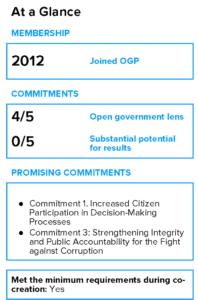
The IRM has assessed two promising commitments in the Action Plan Review. EngagementLes engagements du PGO sont des promesses de réforme co-créées par les gouvernements et la société civile et soumises dans le cadre d'un plan d'action. Les engagements comprennent généralement une description du problème, des actions concrètes... 1 aims to strengthen civic participation in decision-making through an interdepartmental body for participation citoyenneSelon les statuts de l'OGP, la participation citoyenne se manifeste lorsque « les gouvernements cherchent à mobiliser les citoyens pour qu'ils participent au débat public, donnent leur avis et contribuent à des actions qui mènent à davantage de progrès… Autres, the development of citizen consultation guidelines, trainings for civil servants, and improvements to the e-Participation system. Commitment 3 seeks to establish an interactive platform and map for citizens to report instances of corruption. These commitments share a common focus on improving interaction between citizens and public institutions, by creating more accessible participation mechanisms and increasing transparenceSelon les statuts de l'OGP, la transparence est atteinte lorsque « l'information détenue par le gouvernement (y compris sur les activités et les décisions) est ouverte, exhaustive, opportune et librement accessible au public… Autres of institutional performance.
The fourth action plan mostly builds on the policy areas from the previous (2022-2024) plan, including citizen participation, fiscal transparency, anti-corruption, and digital governance.[3] However, it provides a more structured approach to reform, particularly through the introduction of standardized tools, coordinated mechanisms, and attempts to improve implementation practices. Compared to the previous action plan, the fourth plan includes significantly fewer commitments (five compared to 20). The government’s intention was to focus the action plan on feasibility. One civil society stakeholder viewed this as both an improvement, due to greater feasibility of implementation, and a limitation, as several commitments may result in incremental rather than substantial changes.[4] While there is an expanded focus on public sector digitalization and digital governance, no new policy areas are introduced in this action plan, nor new government bodies beyond those previously involved in the OGP process. A public policy expert involved in the development of the action plan noted that this focus of the action plan may have come at the expense of ambition.[5]
During the previous action plan, the Ministry of Public Administration was supported by the National Democratic Institute (NDI) Montenegro and the civil society organization (CSO) Institut Alternativa in organizing discussions and public outreach for the OGP process.[6] For the fourth action plan, by contrast, the ministry successfully led the co-creation process with support from the Regional School of Public Administration (ResPA) in organizing consultations. Government and civil society stakeholders noted several improvements in the co-creation process compared to previous action plans, including an earlier start and more structured consultations.[7] The ministry also continued some of the positive aspects of the third action plan, including the organization of consultation workshops in multiple locations, allowing stakeholders from different regions of Montenegro to participate and contribute to the development of the action plan,[8] and the publication of the responses from public institutions to stakeholder comments submitted during the public hearing of the draft action plan.[9] Moreover, compared to the previous cycle, there were more people in the Ministry of Public Administration working directly on the development on the fourth action plan.
The re-establishment of the Operations Team, Montenegro’s multi-stakeholder forum for OGP, during the co-creation of the fourth action plan, was another positive step for Montenegro’s OGP process.[10] The Operations Team was largely inactive for most of the 2022-2024 action plan after its previous mandate expired in July 2022. The Ministry of Public Administration made two calls for non-governmental representatives to apply to the Operational Team, on 14 April and 5 May 2025. The ministry faced difficulties around getting CSOs to become involved in the Operations Team and to get involved in the OGP process.[11] Several CSOs that were previously active in the OGP process, such as Institut Alternativa, did not re-apply for the Operations Team based on their experiences from the previous action plan cycles and their skepticism of the OGP process’ ability to influence government decision-making.[12] This highlights a need to rebuild trust among CSOs through iterative dialogue, both within the Operational Team and outside of it. However, the ministry received some feedback from CSOs like “MANS”, even though they did not engage in the Operations Team.
A limitation of the fourth action plan is some commitments’ focus on improving administrative processes (Commitments 1 and 4), which, while positive, may not generate transformative results. Commitment 4 aims to introduce minimum standards and annual reporting on openness practices, develop standardized digital services, and introduce e-consultations at the local level, but the mechanisms for the enforcement of these changes are unclear. Other commitments introduce reforms focusing on promoting open government among citizens and involving them in reforms but are unclear on their added value to the status quo (Commitment 2) or are susceptible to contextual factors beyond the control of commitment implementers (Commitment 3). Other risks include potential changes in personnel, limited institutional memory, and weak inter-institutional coordination, all of which have affected previous action plan cycles.[13]
Montenegro is currently undergoing European Union (EU) accession negotiations, with a target of joining the EU by 2028.[14] As a result, many reforms in the action plan are closely aligned with EU-driven priorities, particularly in areas such as good governance, transparency, and rule of law.[15] While this alignment could reinforce the relevance of open government reforms in the public administration, it may also place additional pressure on administrative capacities, as key institutions may prioritize EU-related obligations over the implementation of OGP commitments.[16]
As this is a four-year action plan, it will undergo a refresh process at the midpoint of implementation. The IRM recommends that the Ministry of Public Administration and the Operations Team consider using this refresh process to refine commitments, increase ambition where feasible, and address implementation gaps identified during the first two years. The Operations Team’s effectiveness as a space for dialogue will require it to meet regularly throughout action plan implementation.[17] Rebuilding trust between institutions and civil society will be essential, particularly through transparent communication and responsiveness to stakeholder input.
[1] “Public Administration Reform Strategy 2022-2026,” Government of Montenegro, accessed September 24, 2026, https://www.gov.me/en/documents/0aaa040b-0413-46b6-a8c7-5b2c10cdc9dc.
[2] “Montenegro Digital Transformation Strategy,” Government of Montenegro, accessed September 24, 2026, https://www.gov.me/en/documents/59dcab9b-b0e8-48b7-830b-6e4eab690521.
[3] “OGP Montenegro National Action Plan 2023-2024,” Open Government Partnership, accessed September 24, 2026, https://www.opengovpartnership.org/wp-content/uploads/2022/12/Montenegro_Action-Plan_2022-2024_December_EN.pdf.
[4] Miodrag Vujovic (NGO KOD), interview by the IRM, 3 April 2026.
[5] Nenad Koprivnica (ReSPA Expert involved in the preparation of the action plan), interview by the IRM, 26 March 2026.
[6] “Montenegro Action Plan Review 2022-24,” Open Government Partnership, accessed September 24, 2026, https://www.opengovpartnership.org/wp-content/uploads/2023/07/Montenegro_Action-Plan-Review_2022-2024_EN.pdf.
[7] Draško Loncar (Ministry for Public Administration), interview by the IRM, 26 February 2026; Snezana Nikcevic (NVO 35mm), interview by the IRM, 31 March 2026.
[8] “Public discussion on the draft National Action Plan 2026-2029,” Government of Montenegro, accessed September 24, 2026, https://www.gov.me/clanak/nacionalni-akcioni-planovi?utm_source=chatgpt.com.
[9] “Report on the conducted public discussion of NAP 2026-2029,” Government of Montenegro, accessed September 24, 2026, https://www.gov.me/dokumenta/7ead40fe-8cbc-47fb-b325-ff1954ef207f.
[10] “Report of the initial meeting of the OGP operation team,” Government of Montenegro, accessed September 24, 2026, https://www.gov.me/clanak/odrzana-inicijalna-sjednica-operativnog-tima-partnerstva-za-otvorenu-upravu.
[11] “REPEATED PUBLIC CALL FOR NOMINATIONS OF NON-GOVERNMENTAL ORGANIZATION REPRESENTATIVES TO THE OPEN GOVERNMENT PARTNERSHIP OPERATIONAL TEAM,” Government of Montenegro, accessed September 24, 2026, https://www.gov.me/clanak/ponovljeni-javni-poziv-za-predlaganje-predstavnika-nevladine-organizacije-u-operativni-tim-partnerstva-za-otvorenu-upravu.
[12] “IRM Montenegro Results Report 2022-2024,” Open Government Partnership, accessed September 24, 2026, https://www.opengovpartnership.org/documents/montenegro-results-report-2022-2024-for-public-comment/;
Marko Sosic (Institut Alternativa), interview by the IRM, 2 April 2026.
[13] Nenad Koprivnica (ReSPA Expert involved in the preparation of the action plan), interview by the IRM, 26 March 2026.
[14]“A Historic Opportunity for Montenegro to Conclude the EU Accession Process,” Delegation of the European Union to Montenegro, April 24, 2026, https://www.eeas.europa.eu/delegations/montenegro/historic-opportunity-montenegro-conclude-eu-accession-process_en.
[15] “Montenegro Report 2025,” European Commission, accessed September 24, 2026, https://enlargement.ec.europa.eu/montenegro-report-2025_en.
[16] Nenad Koprivnica (ReSPA Expert involved in the preparation of the action plan), interview by the IRM, 26 March 2026.
[17] Snezana Nikcevic (NVO 35mm), interview by the IRM, 31 March 2026.
Laissez un commentaire