Rapport sur les résultats de la Colombie 2023-2025
- Plan d'action: Plan d'action pour la Colombie 2023-2025
- Dates à l'examen: 2023-2025
- Année de publication du rapport: 2026
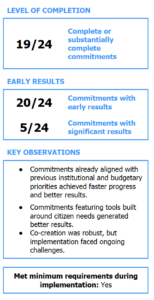
Colombia’s fifth plan d'actionLes plans d’action sont au cœur de la participation d’un gouvernement au PGO. Ils sont le fruit d’un processus de co-création dans lequel le gouvernement et la société civile élaborent conjointement des engagements en faveur d’un gouvernement ouvert… saw a solid level of implementation, with 19 commitments either substantially or fully completed, and 20 yielding premiers résultatsLes premiers résultats font référence à des changements concrets dans les pratiques gouvernementales liées à la transparence, à la participation citoyenne et/ou à la responsabilité publique, suite à la mise en œuvre d'un engagement. L'initiative OGP... Autres. The most notable progress was concentrated in the areas of sectoral transparenceSelon les statuts de l'OGP, la transparence est atteinte lorsque « l'information détenue par le gouvernement (y compris sur les activités et les décisions) est ouverte, exhaustive, opportune et librement accessible au public… Autres, public works, justice ouverteUn système judiciaire ouvert, indépendant et impartial constitue le fondement d'un meilleur accès à la justice en garantissant les libertés civiles de tous et en permettant aux individus de mieux protéger leurs droits., and access to information that is more easily understood by the public. Co-creation was a key strength of this cycle—featuring regional dialogues, public consultation, and diverse participation—though challenges persisted during implementation, particularly regarding institutional communication and the division of monitoring responsibilities between the government and civil society.
Mise en œuvre
Colombia’s fifth action plan yielded positive results, with 19 out of 24 commitments reaching a substantial or full level of implementation, and 20 out of 24 showing early results. The most significant progress was seen in commitments that either built upon existing foundations or successfully leveraged open government mechanisms to develop tools useful to the public.
Key areas of progress included transparency, public works, open justicePour surmonter les obstacles qui empêchent les citoyens de voir leurs besoins en matière de justice satisfaits, les gouvernements participants à l'OGP s'efforcent d'étendre la transparence, la responsabilité et l'inclusion dans tous les systèmes de justice..., and public-sector innovation. Notable achievements include the launch of the Transparency Portal for Transport Sector Contracting, which improved access to information regarding contract planning. Also noteworthy is the “Infrastructure for All” (Infraestructura para Todos) portal in Santiago de Cali, which enabled real-time monitoring of public works and fostered greater diversification among suppliers. Furthermore, the Constitutional Court and the Council of State made efforts to increase the accessibility of judicial information through the use of inclusive formats and new digital channels.
The Government of Colombia linked the implementation of these commitments to the 2022–2026 National Development Plan, with the aim of unifying efforts and increasing the effectiveness of public institutions. The commitments that saw the most progress shared several common elements: they had prior political or institutional backing, were aligned with existing priorities, and, in several cases, benefited from technical support provided by civil society or international cooperation. Conversely, commitments that relied on new structures, greater inter-institutional coordination, or more protracted coordination processes progressed more slowly.
Participation et co-création
The process was led by the Presidential Secretariat for Transparency, which served as the Technical Secretariat for the Open State Committee—the country’s forum multipartiteUn dialogue régulier entre le gouvernement et la société civile est un élément central de la participation à l'OGP. Il renforce la confiance, favorise la résolution conjointe des problèmes et permet à la société civile d'influencer la conception, la mise en œuvre... for open government. This Committee brought together six public institutions and four civil society organizations, holding regular meetings to monitor the plan. The co-creation phase was one of the plan’s key strengths: it incorporated citizen voting, public consultation, eight regional dialogues, and the participation of diverse groups.
During the implementation phase, the Committee continued to play a role in tracking the commitments. However, the quality of this participation was less consistent than it had been during the co-creation stage. Information gathered—including input from the Open State Committee—indicates that, at certain points, civil society organizations took on a greater responsibility for sustaining the process, supporting the implementation of commitments, and maintaining coordination. Despite these limitations, the country maintained a space for dialogue and monitoring throughout the entire cycle.
Regarding the scope of the plan, and in comparison with previous cycles, there was greater participation from other branches of government in the formulation and implementation of commitments. On the other hand, the functioning of the forum still faces challenges related to the renewal of its members, territorial representation, and a balanced level of participation between the government and civil society.
Mise en œuvre en contexte
The implementation process was shaped by both facilitating and limiting factors. Positive elements included the alignment of many commitments with the National Development Plan[1], the existence of prior work on commitments that yielded significant results, support from external partners, and the use of funding from international cooperation agencies to assist with certain commitments.
On the other hand, according to interviews with representatives of the Open State Committee, the implementation of the plan was hindered by challenges such as the turnover of government liaisons—a consequence of electoral processes—as well as staff changes within the entities responsible for executing the commitments. These transitions posed challenges for the continuity of the agenda and the maintenance of dialogue between the government and civil society. This action plan has helped confirm that Colombia possesses a solid institutional foundation for the Open Government PartnershipLe Open Government Partnership (OGP) est une initiative multipartite axée sur l'amélioration de la transparence du gouvernement, la garantie d'opportunités de participation des citoyens aux affaires publiques et le renforcement ... Autres (OGP); however, its long-term sustainability will depend on strengthening operational continuity, broadening participation at the regional/territorial level, and reducing reliance on a small number of actors to drive significant progress in the process.
[1] National Planning Department (2025). “National Development Plan 2022–2026: Colombia, a World Power for Life”, https://www.dnp.gov.co/plan-nacional-desarrollo/pnd-2022-2026.
Laissez un commentaire