Rapport sur les résultats du Kosovo 2023-2025
- Plan d'action: Plan d'action pour le Kosovo 2023-2025 (décembre)
- Dates à l'examen: 2023-2025
- Année de publication du rapport: 2026
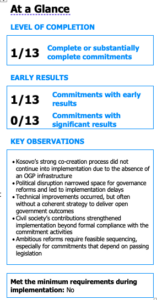
Premier partenariat ouvert du Kosovo plan d'actionLes plans d’action sont au cœur de la participation d’un gouvernement au PGO. Ils sont le fruit d’un processus de co-création dans lequel le gouvernement et la société civile élaborent conjointement des engagements en faveur d’un gouvernement ouvert… (2023–2025) ont amélioré le transparenceSelon les statuts de l'OGP, la transparence est atteinte lorsque « l'information détenue par le gouvernement (y compris sur les activités et les décisions) est ouverte, exhaustive, opportune et librement accessible au public… Autres du recrutement de hauts fonctionnaires. Cependant, la plupart des autres engagements ont connu un essor limité. achèvementPour que leurs engagements aient un impact, les responsables de leur mise en œuvre doivent les respecter. Pour chaque engagement, le Mécanisme de rapport indépendant (MRI) de l'OGP évalue dans quelle mesure les activités décrites… AutresLe plan d'action a été élaboré de manière collaborative grâce à un processus ouvert et inclusif, mais sa mise en œuvre a souffert d'un manque de coordination centrale et d'implication des parties prenantes. Les futurs plans d'action gagneraient à adopter une approche plus concertée. infrastructure OGP systématique et des partenariats structurés avec la société civile pour co-créer et co-mettre en œuvre des engagements.
Mise en œuvre
Le plan d'action du Kosovo pour 2023-2025 comprenait 13 engagements couvrant gouvernance numériqueAlors que les technologies en évolution offrent de nouvelles opportunités aux gouvernements et aux citoyens pour faire progresser l'ouverture et la responsabilité, les gouvernements participants à l'OGP s'efforcent de créer des politiques qui traitent de la ... Autres, données ouvertesEn ouvrant les données et en les rendant partageables et réutilisables, les gouvernements peuvent permettre un débat éclairé, une meilleure prise de décision et le développement de nouveaux services innovants. Spécifications techniques : Police..., citoyen pa
participation à la prise de décision, espace civique, marchés publicsLa transparence du processus de passation des marchés publics peut contribuer à lutter contre la corruption et le gaspillage qui pèsent sur une part importante des budgets des marchés publics à l’échelle mondiale. Spécifications techniques : Des engagements qui visent à... Autres et finance politiqueAssurer la transparence dans le financement des campagnes, des partis politiques et de la politique démocratique est un mécanisme de responsabilité essentiel pour un gouvernement démocratique et est un domaine d'intérêt croissant dans l'OGP ... Autres transparence. EngagementLes engagements du PGO sont des promesses de réforme co-créées par les gouvernements et la société civile et soumises dans le cadre d'un plan d'action. Les engagements comprennent généralement une description du problème, des actions concrètes... Le volet 4.2 (recrutement transparent des hauts fonctionnaires) a été en grande partie mis en œuvre. Cet engagement a conduit à la mise en place d'un nouveau cadre juridique et d'une plateforme centralisée de gestion des ressources humaines, contribuant ainsi à une plus grande standardisation du processus de recrutement, avec la publication des offres d'emploi et le recours aux candidatures en ligne. Toutefois, des lacunes en matière de transparence subsistent (par exemple, absence de publication des notes attribuées par les jurys et pratiques de justification incohérentes), les garanties d'intégrité n'ont pas été institutionnalisées comme prévu et le recours aux nominations par intérim a limité l'impact des réformes sur la confiance du public et la responsabilisation.
D'autres engagements ont progressé de manière inégale ou ont été bloqués. De nombreux engagements concernant des plateformes numériques, tels que le portail national de données ouvertes (engagements 2.1 à 2.4) et le portail de la municipalité électronique (« e-Komunat ») (engagement 1.2), ont été affectés par des capacités techniques et humaines inégales au sein du gouvernement, ainsi que par des problèmes de fonctionnement des plateformes. Les deux engagements identifiés comme les plus ambitieux dans l'examen du plan d'action du Mécanisme international de recherche et d'innovation (engagement 4.1 sur la transparence des marchés publics et engagement 4.3 sur la transparence du financement politique) étaient conditionnés par l'adoption de… législationLa création et l'adoption de lois sont l'un des moyens les plus efficaces de garantir que les réformes du gouvernement ouvert ont des effets durables sur les pratiques gouvernementales. Spécifications techniques : Acte de création ou de r... Le plan d'action n'a pas pu progresser faute de Parlement opérationnel pendant la majeure partie de sa mise en œuvre. De plus, une interruption prolongée de la coordination centrale en a limité l'application.
Participation et co-création
Le Kosovo a co-créé son premier plan d'action grâce à un processus inclusif, avec un forum multipartiteUn dialogue régulier entre le gouvernement et la société civile est un élément central de la participation à l'OGP. Il renforce la confiance, favorise la résolution conjointe des problèmes et permet à la société civile d'influencer la conception, la mise en œuvre... Le Comité national de coordination (CNC), de nombreux ateliers thématiques, des débats publics et une vaste consultation en ligne ont été organisés. La société civile a largement indiqué que ses contributions avaient été prises en compte dans le plan final, grâce au soutien d'un point de contact mobilisé lors de sa co-élaboration. En revanche, la participation s'est enrayée lors de la mise en œuvre. Le Kosovo a fonctionné pendant une longue période sans point de contact actif au sein du ministère de l'Administration locale (MLGA) après l'adoption du plan, le CNC ne s'est pas réuni pendant la mise en œuvre et aucune communication ni aucun compte rendu systématique n'ont été établis avec la société civile. Le site web dédié au PGO, initialement géré par la société civile, n'a pas été mis à jour pendant la mise en œuvre et est resté non fonctionnel même après le transfert technique au gouvernement, ne laissant aucune information accessible. dépôtL'accès aux informations pertinentes est essentiel pour permettre la participation et assurer la responsabilité tout au long du processus OGP. Un référentiel OGP est un site Web centralisé en ligne, une page Web, une plate-forme ou ... de preuves ou de suivi des progrès. Par conséquent, le Kosovo n'a pas satisfait aux exigences. exigences minimalesTous les pays participants à l'OGP doivent adhérer aux normes de participation et de co-création. Chaque norme comprend des exigences minimales claires et mesurables que tous les participants OGP comptent ... pour la mise en œuvre dans le cadre de l'OGP Normes de participation et de co-créationLa collaboration entre le gouvernement, la société civile et les autres parties prenantes est au cœur du processus OGP. Les Normes de participation et de co-création visent à soutenir cette collaboration à travers...En juin 2025, le MLGA a créé une division dédiée au PGO, qui a piloté l'élaboration du nouveau plan d'action 2026-2028 et qui devrait renforcer la continuité de la coordination, favoriser un dialogue plus régulier avec les parties prenantes et améliorer le suivi et le compte rendu publics de la mise en œuvre.
Mise en œuvre en contexte
La mise en œuvre s'est déroulée dans un contexte politique complexe et instable au Kosovo. En 2024, les tensions entre le Kosovo et la Serbie étaient exacerbées, les processus d'intégration internationale et européenne étaient au point mort, et le débat public était dominé par les questions sécuritaires, ce qui a détourné l'attention politique des réformes de gouvernance. En 2025, des tensions récurrentes sont apparues. des électionsAméliorer la transparence des élections et maintenir l'indépendance des commissions électorales est essentiel pour promouvoir la confiance dans le système électoral, prévenir la fraude électorale et défendre la démocratie. Autres La paralysie institutionnelle a encore davantage entravé la mise en œuvre des réformes : les retards prolongés dans la constitution du Parlement, un gouvernement intérimaire aux pouvoirs limités et des cycles électoraux répétés ont réduit les possibilités de coordination interinstitutionnelle et de suivi durable des politiques. Ces dynamiques ont contribué à une application fragmentée des engagements entre les institutions et ont limité les possibilités de suivi structuré et de responsabilisation des parties prenantes.
Télécharger
- Rapport sur les résultats du Kosovo 2023-2025_EN
- Kosovo_2023-2025_Résultats-Rapport_SQ
- Rapport sur les résultats du Kosovo 2023-2025 – Commentaires reçus
Laissez un commentaire