Rapport sur les résultats du Royaume-Uni 2023-2025
- Plan d'action: Plan d'action du Royaume-Uni 2023-2025 (décembre)
- Dates à l'examen: 2023-2025
- Année de publication du rapport: 2026
Le sixième tournoi national OGP du Royaume-Uni plan d'actionLes plans d’action sont au cœur de la participation d’un gouvernement au PGO. Ils sont le fruit d’un processus de co-création dans lequel le gouvernement et la société civile élaborent conjointement des engagements en faveur d’un gouvernement ouvert… a produit des résultats substantiels premiers résultatsLes premiers résultats font référence à des changements concrets dans les pratiques gouvernementales liées à la transparence, à la participation citoyenne et/ou à la responsabilité publique, suite à la mise en œuvre d'un engagement. L'initiative OGP... Autres in marchés publicsLa transparence du processus de passation des marchés publics peut contribuer à lutter contre la corruption et le gaspillage qui pèsent sur une part importante des budgets des marchés publics à l’échelle mondiale. Spécifications techniques : Des engagements qui visent à... Autres transparenceSelon les statuts de l'OGP, la transparence est atteinte lorsque « l'information détenue par le gouvernement (y compris sur les activités et les décisions) est ouverte, exhaustive, opportune et librement accessible au public… Autres par la mise en œuvre de la loi de 2023 sur les marchés publics. Le plan d'action a également permis d'améliorer la disponibilité et l'utilisation des technologies internationales. aideDes informations plus nombreuses et de meilleure qualité sur l'aide aident les pays partenaires et les institutions donatrices à planifier et à gérer plus efficacement les ressources d'aide, les parlements et la société civile à tenir les gouver... Les données montrent que la collaboration entre le gouvernement et la société civile est restée forte tout au long de la période de mise en œuvre malgré les perturbations institutionnelles survenues après les élections générales de juillet 2024.
Mise en œuvre
Le sixième plan d'action national du Royaume-Uni (NAP6) comprenait quatre engagements qui étaient tous entièrement ou en grande partie co-réalisés.
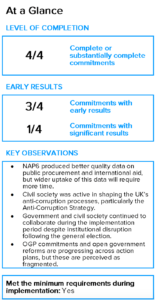
réalisé pendant la période de mise en œuvre.
EngagementLes engagements du PGO sont des promesses de réforme co-créées par les gouvernements et la société civile et soumises dans le cadre d'un plan d'action. Les engagements comprennent généralement une description du problème, des actions concrètes... 1. S'appuyant avec succès sur les engagements antérieurs du Royaume-Uni en faveur de la transparence dans les marchés publics.
La mise en œuvre de la loi sur les marchés publics de 2023, entrée en vigueur en février 2025, a permis la création d'une nouvelle plateforme centrale de publication des informations relatives aux marchés publics tout au long du cycle de vie des contrats et a augmenté le volume de données.
L'engagement 2 a permis d'améliorer la structure des données relatives aux marchés publics. Il a également instauré de nouvelles obligations de notification, renforçant ainsi la visibilité des opportunités de passation de marchés et le contrôle des dépenses publiques. Cet engagement a amélioré la qualité, l'exhaustivité et la régularité des rapports de données du Royaume-Uni sur l'aide internationale. Un plus grand nombre de ministères publient désormais ces données dans des formats standardisés. Ces efforts ont contribué à l'amélioration des performances du Royaume-Uni dans l'Indice de transparence de l'aide 2024 et ont renforcé le suivi interne de la qualité des données relatives à l'aide.
Les engagements 3 et 4 ont contribué à formaliser l'implication de la société civile dans les efforts anticorruption nationaux et internationaux du Royaume-Uni, tels que la Stratégie anticorruption du Royaume-Uni (ACS) et la participation du Royaume-Uni aux Nations Unies.
Initiatives contre la corruption. La société civile s'est activement engagée dans les processus de lutte contre la corruption durant le 6e PNA, notamment en développant et en lançant l'ACS.
Participation et co-création
Les représentants de la société civile et du gouvernement ont reconnu que processus de co-créationLa collaboration entre le gouvernement, la société civile et les autres parties prenantes (par exemple, les citoyens, les universitaires, le secteur privé) est au cœur du processus OGP. Les gouvernements participants doivent s'assurer qu'une plongée... Le NAP6 représentait une amélioration par rapport au plan d'action précédent (2021-2023). Son champ d'application se limitait à quatre engagements qui
La mise en œuvre de ce plan devrait être réalisable au cours de la période de deux ans prévue. Les représentants du gouvernement et de la société civile ont attribué le manque de mobilisation plus large principalement à des contraintes de ressources, à un temps insuffisant dans le cadre des fenêtres d'exécution du plan d'action du PGO, ainsi qu'aux limitations de ressources et de capacités du Réseau britannique de la société civile pour un gouvernement ouvert.
La responsabilité de la coordination du processus du PGO a été transférée à l'Unité de stratégie de la fonction publique (CSSU) au sein du Cabinet Office en avril 2025, tandis que le point de contact gouvernemental est resté inchangé. Suite aux élections générales de juillet 2024, des changements institutionnels ont entraîné la suspension des réunions du Forum multipartite (MSF) jusqu'en décembre 2025.[1] Toutefois, l’engagement s’est poursuivi au niveau des engagements individuels, où les organisations de la société civile et les responsables politiques se sont rencontrés au sein de groupes consultatifs, de réseaux thématiques et par le biais d’une collaboration directe.[2] Cette approche a permis de maintenir la collaboration au niveau de la mise en œuvre, mais l'absence de réunions de MSF pendant cette période a réduit les possibilités d'apprentissage croisé et de dialogue stratégique plus large.
Mise en œuvre en contexte
La mise en œuvre du 6e PNA s'est déroulée dans un contexte de profonds changements institutionnels. Suite aux élections générales de 2024, le changement de gouvernement a entraîné le transfert des responsabilités de coordination du PGO du Bureau central du numérique et des données (CDDO) à l'Unité de soutien aux cadres de la fonction publique (CSSU) au sein du Cabinet Office. Cette transition a engendré des difficultés de coordination interne et de renforcement des capacités, contribuant à la suspension des réunions du MSF pendant 17 mois. Ces difficultés reflétaient des problèmes plus généraux liés au rétablissement de la coordination dans le nouveau contexte. Le CDDO, ainsi que le Service numérique du gouvernement, ont été transférés au ministère des Sciences, de l'Innovation et de la Technologie dans le cadre d'une restructuration de l'administration. Dans les mois qui ont suivi, il a été convenu de confier à nouveau le mandat du PGO à une unité opérationnelle appropriée au sein du Cabinet Office. Durant toute cette période, aucun ministre n'a été désigné responsable du gouvernement ouvert, une désignation pourtant jugée essentielle à la reprise des réunions du MSF suite au changement de gouvernement.
Dans le même temps, plusieurs évolutions survenues lors du 6e Plan d'action national (PAN6) ont contribué à institutionnaliser les principes de gouvernement ouvert au Royaume-Uni. Parmi celles-ci figurent l'élaboration, en juillet 2025, du Pacte de la société civile, qui énonce un ensemble de principes visant à établir des partenariats efficaces entre la société civile et le gouvernement, ainsi que la présentation, en septembre 2025, du projet de loi sur la responsabilité des fonctionnaires au Parlement, qui instaurera une obligation légale pour les agents publics d'agir avec franchise et transparence, et prévoit des sanctions pénales en cas de manquements graves.[3] Par ailleurs, le gouvernement britannique a été élu coprésident de l'OGP pour la période d'octobre 2026 à septembre 2027, ce qui pourrait apporter un soutien politique de haut niveau au programme de gouvernement ouvert au Royaume-Uni.
[1] Matthew Donnelly et Ben Gittins (Cabinet Office), entretien réalisé par l'IRM, 2 mars 2026.
[2] Kevin Keith (président de l'OGN britannique), interviewé par l'IRM, le 9 mars 2026.
[3] GOV.UK, « La loi Hillsborough garantira que la vérité ne soit plus jamais dissimulée par l'État », communiqué de presse, 15 septembre 2025. https://www.gov.uk/government/news/hillsborough-law-to-ensure-truth-never-concealed-by-state-again.
Laissez un commentaire