The Resilience of Open Government
In 2024-25, OGP generated both significant momentum and navigated persistent challenges as we worked to advance the strategic priorities established in its 2023-2028 strategy, revealing both the resilience of the open government movement and the continuing hurdles to meaningful reform. Explore key findings from the report below.
Impact
Inspiring Ambitious Reforms
95% of OGP countries implemented an OGP action plan in 2024, while 11 countries and 33 subnational members submitted new action plans.
Among commitments submitted and implemented, 40% of all commitments focused on public participation, with commitments in digital transformation, inclusion, and open data also being popular.
Nearly 100 commitments from 30 OGP Local members marked the second-highest total of annual local commitments in OGP history.
This surge demonstrates accelerating grassroots momentum for open government reform. Beyond commitment volume, OGP saw strong national-local collaboration and scaling of local initiatives across multiple countries, including Ukraine, Morocco, Colombia, the Philippines, and Moldova.

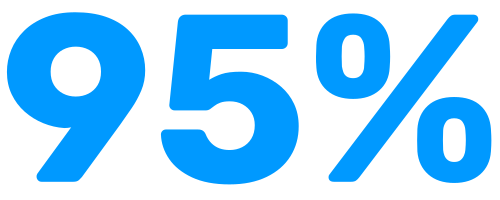
of OGP countries implemented an OGP action plan in 2024, while 11 countries and 33 subnational members submitted new action plans.

Building a Coalition of Reformers
The Partnership continues to grow, with three new national members (Maldives, Zambia, and Benin) and 55 new local members joining in the last year.
OGP leveraged political windows of opportunity to drive increased political engagement and meaningful reforms.
In Brazil, Guatemala, Moldova, Malawi, Poland, and Zambia, strategic support from OGP helped governments advance ambitious anti-corruption and public participation initiatives. This indicates how OGP can amplify reform momentum during opportune political transitions.
Reformers came together for inspiration, peer learning, and accelerating domestic reforms at three OGP regional meetings in 2024 and 2025.
These convenings brought together nearly 2,300 members of the open government community across the Americas, Asia-Pacific, and Africa and the Middle East.
OGP supported capacity-building among the next generation of open government reformers.
Notably, the OGP-led Open Government Leadership Collaborative convened anti-corruption leaders from 11 countries; OGP partnered with four French and Francophone African schools of government to embed open government principles in civil service training; OGP supported an accelerator supporting 20 reformers from government and civil society to scale participatory governance practices; and OGP collaborated with Apolitical to develop an open government course reaching the platform’s membership of 250,000 public servants from 160+ countries.
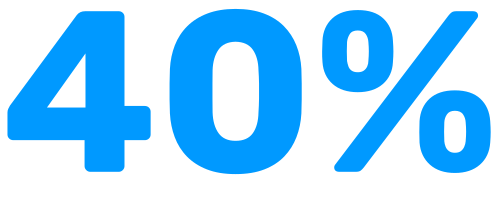
of submitted commitments focused on public participation. Digital transformation, inclusion, and open data commitments were also popular.
Spreading
Norms
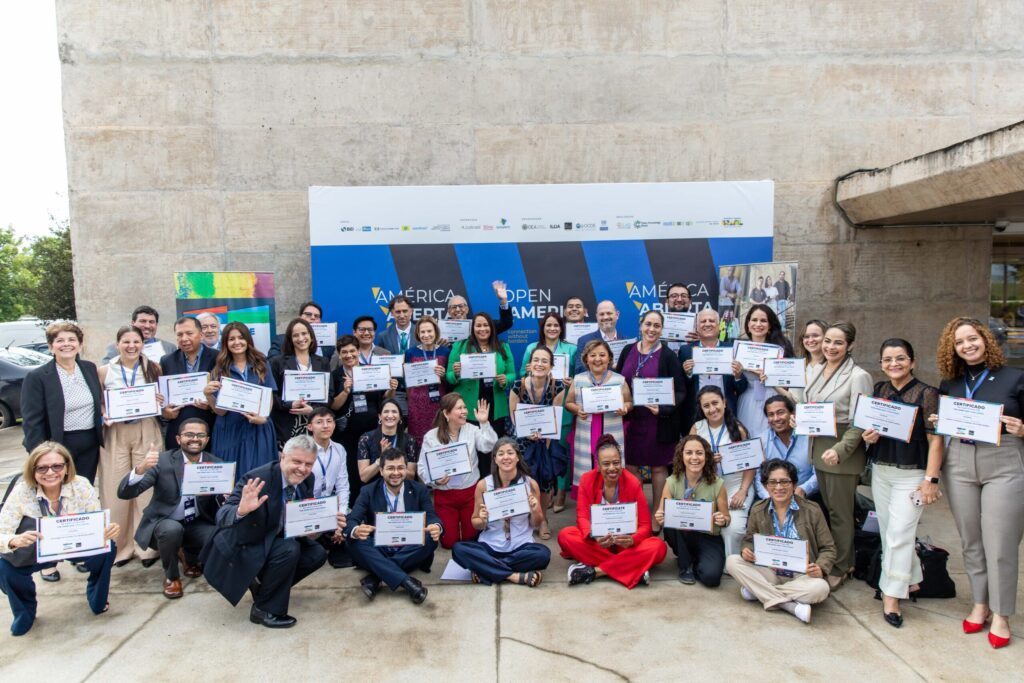
The Open Gov Challenge saw remarkable momentum in its first year, with over 73 successful submissions from 48 governments across national and subnational levels.
Strong political support from government bodies emerged as the primary driver of participation, while OGP’s strategic use of regional events created action-forcing moments that spurred commitment development.
OGP strengthened global anti-corruption efforts through strategic engagement in influential international forums.
Notably, OGP contributed to the European Commission’s guidance on anti-corruption in key Global Gateway sectors, and shaped the United Nations Convention against Corruption (UNCAC) Implementation Review Mechanism initiative through strategic participation in six major forums.
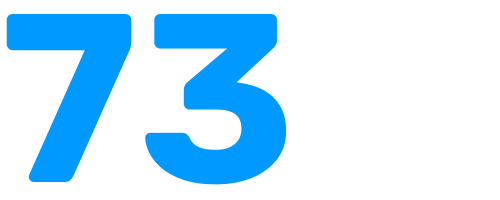
commitments were successfully submitted to the Open Gov Challenge from 48 governments across national and subnational levels of government.
Mainstreaming Open Government
Countries are increasingly using open government approaches and OGP action plans to connect between different levels and branches of government.
Out of the 10 national action plans submitted in 2024, three included commitments from the parliament, four included commitments from the judiciary, and seven included subnational commitments.
OGP members are incorporating open government approaches across government functions, and seeing the benefits of more stable and institutionalized dialogue pathways for government and civil society.
In the Philippines, an executive order established a dedicated project management office for OGP, significantly enhancing implementation capacity. Sierra Leone created an OGP parliamentary caucus that successfully advocated for open government legislation, including a gender equality act incorporating transparency principles. Similarly, the Americas region’s strong reform record may reflect the high rate of institutionalized multi-stakeholder forums (MSFs) that provide stable platforms for government-civil society collaboration across electoral cycles.
Challenges
Shifts in the funding landscape, including reduced bilateral development aid and shifting aid priorities, are significantly affecting OGP’s broader ecosystem.
In particular, the freeze and subsequent cessation of the majority of US foreign aid, as well as reductions from other key bilateral aid funders, has reduced resourcing for partners working on open government priorities within OGP countries and at a global level. OGP, through the Steering Committee, is working to support stakeholders by convening community sharing moments and mobilizing financial support to affected actors through emergency response funding, particularly in countries where opportunities may be lost.
Political transitions have challenged the success of open government reforms as 35+ member countries underwent elections in the last year.
This super-year of elections saw several key OGP member countries experience incumbent party losses and resulting institutional changes, which caused implementation delays and reduced commitment to open government. OGP is helping domestic reformers to navigate new political contexts by identifying new champions and sustaining progress where possible.
The state of civic space has been mixed in recent years.
As measured by V-Dem, the repression of CSOs has largely worsened outside of OGP. Within OGP priority countries and in the Americas region civic space improved. Overall in 2024-25, there was a slight improvement in the number of civic space commitments across the Partnership.
Download
Download the 2024-2025 Annual Report here.