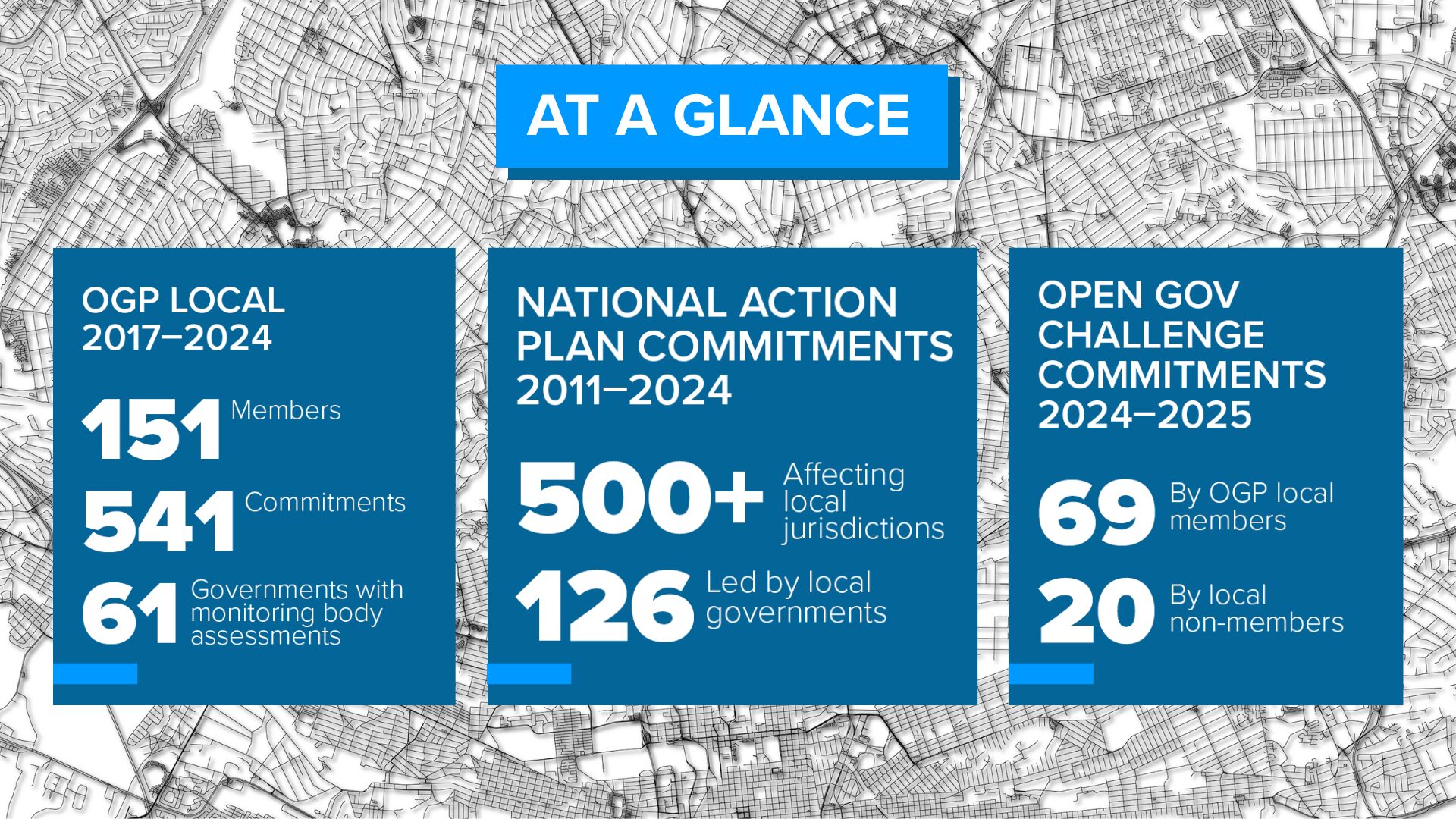
This report explores results from 541 OGP local commitments made from 2017 to 2024 and highlights good practices in developing and implementing OGP local action plans. It also covers local commitments in the Open Gov Challenge and national action plans.
OGP Local launched in 2016 with 15 pioneer local jurisdictions. Since then, it has expanded to 151 members around the world—comprised of 143 individual local governments and eight consortia of local governments. It provides a platform for reform-minded local governments to collaborate, implement, and showcase open government initiatives which make tangible improvements to the lives of their residents. By the end of 2024, 107 local governments had begun to implement an OGP action plan, of which 26 had gone on to produce multiple plans. A total of 55 governments was still due to submit their first plan and 11 had left the Partnership.
Open government reforms on public participation, public service delivery, inclusion, and open data were the most popular policy areas for commitments in these local plans. Featured in this report, many of the commitments achieved real-world changes:
- San Pedro Garza García developed one of the best government chatbots in Mexico, garnering 67,715 citizen reports on public services last year.
- Plateau State (Nigeria) launched a groundbreaking Gender and Equal Opportunities Commission that worked to reflect women’s perspectives in state policies.
- In Indonesia, five OGP local members piloted open data portals that released over 3,000 government datasets to the public, enhancing decision making on disaster response and risk management.
- In Glasgow (United Kingdom), two wards gave residents a direct say in their neighborhood budgets, funding 41 community ideas for better infrastructure.
The report also surfaces good collaboration practices as local members developed and implemented their action plans. Over successive action plan cycles, many of these processes became more embedded and participatory:
- Before Yoff (Senegal) co-created OGP commitments, it co-created a Sustainable Municipal Development Plan, which offered a natural roadmap for its open government process.
- Aragón (Spain) involved its existing open government lab during the development of its plan. In turn, this opened the lab itself to, for instance, introduce citizen voting on workstreams.
- The participation of Santo Domingo de los Tsáchilas’ (Ecuador) indigenous community was crucial to developing an OGP commitment to preserve their ancestral and cultural heritage.
- As the pioneer OGP local member in the Philippines, South Cotabato mentored four new members developing their first action plans across the country.
OGP local members were also joined by non-members to advance reforms through the Open Gov Challenge launched in 2024, an initiative to raise reforms’ ambition in ten thematic areas. The most popular thematic areas were public participation, climate and environment, and fiscal openness. By June 2025, out of 160 total Open Gov Challenge commitments, 69 came from local members, and 20 from non-members.
Meanwhile, national action plans from 2011–2024 included more than 500 commitments that affected local jurisdictions. These reforms established national-local networks of open government, piloted reforms in local jurisdictions, and passed local legislation. Of these, 126 commitments were directly implemented by local governments and had stronger open government results. Many came from Colombia, Georgia, Spain, Uruguay, and the United Kingdom.
Overall, this report’s analysis draws from data on 541 commitments made through OGP local (2017–2024), local monitoring body assessments published for 61 governments, IRM interviews with key government and civil society stakeholders, and data on local commitments in national action plans (2011–2024).
Alongside this report, OGP is releasing new data on hundreds of local commitments, including reforms’ policy areas and local monitoring body assessments, now accessible here.