
Announcing the Recipients of the Helen Darbishire Fund for Civil Society
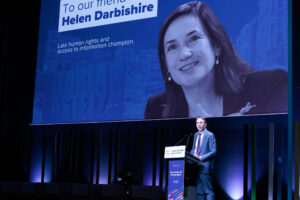
The Open Government Partnership (OGP) is proud to announce the recipients of the first call for applications under the Helen Darbishire Fund for Civil Society, designed to strengthen open government processes and reforms across OGP member countries.
Named in honor of Helen Darbishire, the late human rights and access to information champion and former OGP Steering Committee member, the Fund recognizes her lifelong commitment to ensuring that citizens have both the right and the means to hold power to account and to ensure civil society has the enabling environment and the resources to operate.
We are delighted to introduce the winners of this call’s OGP Helen Darbishire Fund for Civil Society:
- Benin – Africitizen – Africitizen is a social innovation agency specializing in the production and use of citizen data to inform public policy. Their project will empower young citizens across Benin to drive local participation in the country’s first OGP action plan, gathering community data, facilitating dialogue, and producing policy papers that reflect local priorities through digital tools and multimedia campaigns.
- Brazil – Transparency International Brazil – TI Brazil works with a team of Brazilian professionals with vast experience in fields related to transparency, anti-corruption, compliance, and good governance. Their project will engage the judiciary and local governments, advancing key commitments in transparency and anti-corruption, and supporting the development of a national Open Government Strategy to ensure continuity through the 2026 government transition.
- Canada – Transparency International Canada – TI Canada’s mission is to combat corruption and foster a culture of integrity in all sectors of Canadian society by conducting research, policy development, capacity building, and advocacy. Their project will re-engage civil society, advance beneficial ownership transparency, and boost accountability in anti-money laundering policy through national dialogues, advocacy, and public engagement.
- France – Démocratie Ouverte, Transparency International France, Code for France – These are leading French civil society organizations promoting transparency, anti-corruption, participatory democracy, and civic tech solutions to advance open government nationally and internationally. Their project will unify French civil society actors into a coordinated network, fostering joint dialogue and co-designing an inclusive MSF to enhance advocacy, institutionalize collaboration, and align with OGP standards.
- Germany – Open Knowledge Foundation, Transparency International Deutschland, The Open Government Institute (consortium) – These are leading civil society organizations in Germany that advance transparency, democratic participation, and open government through digital tools, anti-corruption advocacy, interdisciplinary research, and innovative citizen engagement initiatives. Through their project, they will restructure and strengthen Germany’s civil society OGN, advocate for a lead government institution, and establish a formal MSF to embed participatory governance in the co-creation of Germany’s 2025 National Action Plan.
- Italy – The Good Lobby Italia, Libera, Period Think Tank, PA Social – These are Italian civil society organizations advancing democratic participation, social justice, transparency, gender equity, and digital communication through advocacy, research, and capacity-building initiatives. These organizations will strengthen Italy’s OGP Forum and civil society community to ensure meaningful participation in the 6th national action plan, enhance dialogue with government officials, and reinforce capacity building, advocacy, and public engagement.
- Maldives – Association for Democracy in the Maldives (ADM) – ADM is a non-governmental organization dedicated to the promotion and protection of human rights and democracy in the Maldives. Their project will strengthen civil society’s capacity to participate in OGP processes by developing advocacy strategies, building consensus on priority reforms, and mobilizing solutions through workshops, surveys, and collaborative dialogue with government.
- North Macedonia – Metamorphosis Foundation for Internet and Society and the Center for Civil Communications – Both organizations will strengthen North Macedonia’s Open Government Partnership (OGP) process by promoting transparency and inclusive governance. The project will support the development of by-laws for digitalized financial reporting of political parties to enhance accountability and will lead a participatory process to co-create the country’s next OGP action plan for 2027–2029. Through expert engagement, regional workshops, and stakeholder consultations, the initiative aims to foster sustainable, citizen-driven reforms and improve government openness and anti-corruption efforts.
- South Africa – Centre for the Advancement of Community Advice Offices in South Africa (CAOSA) – CAOSA provides vital legal and socio-economic services to marginalized and poor communities, ensuring access to justice and the protection of basic human rights. Their project will revitalize South Africa’s OGP engagement in the justice sector by coordinating stakeholders, developing robust commitments, and amplifying existing initiatives.
- United Kingdom – UK Open Government Network (UK OGN) – The UK OGN is a coalition of civil society organizations and active citizens dedicated to rebuilding public trust through open government – transparency, accountability, and stakeholder participation. Through their project UK OGN will coordinate civil society input for the 7th national action plan, secure sustainable funding, and build a “network-of-networks” to ensure broad, inclusive participation across all UK nations.
- Uruguay – Asociación Nacional de Organizaciones No Gubernamentales Orientadas al Desarrollo (ANONG) – ANONG, representing Uruguay’s Open Government Network, will strengthen civil society’s role in monitoring and co-implementing commitments from Uruguay’s 6th Open Government Action Plan. The project will recruit and train organizations to engage in these processes—providing financial and technical support to ensure sustained participation—and foster collaboration between civil society and public institutions. Additionally, it will conduct research on the long-term impact of past OGP commitments, producing a report that assesses which have become lasting public policies, helping demonstrate the value and effectiveness of open government in Uruguay.
In 2025, OGP is providing these eight grants ranging from USD 20,000 to 25,000 supporting initiatives over a 6–18 month implementation period. These grants aim to strengthen civil society capacity, sustain multi-stakeholder collaboration, and secure progress on open government reforms in critical areas.
The launch of the Helen Darbishire Fund marks an important milestone in OGP’s broader effort to safeguard civic space, sustain reform momentum, and support civil society organizations at a time when funding challenges are reshaping the open government landscape. OGP is also providing targeted financial support to civil society organizations in countries like through OGP’s current grant-based funding.
Degife Hailemariam Reply
Ethiopia include in this program