Designed to mimic the informal, social dynamics of an office coffee break in a virtual setting, Coffee Conversations provide a space to exchange tacit knowledge, build relationships, and promote collaboration among peers.
CONVERSATIONS
Conversation on Forums
Conversation on Co-Creation
Conversation on Innovation Labs
Conversation on Participatory Budgeting
Conversation on Children and Teenagers’ Participation
Conversation on Clear Language
Conversation on Sustaining Partnerships for Open Data
September 2026
About
This session examined how OGP Local members sustain open data partnerships beyond initial commitments and publication. Participants discussed the institutional, political, community, and technical conditions that support useful and durable open data.
As Scotland reflects on its next phase of open data work, Buenos Aires, Greater Manchester, Elgeyo-Marakwet, Madrid, and Ukraine shared good practices that emphasize linking open data to public needs, sustaining collaboration, supporting data use, and demonstrating organizational value. One relevant idea stood out: sustaining open data depends on strong institutional foundations and active relationships with those who produce, use, and benefit from data.
More information
- Open data policy should focus not only on how much data is published, but on whether data is relevant, discoverable, understandable, usable, and actually used.
- As AI becomes a major way to access and process information, open data needs to be well documented, machine-readable, interoperable, and increasingly AI-ready.
- Sustainable open data requires institutional ownership, political support, clear responsibilities and technical capacity, not reliance on individual champions alone.
- Strong partnerships work best when civil society, academia, communities and other data users have meaningful roles in generating knowledge, identifying needs, monitoring progress and using data.
- Sustained participation is strengthened when contributors can see how their input was considered and what impact it had.
- Demonstrating practical value can sustain engagement: data can support public-sector decision-making and internal efficiency as well as transparency and external use.
- Florencia Cavalli, Buenos Aires (Argentina)
- Angela Pérez Brunette, Madrid (Spain)
- Nadiia Babynska, Ukraine
- Christopher Pope, Greater Manchester (United Kingdom)
- Felix Kipngetich, Elgeyo-Marakwet (Kenya)
- Louise Meikleham, Scotland (UK)
- Doreen Grove, Scotland (UK)
- Martin Macfie, Scotland (UK)
April 2025
About
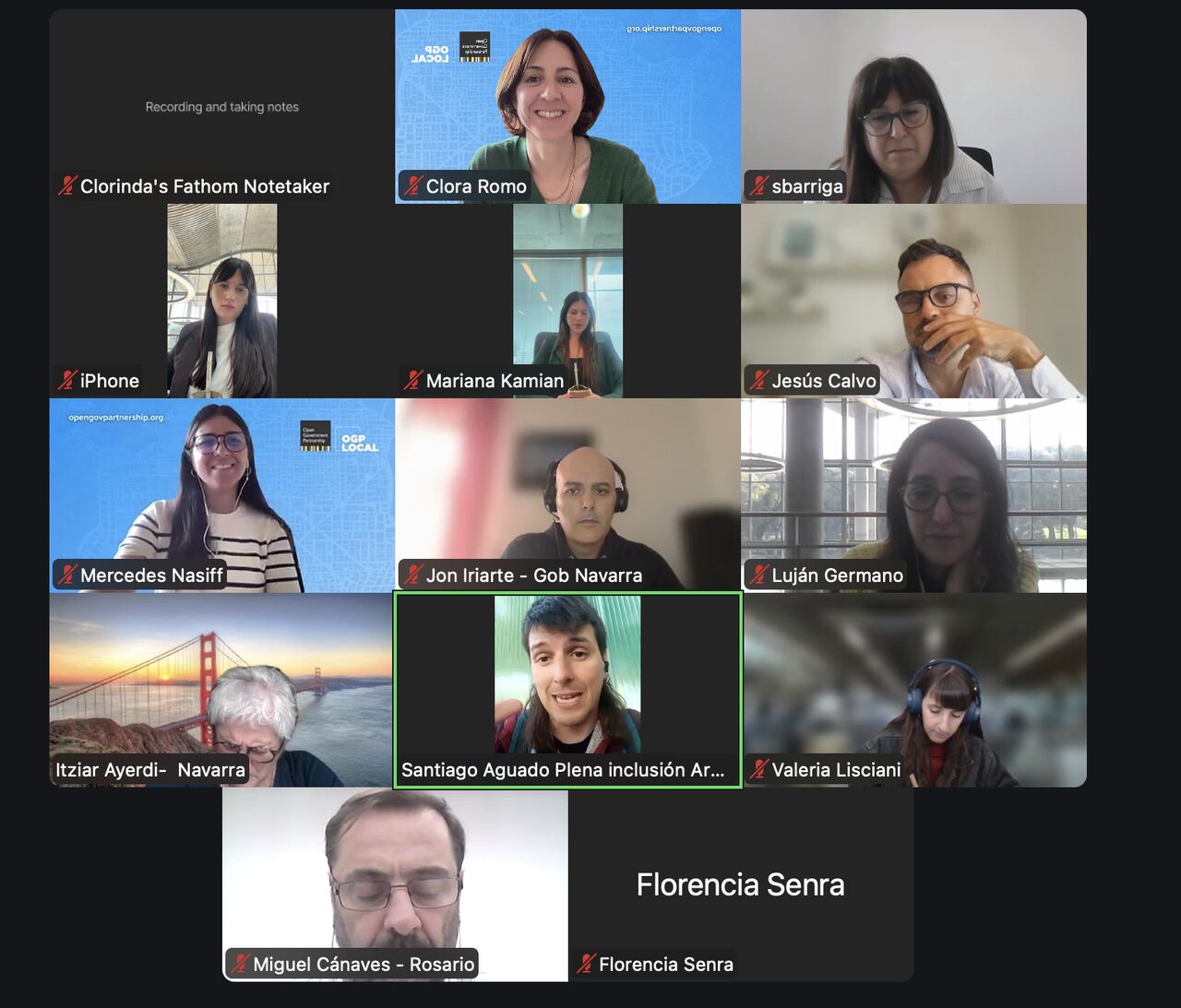
This OGP Local Coffee Conversation brought together representatives from Buenos Aires, Rosario, Madrid, Navarra, and Aragón to exchange practical experiences on clear language, easy-to-read communication, and accessibility in local government. Participants shared how they are making public information, services, legal documents, and administrative processes easier to understand, while exploring how clear communication strengthens open government, improves service delivery, and builds trust with citizens. Overall, the conversation highlighted that clear language is most effective when it is institutionalized, tested with real users, and connected to broader efforts to improve public services.
More information
- Clear language is a practical open government tool. It improves access to public information, strengthens transparency, and helps citizens understand and use public services.
- Clarity does not mean losing legal or technical rigor. Governments can simplify communication while maintaining precision and compliance.
- Clear language becomes sustainable when public servants have practical tools, shared standards, and ongoing support to apply it in their daily work.
- Testing with real users improves results. Validating documents and services with citizens helps identify barriers that internal teams often miss.
- AI tools are showing strong potential to support drafting, reviewing, but human expertise and user validation remain essential.
- Mariana Kamian, Tamara Laznik and Luján Germano, Buenos Aires (Argentina)
- Miguel Canaves, Rosario (Argentina)
- Jesús Calvo, Madrid (Spain)
- Itziar Ayerdi and Jon Iriarte, Navarra (Spain)
- Susana Barriga and Santiago Aguado, Aragón (Spain)
February 2025
About
This OGP Local Coffee Conversation focused on children and teenagers’ participation in open government processes, bringing together representatives from Ouellé (Côte d’Ivoire), Navarra (Spain), Nuevo León (Mexico), and Zviahel (Ukraine). The purpose was to exchange practical experiences on designing meaningful and sustainable participation mechanisms for children and youth. Participants shared models ranging from school participatory budgets to regional children’s councils and public hearings. Overall, the conversation underscored that youth participation is most powerful when it is structured, institutionally supported, adapted to children’s realities, and clearly connected to real decision-making.
More information
- There is no single model for youth participation: councils, committees, public hearings, and participatory budgeting can all be effective when adapted to contexts.
- Meaningful participation requires real influence. Youth engagement gains legitimacy when connected to tangible outcomes and actual decision-making spaces.
- Design and facilitation are critical. Processes must be age-adapted and supported by professionals with expertise in both child development and participatory methodologies.
- Closing the feedback loop builds trust and strengthens learning.
- Political will and legal frameworks help institutionalize youth participation and ensure its sustainability over time.
- Sarah Bakayoko, Ouellé (Côte d’Ivoire)
- Mariana Cancela Moreira Leite, Navarra (Spain)
- Itziar Ayerdi, Navarra (Spain)
- Ana Etxaleku, Navarra (Spain)
- Johany Itzel Alanis Martínez, Nuevo León (México)
- Exae Alexis Morales Navarrete, Nuevo León (México)
- Iryna Potopalska, Zviahel (Ukraine)
November 2025
About
This Coffee Conversation focused on how OGP Local members design, sustain, and strengthen their local forums. Members from Buenos Aires, Medellin, Bogotá, Navarra, and Kaduna State compared structures, engagement strategies, and lessons on keeping forums active beyond co-creation. The discussion offered practical models to help OGP Local members maintain relevance, continuity, and shared ownership in their local forums, and underscored that there is no single ideal model. Forums succeed when they align with local context, purpose, and incentives.
More information
- Context determines the right forum model. Levels of formality, regulatory frameworks, community size, and civic appetite shape what is possible and valuable.
- Purpose must be explicit. Forums can support co-creation, monitoring, innovation, visibility, or strategic direction, and each purpose requires different formats and actors.
- Structure + incentives sustain participation. Clear design and meaningful incentives (influence, recognition, access to information) help maintain engagement throughout implementation.
- Evolution and flexibility are essential to finding the approach that best matches specific needs. Adapting over time helps ensure the forum’s relevance and impact.
- Different models can succeed when aligned to needs. Small stable groups, thematic circles, formal committees, virtual and in-person follow-up sessions, or open-door spaces all work when grounded in local realities.
- Tamara Laznik, Buenos Aires (Argentina)
- Juan Esteban Uribe, Bogotá (Colombia)
- Jon Iriarte, Navarra (Spain)
- Tara Jeremiah, Kaduna State (Nigeria)
- Daniel Fernández, Medellín (Colombia)
May 2025
About
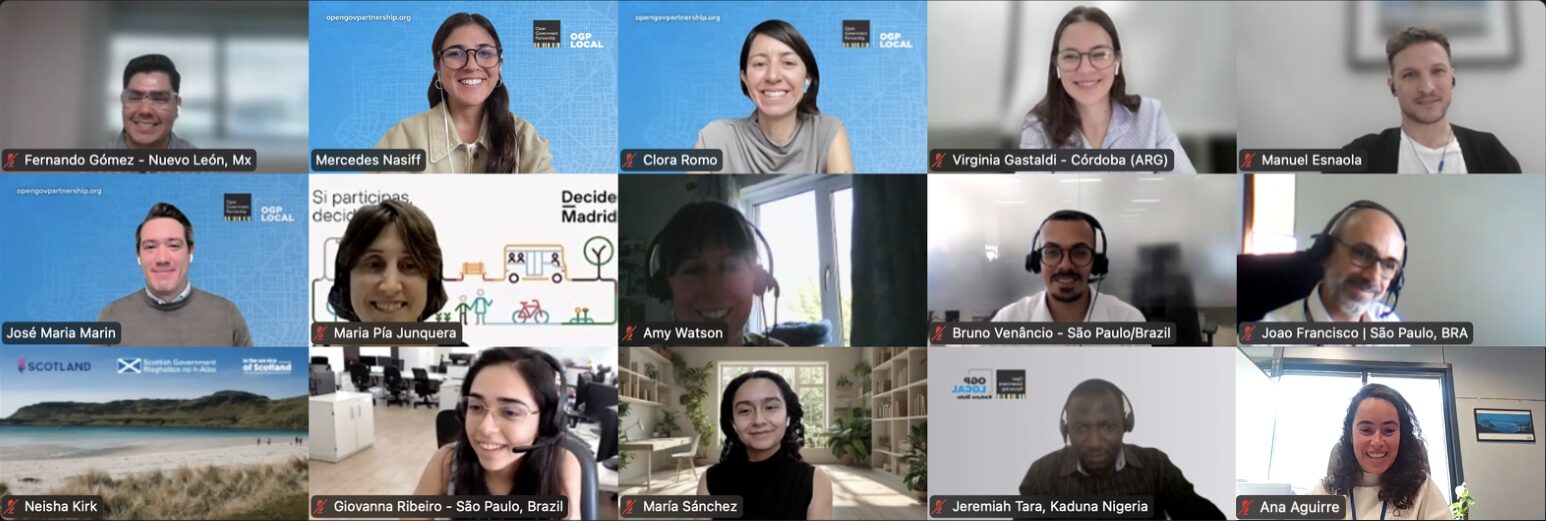
This Coffee Conversation brought together OGP Local members to exchange lessons, challenges, and practical ideas on designing effective co-creation processes. Participants shared how they are shaping their strategies to improve collaboration and implementation.
More information
- Structure matters: Members emphasized the importance of defining a clear structure. The Basque Country (Spain) described a multi-level approach with a small “promoter” group representing key territories and sectors, complemented by broader coordination spaces. Madrid (Spain) combined an open government steering group with participatory councils and online platforms. São Paulo (Brazil) uses a multi-stakeholder forum, with each commitment supported by its working group.
- Process clarity is crucial: Participants highlighted the value of having defined steps, including pre-session materials, feasibility checks, and regular coordination mechanisms. Córdoba (Argentina) developed a methodology to engage representatives from universities and other institutions. Nuevo León (Mexico) integrates planning steps, including mapping participants’ capacity and expectations.
- Engaging the right actors: Members are intentionally mapping stakeholders to determine how and when to involve them. Nuevo León and Córdoba spoke about their ongoing efforts to maintain collaboration with civil society and universities, building sustained relationships of trust and cooperation throughout various participatory processes. Several participants are creating co-leadership models where government and civil society share responsibility for commitments.
- Achieving stakeholder buy-in: Engagement was seen as more effective when supported by high-level political commitment and alignment with institutional priorities. São Paulo includes senior secretariat staff in workshops, and Madrid builds on existing participatory bodies. Members also noted the need to recognize civil society’s time limitations and adjust expectations accordingly.
- Commitment design: Participants recommended focusing on a small number of commitments for two years. This can make implementation more manageable and keep engagement levels high throughout the process.
- Words of wisdom:
- Have patience, listen, don’t assume, and good participation takes time.
- Co-creation does not mean giving up all control – it will always be a joint decision. Don’t be afraid of co-creation.
- Be honest with each other.
- Be strategic to be more efficient and save resources.
- As co-creation evolves across the OGP Local community, spaces like this are essential for sharpening practices and supporting one another.
- Amy Watson and Neisha Kirk, Scotland (UK)
- María Pía Junquera Temprano, Madrid (Spain)
- Ana Aguirre, Basque Country (Spain)
- Manuel Esnaola and Virginia Gastaldi, Córdoba Province (Argentina)
- Bruno Venancio, Joao Francisco and Giovanna Ribeiro, Sao Paulo (Brazil)
- Fernando Gomez, Nuevo León (México)
June 2025
About
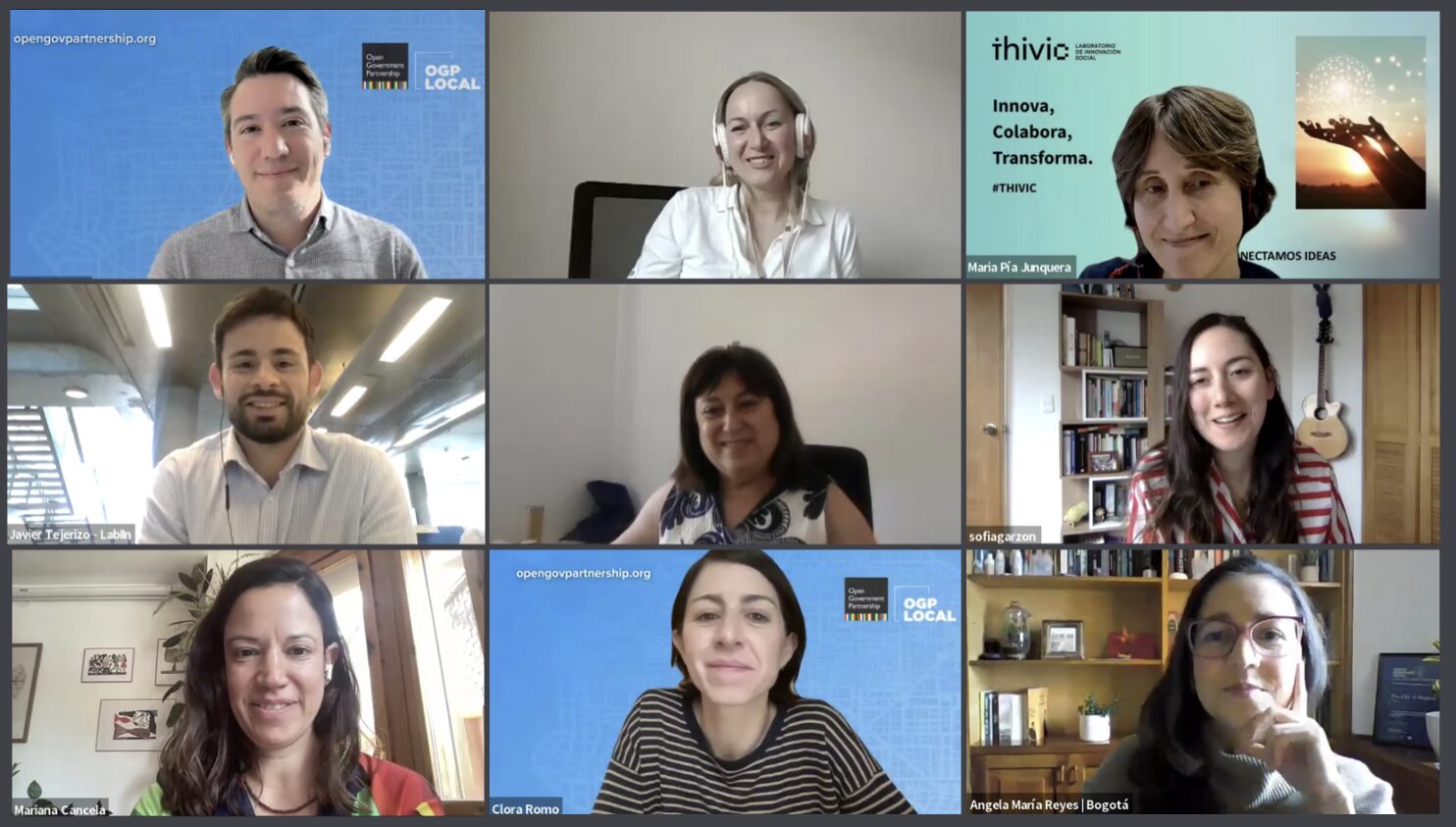
This Coffee Conversation brought together OGP Local members to exchange experiences and lessons on building and sustaining local innovation labs. These labs are spaces where governments and communities co-create, test, and refine ideas to improve public services and strengthen civic trust. Participants shared diverse approaches, from fostering a culture of experimentation to institutionalizing successful prototypes. The conversation highlighted both the unique local contexts and common challenges in making innovation labs impactful and sustainable.
More information
- Banská Bystrica’s (Slovakia) innovation lab centers on co-creation with citizens as active partners in public service design. Their work focuses on building trust between institutions and people by demonstrating real impact. They emphasize cross-department collaboration and training public employees in design methodologies to sustain innovation.
- The City of Buenos Aires’ (Argentina) electoral innovation lab focuses on co-creating solutions and piloting projects like communication dashboards and a multilingual AI assistant on WhatsApp.
- Bogota’s (Colombia) lab is embedded in the mayor’s office, funded initially by Bloomberg grants, and now institutionalized. They focus on ecosystem building and capacity development, utilizing their design thinking methodology and projects such as chatbots for citizen engagement and improving utility bills.
- Aragón’s (Spain) lab’s goal is to bridge the gap between citizens and government through transparency, mandatory participation, and innovation. Since 2019, they’ve run projects like SeniorLab, engaging older adults in co-creation, using collaborative methods with a small core team supported by external partners.
- Madrid (Spain) focuses on co-creating public programs addressing air quality, social inequality, and youth loneliness. They emphasize design thinking, involving young people and public employees, and have integrated prototypes into official city plans while building internal allies and educating stakeholders.
- Labs help move from consultation to co-creation, where citizens are active protagonists, not just participants, of the solutions that affect them.
- They allow governments to pilot and refine ideas, reducing the risk of launching projects that won’t survive institutionalization.
- Demonstrating impact is essential; showing real improvements in people’s lives and trust between institutions and citizens keeps innovation efforts alive.
- Collaborating across departments and sectors allows labs to make more innovative use of limited resources.
- Training public employees and community actors in design methodologies, like design thinking, builds long-term capacity for creative collaboration.
- Bright tip: integrate learning into the process. Explaining why specific tools or methods are used helps everyone understand, contribute, and own the outcomes.
- Whether built to foster creativity, strengthen civic collaboration, or pilot new ideas, innovation labs are helping local governments build open, resilient, and citizen-centered democracies.
- Sona Karikova, Banská Bystrica (Slovakia)
- Javier Tejerizo and Tamara Laznik, Buenos Aires (Argentina)
- Ángela María Reyes and Sofía Garzon, Bogotá (Colombia)
- Susana Barriga and Mariana Cancela, Aragón (Spain)
- María Pía Junquera Temprano, Madrid (Spain)
July 2025
About
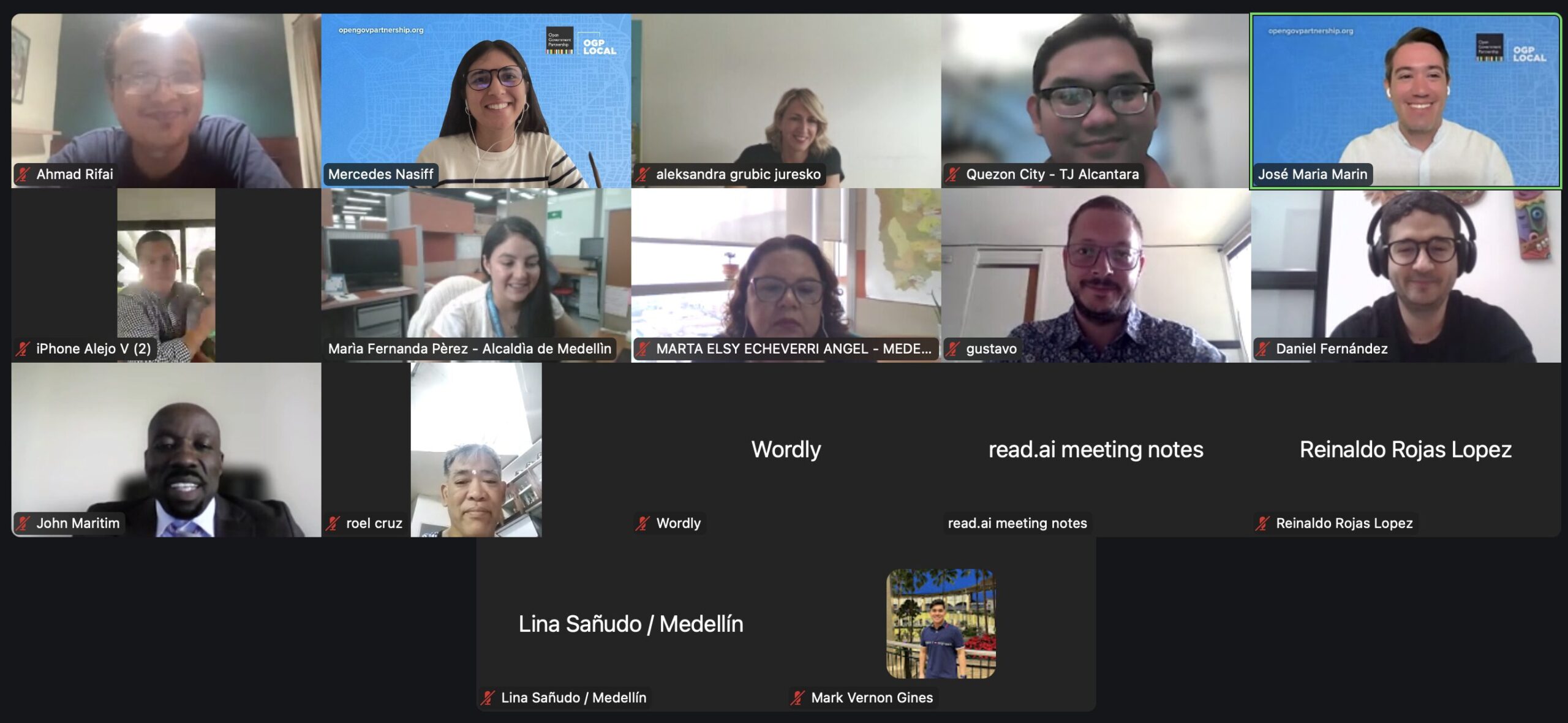
This Coffee Conversation brought together members of OGP Local to discuss participatory budgeting. Participants shared practical experiences and examples from different cities, focusing on citizen engagement, project selection, and monitoring. The conversation highlighted participatory budgeting as a key tool for advancing open government through a bottom-up, citizen-led approach.
More information
- Quezon City (Philippines) is working to enhance digital platforms for public participation in the overall budget creation and allocate specific funds for community-driven projects. They aim to be more innovative in their participation approaches.
- Mendoza (Argentina) is implementing its participatory budgeting for the first year with an online GIS-based proposal submission system. Its extensive offline outreach helps boost participation. The top-voted proposals will be implemented in 2026.
- Medellín (Colombia) allocates 5% of its city’s investment budget to participatory budgeting across 16 urban communes and five rural districts. They combine in-person and online voting with facial biometric verification (open to citizens 14+ years old). The city organizes public events to share project progress.
- The Kota Kita Organisation (Indonesia) shared how Indonesian local governments transitioned from participatory planning to budgeting, supported by national mandates like the Village Law. They emphasize innovation and community capacity to design solid proposals and community-driven projects. Their main challenges include experts making decisions without input from citizens and powerful groups taking control.
- Elgeyo Marakwet (Kenya) adopted participatory budgeting in 2015-2016 to address bias, balance needs, and guarantee funding. Today, 60% of the budget is allocated through the participatory process, and they use a delegate system to ensure the voice of marginalized groups.
- Zagreb (Croatia) ran a pilot that allocated 6% of the district’s budget to participatory funds in 4 districts. Citizens submitted 700 ideas, and 16 projects were selected through online and in-office voting. They promote transparency and trust via public signs and linking project completion to citizen suggestions.
- Participatory budgeting can take different forms, from involving citizens in overall budget planning to allocating specific funds for community-driven projects.
- Key success factors include clear processes, transparency, inclusivity of marginalized groups, and follow-through on implementing selected projects.
- Common challenges include balancing short-term needs vs. long-term planning and maintaining political support.
- Digital platforms and tools can enhance accessibility and engagement, but in-person outreach is still important.
- Lourdes Gabrielli, Ciudad de Mendoza (Argentina)
- TJ Alcantara, Quezon City (Philippines)
- Alejandro Velásquez Osorio, Medellin (Colombia)
- Gustavo Londono, Medellín (Colombia)
- Marta Elsy Echeverri Angel, Medellín (Colombia)
- John Maritim, Elgeyo Marakwet County (Kenya)
- Semiye Mighael, CoST (Nigeria)
- Ahmad Rifai, Kota Kita (Indonesia)
- Aleksandra Grubić Jureško, City of Zagreb (Croatia)