Local Roundup | April 2026
Here’s our monthly roundup of updates from the OGP Local community for April 2026. Check out previous Roundups here!
Hear from Local Leaders
Governor Claudio Orrego of Santiago, Chile
“We believe open government is a cornerstone of a strong democracy. Join us for Open Government Week, May 18–22, and help lead the way in transparency, participation, and innovation.”
View this post on Instagram
Featured Story
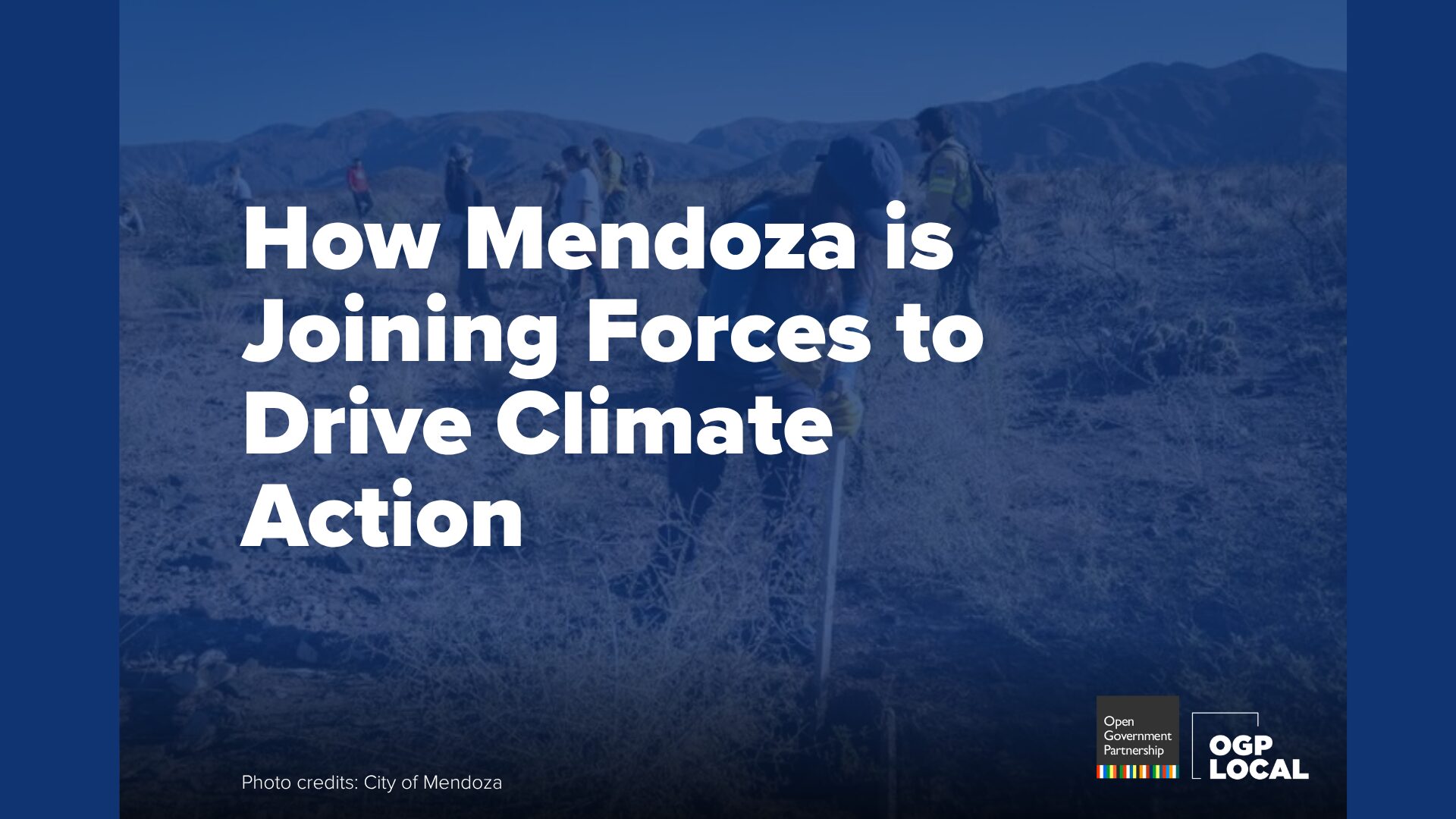
Mendoza (Argentina) is advancing climate action through open government, bringing together public, private, and civil society actors to co-create solutions. Public data, citizen participation, and a new Green Fund are helping turn commitments into concrete results. More here.
From Promises to Action
NEW ACTION PLANS, NEW AMBITIONS
Contagem (Brazil)’s 2026–2028 action plan seeks to improve access to justice by establishing a mediation chamber to resolve disputes outside the courts, while also promoting participatory urban tree planning and integrating data to track inequalities and improve policies for women. More here.
Cartagena (Colombia)’s 2026–2027 action plan focuses on improving access to services through a digital assistant, expanding participation in urban planning, and creating neighborhood forums and multi-stakeholder spaces to strengthen accountability and collaboration. More here.
CHANGE IN MOTION
Tangier-Tétouan-Al Hoceima (Morocco) has launched its Citizen Budget and is co-creating its Regional Disability Plan 2035 with government and civil society to advance inclusive policies, improve services, and strengthen participation for people with disabilities. More here, here, and here.
Quezon City (Philippines) has launched open data dashboards providing real-time insights into public programs and spending, enabling citizens to monitor services and hold the government to account. More here.
Buenos Aires (Argentina) convened a new Open Government Forum with all three branches of government, academia, and civil society to advance plain language as a shared reform, making public documents and communications more accessible. More here.
Villanueva (Honduras) held its second Open Town Hall and Open Government Fair, opening spaces for citizen participation that will inform participatory budgeting and the co-creation of its second open government action plan. More here and here.
São Paulo (Brazil) is co-creating its fourth open government action plan through participatory, multi-stakeholder workshops to shape solutions on priorities like environmental education. More here.
The Valencian Community (Spain) reported 95% implementation of its open government strategy in 2025, including a public algorithm registry, a network supporting open government across municipalities, and citizen audit initiatives. More here.
Navarra (Spain) reported that its mobile citizen service office reached 4,500 people in its first year, bringing public services and administrative support directly to rural communities and helping close access gaps across the region. More here.
Local open government is scaling beyond OGP Local members, with municipalities in Córdoba Province (Argentina) and across Côte d'Ivoire adopting new tools and practices to strengthen transparency, participation, and decision-making, while Portoviejo (Ecuador) has launched its 2026–2027 open government action plan inspired by OGP Local approaches. More here, here, and here.
Local Lessons
EXCHANGING IDEAS
🌐 Buenos Aires and Rosario (Argentina), along with Madrid, Navarra, and Aragón (Spain) discussed how clear language can evolve from a communication practice into institutional change during our latest OGP Local Coffee Conversation. More here.
🌐 Armavir (Armenia) shared how youth-led participation is driving environmental priorities and shaping local policies through initiatives like participatory budgeting at the UN ECOSOC Youth Forum. More here.
🌐 Quintana Roo (Mexico) shared how it turned Rule of Law Index data into action, bringing seven state institutions together to co-create implementation plans for a more transparent, accountable, and inclusive justice system during a OGP Coalition on Justice peer exchange. More here.
TAKEAWAYS
📘 Discover how Makueni (Kenya) advanced open contracting through new policies, including a procurement data portal and civic engagement efforts, while facing challenges in integrating with national systems that highlight the importance of early coordination for digital reforms. More here.
📘 Learn how Villanueva (Honduras) used simple digital tools to expand access to information and strengthen citizen participation, while also working with communities to improve waste collection, eliminate illegal dumps, and raise environmental awareness. More here and here.
📘 Discover how Navarra (Spain) leveraged an established network of public and civil society actors through a structured steering group to co-create its first open government action plan, while working to broaden participation across more diverse groups. More here.
RESOURCES
📘 Access the lastest Infrastructure Transparency Index (ITI) assessments from Jalisco (Mexico), Kaduna (Nigeria), and West Nusa Tenggara (Indonesia), featuring practical lessons on how governments are making infrastructure planning, procurement, and project delivery more transparent and accountable. More here, here, and here.
Get Involved
EVENTS
🌐 Discover how cities are applying open government principles to navigate AI and emerging technologies at the OGP Local Circle on Digital Governance and AI on May 19. Register here.
🌐 Explore how local governments are strengthening integrity and preventing corruption from within at the OGP Local Anti-Corruption Learning Circle on May 20. Register here.
🌐 The UCLG World Congress will take place from June 22–25, 2026 in Tangier (Morocco), bringing together local and regional governments from around the world. Register by May 15. More here and here.
Open Gov Challenge
As Open Gov Week approaches, Nuevo León (Mexico) shows that rebuilding trust starts with making participation easier and an ongoing process. By combining public hearings with digital tools, the state is expanding access and turning participation into an everyday practice.
Leave a Reply