Over the course of 15 years, OGP has helped define how open governments can and should work, and the Partnership has built the experience to help address today’s complex challenges. Since 2011, members have delivered meaningful policy and institutional change. What began as a focus on transparency and open data 15 years ago has evolved into a platform for generating reforms that drive tangible outcomes, like expanding civil society participation in policy-making and improving public services, government responsiveness, and resource allocation.
Today, open government principles and practices have extended beyond individual champions or executive-led initiatives. These principles and practices are increasingly embedded across branches and levels of government, enabling governments to seize moments of opportunity and to sustain progress over time.
Reformers have used the OGP platform to drive results. Collaboration between actors inside and outside of government is in the DNA of the OGP model, and has proven that it produces stronger, more durable reforms. Repeated cycles of action planning have cultivated trust and relationships between reformers over time. Coalitions between like-minded countries were built to connect global policy debates with in-country reforms. OGP’s global visibility and cross-country learning opportunities sharpened political incentives and provided practical tools to turn ideas into action.
This publication celebrates the hard work of political champions, public servants, civil society reformers, and partners. It also reflects the Partnership’s resilience in advancing open government reforms in the past 15 years. This milestone is both a recognition of what has been built and a call to go further by scaling ambitious reforms.
Open government delivers stronger institutions, collaborative governments, and better services.
Open government reforms have led to tangible results: new or improved legislation mandating openness, greater proactive disclosure of data, and enhanced civil society participation in policy design across a range of policy areas. Open government principles and practices are being institutionalized, replicated, and scaled across branches and levels of government.
Open government reforms lead to concrete policy outcomes.
- Beneficial Ownership Transparency: Nearly 30 OGP countries have achieved concrete results, such as new beneficial ownership legislation, the publication of beneficial ownership data, or greater involvement of civil society organizations (CSOs). Twelve OGP countries started publishing beneficial ownership data for the first time, several through central registers.
- Open Contracting: 43 OGP countries have achieved concrete results, such as newly disclosed data, new legislation mandating greater openness, and greater involvement of CSOs.
- Fiscal Openness: Nearly 60 OGP countries have improved access to fiscal information during their action plans. Most of these countries have established centralized platforms dedicated to fiscal information to improve public accessibility. About half of these countries have published Citizen Budgets or otherwise more accessible forms of budget information for the general public.
- Public Participation: 62 OGP countries have achieved concrete outcomes, such as creating standing spaces for participation, passing new laws or regulations on participation, or involving civil society in implementing commitments.
- Right to Information (RTI): Nearly 50 OGP countries have achieved concrete results in implementing their RTI reforms, including strengthened RTI laws, greater proactive disclosure, improved RTI capacity, or civil society participation in policy design. OGP has contributed to establishing the first-ever RTI legal frameworks in eight countries.
Open government reforms expose mismanagement of public funds and save money.
In at least 10 OGP countries, open contracting reforms produced economic impacts, such as greater government efficiency, more competitiveness among suppliers, and lower procurement costs. For example, anti-corruption authorities in Nigeria reported that regulatory and enforcement agencies used access to beneficial ownership information to reclaim over USD 105 million in recovered assets in 2024.
Local open government reforms drive real impact.
Commitments made by local governments tend to be more ambitious and more likely to show results compared to those led by national governments. These commitments have helped repatriate nearly 100 trafficked children in Plateau State (Nigeria), awarded contracts for school lunches to small, women-led agricultural businesses for the first time in Palmira (Colombia), and cut resident complaint response times in half through a chatbot in San Pedro Garza García (Mexico).
OGP countries lead the way.
- Beneficial Ownership: Compared to 41 percent of OGP countries with a public beneficial ownership register, only 12 percent of non-OGP countries have the same.
- Open Contracting: 59 percent of OGP countries (43 out of 73) are currently disclosing contracting data in a format aligned with the Open Contracting Data Standard, while 13 percent of non-OGP countries do the same.
- Fiscal Openness: OGP countries publish sufficient information to support informed public debate on the budget at nearly four times the rate of non-OGP countries, according to the Open Budget Survey. OGP countries also outperform non-OGP countries on public engagement in the budget process, more than doubling their OBS participation score.
- Right to Information (RTI): While two-thirds of OGP countries improved their RTI legal frameworks between 2011 and 2026, fewer than half of non-OGP countries improved.
Open government has been adopted, replicated, and scaled across government.
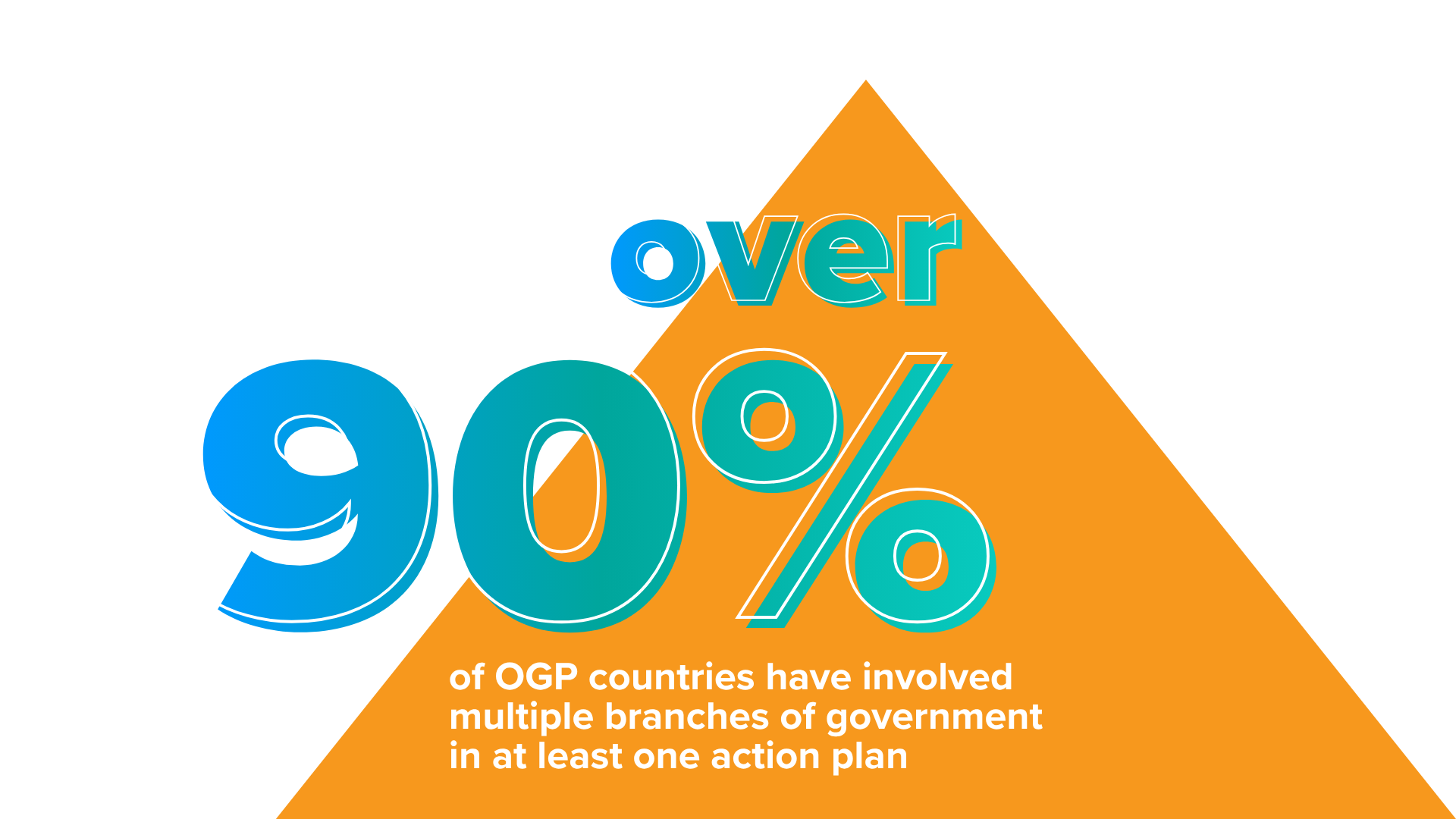
- More branches implementing open government: In 2011 and 2012, 29 percent of countries involved parliament or the judiciary. By 2024 and 2025, this stood at 54 percent. Adding in local governments, 90 percent of OGP countries (66 out of 73) have involved multiple branches of government in at least one action plan to date. Parliaments and judiciaries are implementing open government commitments in countries like Spain, Morocco, Colombia, Honduras, and North Macedonia, among others.
- Replication and scaling at the local level: Since its launch in 2016 with just 15 pioneer jurisdictions, OGP Local has grown nine-fold to 136 members by 2026, and demand to join the program has continued to grow. Open government initiatives led by the national government have been widely replicated and scaled at the local level in Spain, Chile, Germany, Estonia, Nigeria, and Morocco, while initiatives begun at the local level have inspired reforms at the national level.
OGP creates the political and practical conditions for stronger, more durable reforms.
OGP is a political, action-oriented, and country-owned platform. Its action framework and model of government-civil society collaboration grounds reforms in structural change, leading to policies, practices, and resources dedicated to opening government. By institutionalizing collaboration between government and civil society, OGP hardwires participation into how decisions are made, making it more likely that open government practices survive electoral cycles and political transitions. Beyond these tangible mechanisms, OGP also influences the relational conditions for reform: its global visibility and cross-country coalitions and learning sharpen political incentives and legitimacy for reformers to take action.
Institutionalizing open government sustains reforms across political transitions.
At the policy level, 57 countries in the Partnership have passed, amended, or strengthened legislation or regulations on beneficial ownership transparency, open contracting, fiscal openness, public participation, or the right to information.
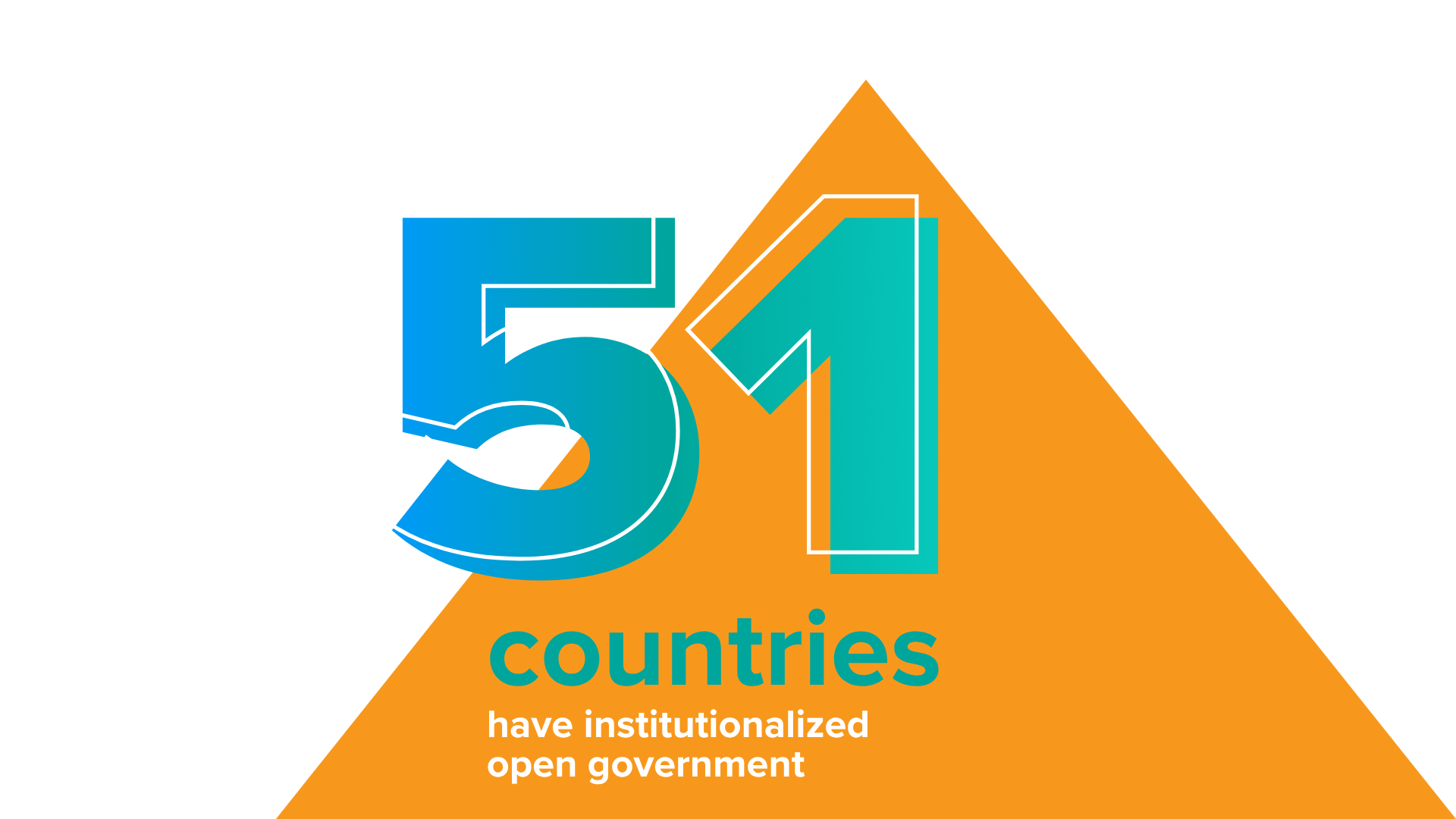
Fifty-one countries have embedded open government principles and practices in administrative, executive, or legal instruments to ensure continuity across political transitions. In a majority of these countries, (46 out of 51), governments also institutionalized the multi-stakeholder forum.
OGP enables civil society to shape and influence policy.
Fifty-one countries used OGP to institutionalize public participation. These reforms include requiring public consultation in policy-making, adopting participation standards or guidelines, establishing permanent spaces for government-civil society dialogue, or creating new institutions responsible for improving public participation across government.
- Civil society priorities: In a survey conducted in 2025, nearly 90 percent of civil society respondents said their priorities are reflected in their country’s OGP initiatives to some or a large extent.
- Inclusive participation: 40 OGP countries involved underrepresented groups in implementing reforms. This includes people with disabilities, women and girls, LGBTQIA+ communities, youth, elderly people, and indigenous people.
Participatory processes led to tangible governance improvements.
Evidence shows that when government and civil society work together, reforms are more ambitious, better implemented, and deliver stronger results. Sixty-two out of 67 countries with participation commitments have achieved concrete outcomes such as creating standing spaces for participation, passing new laws or regulations around participation, or involving civil society in implementing commitments. In 26 countries, evidence shows that participatory processes contributed to tangible improvements to policy outcomes, such as improved public services and public trust.
OGP is a platform for a plurilateral system.
In today’s geopolitical context, the multilateral system that once provided guardrails and shared rules of engagement is under serious pressure. OGP provides a powerful alternative by convening like-minded countries around specific policy areas such as public participation and justice, turning national commitments into coordinated global pushes. Examples include the Participation Action Group (led by France and the UK) and the Justice Coalition (led by Chile and Canada). New alliances such as the Proactive Disclosure Coalition (Netherlands with OECD) and the Civic Space Lab (with UNDP and partners) are setting standards and advancing reforms on transparency and civic freedoms. The Open Algorithms Network is also connecting countries to collaborate on responsible AI governance.
OGP’s action framework enables iterative, multi-year reforms.
Repeated iteration improves dialogue between government and civil society, builds pathways for new actors to gain political influence, and brings together reformers within and across countries who previously worked in isolation. For example, across the Philippines, Croatia, and Armenia, embedding reforms in successive OGP action cycles transformed pilot programs on participatory budget and audit practices into institutionalized systems.
Global visibility creates domestic political incentives to deliver.
OGP instruments like the Open Gov Challenge, open government awards, OGP Summits, and other events provide global and regional recognition and visibility, which create political incentives to deliver reforms. In Senegal, repeated OGP commitments, amplified by a public pledge at the 2025 OGP Africa and the Middle East Regional Meeting, helped secure passage of the 2025 RTI law. Regional forums like América Abierta and the International Open Justice Conference convened high-level judges to make judicial commitments and produced the Santo Domingo Declaration, which has been endorsed by multiple countries.
OGP members benefit from continuous learning and accountability.
OGP is a thriving platform for countries to exchange best practices and innovations. In 2025 alone, OGP facilitated 81 cross-country exchanges. Reforms by OGP members also inspire others to advance commitments. For example, Ukraine’s open contracting reforms inspired Finland’s state spending portal, while Guatemala designed its most participatory action plan, inspired by the recent experience of the Dominican Republic through peer exchange.