Independent Reporting Mechanism Accountability Report 2025/26
Introduction
The Independent Reporting Mechanism’s (IRM) Accountability Report 2025/26 provides an overview of the activities of the IRM from 1 April 2025 through to 31 March 2026. It enables the IRM to be transparent and accountable towards the Open Government Partnership (OGP), open government community, and the wider public.
Over 2025/26, the IRM published 48 products, supported OGP members as part of 18 different meetings or events, and collaborated with 80 researchers, expert reviewers, copywriters, and translators.
In response to the update to the OGP’s action framework, the IRM has begun to review its approach and methodology to ensure it continues to provide independent, evidence-based, and objective reporting to hold OGP members accountable and support their open government efforts. Decisions on these changes and their implementation will take place in the next fiscal year, including support materials and guidance.
OGP Action Framework Update
In 2025, the OGP Steering Committee created the Action Framework Task Force to review and update the rules, guidance, and communications around National Action Plans. While the IRM was not directly within the scope of this review, any changes inevitably require the IRM to respond. The Action Framework Update was discussed and endorsed by the Criteria and Standards (C&S) Subcommittee and was approved by the full Steering Committee on February 4, 2026.
To prepare for the changes, the IRM commissioned an options paper in December 2025 to examine potential changes to IRM products, their scope and timing in light of the updates to the Action Framework. Inputs and changes from the Action Framework Update alongside further consultation would inform this paper. Further consultations will be held with members of the IEP, Criteria & Standards Subcommittee, IRM researchers, and OGP members on these options before they are approved by the IEP and the Steering Committee. This work is ongoing and due to be completed in 2026.
To manage the development and transition to the new approach, the OGP Steering Committee agreed as part of the Action Framework Update that the IRM pause the production of Co-Creation Briefs after February 4, 2026 and Action Plan Reviews for any action plans received after this date. The IRM would continue to research and publish Midterm Reviews for four year plans and any Results Reports, as well as provide recommendations for co-creation upon request.
A message from the International Experts Panel
“Over the past year, the IEP has continued to work closely with the IRM to help ensure the quality and credibility of its products, while also ensuring that the IRM continues to hold members accountable for delivering on their commitments. Throughout this process, the IEP has also sought to draw out lessons learned and reflect on how the IRM can continue evolving to best support the needs of the partnership while remaining faithful to its mandate. Over the last 12 months, the IRM has continued to provide important assessments on country progress through its regular reporting products, as well as publishing two Open Government Journey reports examining long-term changes in Kenya and Spain. The IRM also published its biennial Local Report exploring results from 541 OGP local commitments.
The development and introduction of the revised OGP Action Framework represents a particularly significant development this year. The IEP has taken time to assess how the IRM should adapt its offering to this new framework, while ensuring that accountability is not compromised in the process. The IRM has conducted consultations throughout the year to hear from a wide range of stakeholders on how it can best serve the evolving needs of the partnership as OGP sharpens its focus on action and results. These discussions have also placed significant emphasis on strengthening learning, ensuring that the IRM not only assesses progress but also helps capture insights and lessons that can support stronger implementation across the partnership. In our view, safeguarding the independence of the IRM, together with its accountability function in line with its mandate, remains critical to ensuring its continued credibility and integrity.
It has been a privilege to be a member of the IRM IEP. We look forward to overseeing the next phase of updates to the IRM in the coming year, before passing the baton to a new IEP team once our mandate ends in December 2026.”
This report is endorsed by the IRM’s International Experts Panel (IEP). During the reporting period 2025/26, the IEP was composed of three members: Snježana Bokulić, Maha Jweied, and Rocio Moreno Lopez. They play an important role overseeing the development and implementation of the IRM research methodology and ensuring the highest quality of reports.
Publications
Between 1 April 2025 and 31 March 2026, the IRM produced 48 publications:
- 10 Action Plan Reviews
- 24 Results Reports
- 11 Co-creation Briefs
- 2 Open Government Journeys
- 1 Local Report
IRM Local Report 2025
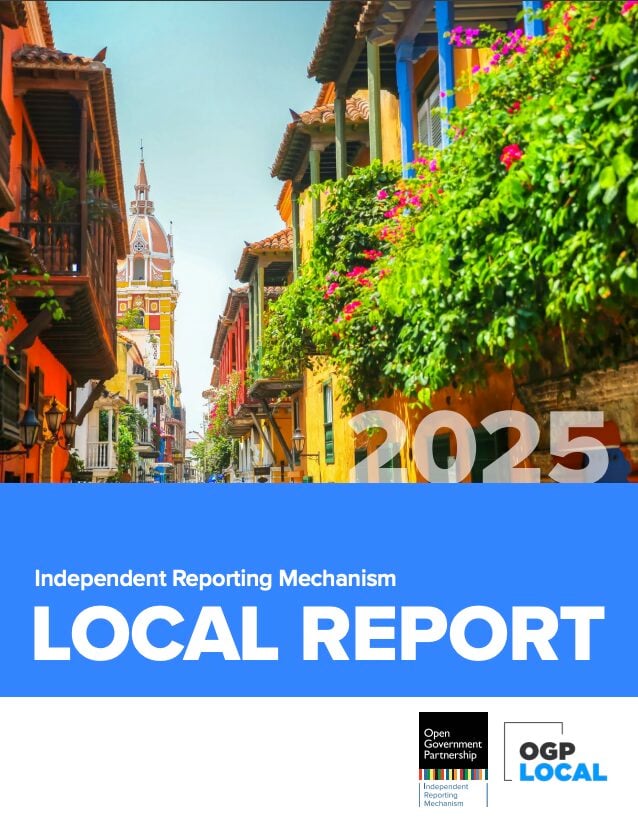
The IRM published the third edition of its biennial IRM Local Report. It explores results from 541 OGP local commitments made until 2024 and highlights good practices in developing and implementing OGP local action plans.
Many commitments achieved real-world changes which are featured in the report, such as from Mexico, Nigeria, Indonesia and the United Kingdom. The report highlights that the most popular open government commitments in local plans focused on public participation, public service delivery, inclusion, and open data.
The report also surfaces good collaboration practices as local members developed and implemented their action plans. It highlights how over successive action plan cycles, many of these processes became more embedded and participatory.
Find out more about these reforms and good practices in the IRM Local Report 2025.
Open Government Journey
The IRM produced two Open Government Journeys this year, following the OGP Africa and Middle East Regional Meeting in Nairobi, Kenya, and the OGP Global Summit in Vitoria, Spain.
In Kenya, the government has increasingly embedded OGP principles across the executive, judiciary, and parliament. Kenya’s Open Government Journey focuses on how the country is expanding access to information, tackling anti-corruption through public procurement and beneficial ownership reform, and increasing public participation and the openness of parliament, among other key initiatives.
Spain's Open Government Journey spotlights the country’s efforts to institutionalize the OGP process, explores how it has used OGP to advance access to information and foster a culture of open government, and discusses the diffusion of open government practices to the local level.
Fostering Learning and Accountability
| Snapshot: IRM Services in 2025/26 |
| In-person Meetings at the OGP Global Summit in Vitoria, Spain (October 2025) |
| Virtual Sessions and workshops related to co-creation and commitment design |
| Introductory sessions on the IRM for new government and civil society participants |
| Online participation at peer exchanges and an OGP Local Global Meeting |
The IRM provides multiple services to support the in-country work of OGP and national stakeholders. In 2025/26, this included a country visit to North Macedonia, five online meetings to introduce the IRM to new stakeholders, five online workshops about improving commitment design and implementation, a further seven online meetings related to IRM findings and assessments, and finally, numerous meetings with stakeholders at the OGP Global Summit in Vitoria, Spain.
Case Study: North Macedonia
In May 2025, the IRM took part in a country visit to North Macedonia with the OGP Support Unit and met with government and civil society stakeholders involved in the country’s OGP process. The IRM presented the findings of the North Macedonia Action Plan Review 2024-2026 to members of the country’s Multistakeholder Forum (OGP Coordination Council). The presentation focused on the IRM’s recommendations on promising commitments in North Macedonia’s action plan, including on beneficial ownership transparency and digitalization of the financial reporting of political parties. The IRM also led a discussion with the Coordination Council on the main obstacles they have encountered to implementing these commitments, potential solutions, resources needed to implement the solutions, and what support OGP can offer.
Case Study: Africa Justice Commitment Design
In March 2025, the IRM held a commitment design workshop for justice reforms during the Africa Regional Meeting in Nairobi, Kenya. The workshop with select justice officials and civil society aimed to address the challenges many countries face in designing justice commitments with a clear connection to open government principles. It provided concrete and targeted guidance for OGP members in Africa and the Middle East developing or implementing justice commitments or Open Gov Challenge submissions. The IRM provided commitment design guidelines along with targeted recommendations for the countries present based on their draft or current commitments. During breakouts, attendees used worksheets tailored to their particular reforms to discuss opportunities to strengthen commitment design with each other and OGP/IRM staff. As a direct result, Ghana, Sierra Leone, and Morocco intend to incorporate this guidance during their action plan mid-point refresh and are considering Challenge submissions.
Ongoing Training
In 2025/26, we strengthened our learning and development program for consultants and staff. We aimed to ensure that training and updated guidance addressed the gaps identified in IEP quality assurance sessions, and that consultants receive consistent guidance across sources including researcher training, staff calibrations, and written guidance. Overall, the IRM held two virtual researcher trainings (four sessions total to account for time zones), four staff calibration sessions, and sent four quarterly Researcher Digests. Training and guidance focused on strengthening the more analytical and strategic elements of IRM reports, such as recommendations and Key Observations. We also provided written guidance and training to strengthen the quality of external reviews, and onboarded four external reviewers to diversify the pool.
Ensuring our Methodology
During 2025/26, the IEP conducted Quality Assurance checks – an ongoing process to validate and oversee consistent application of the IRM methodology, practices, and guidelines. It provides the IEP and IRM staff with a systematic approach to identify issues proactively and resolve problems as they arise. The recommendations of these sessions have been used to inform training of researchers and external reviewers. The IEP conducted three Quality Assurance sessions during this period focused on the quality and consistency of recommendations for Promising Commitments, of assessing the minimum requirements of the OGP Participation and Co-creation Standards, and of the overviews and executive summaries in IRM reports. Summaries of the discussions and recommendations can be found here.
Feedback
“The recommendations by the IRM are relevant and useful for the effective implementation of our 5th National Action Plan”
(Government Point of Contact, Africa and Middle East)
“IRM reports have helped us to generate transparent conversations about issues that are limiting progress, as well as to mark important wins that need to be recognized.
(Civil society stakeholder, Americas)
“We’ve read the report and are pleased to see some of our local governments featured. It was also insightful to learn how other jurisdictions are faring in the implementation of their OGP local action plans.”
(Government Point of Contact, Asia-Pacific)
“Meeting you has shown me that the IRM is not police, it’s a partner. You want us to succeed, you’re not waiting for us to fail and catch us”
(Government Point of Contact, Africa and Middle East)
“This information helps us to identify potential areas for future open government programming assistance as well as potential entry points to help make local open government reforms more comprehensive and sustainable among OGP members that we work with, and beyond.”
International Non-governmental Organisation, Americas
Behind the Scenes in 2025/26
Team and Community
There were no changes to the IRM team, three International Experts Panel members and overall Accountability and Learning structure. We worked with 80 consultant researchers, expert reviewers, copyeditors, and translators to support our work in the 2025/26 fiscal year.
At the end of 2025/26, the IRM began a recruitment process for new IEP members. The current IEP members’ mandate ends on 31 December 2026, following the approval of an extension by the OGP Steering Committee. This extension enables the current IEP members to oversee implementation of the updated IRM approach, which is being conducted in response to the update of OGP’s Action Framework
Conflict of Interest Management
The IRM IEP Ethics Taskforce has continued to manage and process conflict of interest cases. The policy can be found here. During 2025/26, the IRM IEP Ethics Taskforce reviewed two cases, and decided that both cases gave rise to a perceived conflict of interest. One of the two cases also gave rise to an actual conflict of interest in relation to one of the commitments to be assessed. The Taskforce outlined mitigating measures in both cases to manage the actual and perceived conflicts of interest.
Financial Resourcing
During the 2025/26 fiscal year, the IRM spent USD $256,493 on non-salary expenses. Final audits and financial declarations by OGP are published on the Financial Information section of the OGP website.
Accountability Report Drafting and Review Process
This accountability report was drafted by Andreas Pavlou, IRM Lead, reviewed by the IEP and published on 23 July 2026.