
End of Commitment Report – Introduction of an interactive budget. Increasing the transparency of the community budget on the principle of
- Action Plan: Action plan – Vanadzor, Armenia, 2021 – 2026
Overview
Name of Evaluator
Arpine Hakobyan (“NGO Center” civil society development NGO)
[email protected]; [email protected]
Member Name
Vanadzor, Armenia
Action PlanAction plans are at the core of a government’s participation in OGP. They are the product of a co-creation process in which government and civil society jointly develop commitments to open governmen... Title
Action plan – Vanadzor, Armenia, 2021 – 2026
CommitmentOGP commitments are promises for reform co-created by governments and civil society and submitted as part of an action plan. Commitments typically include a description of the problem, concrete action...
Introduction of an interactive budget. Increasing the transparencyAccording to OGP’s Articles of Governance, transparency occurs when “government-held information (including on activities and decisions) is open, comprehensive, timely, freely available to the pub... More of the community budget on the principle of “open data”.
Title
Introduction of an interactive budget. Increasing the transparency of the community budget on the principle of “open data”.
Action
The introduction of an electronic “interactive budget” system will enable not only the expenditure part to be shown in an interactive way, but also the actual revenues according to the sources of production. Using the appropriate improved tools to search for specific data (eg, distribution of budget expenditures within the community, etc) also makes the information available to the user for further processing (Machine-readable). It will ensure the availability of access to information on the budgets of Gyumri and Vanadzor communities, and will improve the transparency of information on actual budget expenditures and revenues collected.
Problem
Currently, citizens of communities have the opportunity to become familiar with the structure of the Community Budget of Vanadzor and Gyumri and the estimated and actual expenditures. The disadvantage of the system is that even though it provides users with the above-mentioned information on the Communities Budget, it is not built upon the “open data” principles. The system does not provide users with an opportunity to download the information and process it for their own purposes.
Section 1.
Commitment completion
1.1 What was the overall level of progress in the commitment implementation at the time of this assessment?
complete
Provide a brief explanation of your answer:
The original “interactive budget” commitment to improve transparency through open dataBy opening up data and making it sharable and reusable, governments can enable informed debate, better decision making, and the development of innovative new services. Technical specifications: Polici... was replaced by participatory budgeting, launched in 2024 with GIZ and MTAI support and continuing in 2025. CSOs assist the municipality with engagement strategies, awareness campaigns, and guiding residents through proposal submission and online voting. Residents now submit proposals, vote online, and monitor implementation. Winning projects entered the 2024 municipal budget and, in 2025, are co-financed by state subsidies. Examples include inclusive kindergarten rooms (2024), plus a football field, sports playground in Shahumyan, and two playgrounds in Gugark (2025). The process strengthened engagement, showing smaller communities can also succeed, building trust in the system. Despite technical issues such as complex registration and inconsistent committee decisions, substantial progress has been made, with goals of participation, transparency, and delivery achieved.
Provide evidence that supports and justifies your answer:
PB in Vanadzor Documentation.zip
Communication strategy for participatory budgeting.docx
Links Participatory Budget Vanadzor.docx
1.2 Describe the main external or internal factors that impacted implementation of this commitment and how they were addressed (or not).
- Low participation and trust: Particularly in rural communities, many residents were initially hesitant to participate in the process, fearing that projects from larger urban areas would dominate voting outcomes and that their voices would not matter. Early experiences in 2024 confirmed these concerns, but the 2025 process demonstrated that rural projects could successfully compete. In Vanadzor, smaller village proposals received sufficient votes to be approved, which increased community confidence. To address initial skepticism, municipal authorities and CSOs organized awareness campaigns, public meetings, and direct consultations to explain the process, deadlines, and benefits of participation.
- Technical voting difficulties: The online voting system required residents to register on the municipal portal (cmis.vanadzor.am) and submit personal information for identification. This procedure proved complicated for some participants, especially elderly residents and those without regular internet access, sometimes creating distrust regarding data security. In several cases, volunteers and community facilitators had to assist residents with registration and voting steps. Simplifying the identification and registration process and providing clear step-by-step guidance are recommended to ensure broader accessibility and higher participation.
- Committee decision inconsistencies: Some project proposals were initially rejected due to unclear criteria. This led to disagreements between project authors, community members, and committee members. To prevent such conflicts, clearer guidelines and standardized decision-making criteria should be formally adopted and communicated in advance through municipal council decisions. Transparency in evaluation criteria is critical for trust and legitimacy of the process.
- Stakeholder engagement: The active participation of local CSOs, municipal staff, project authors, and engaged residents was key to the success of the process.
1.3 Was the commitment implemented as originally planned?
The commitment implemented was completely different from the plan.
Provide a brief explanation of your answer:
The initial objective focused on enhancing transparency through an “open data” approach, where information about the municipal budget would be disclosed and made accessible to the public. However, during implementation, this approach was replaced by participatory budgeting, which significantly changed the scope and nature of the commitment. Instead of passively accessing financial information, residents became active contributors to the budgeting process: they could submit their own project proposals, vote on priorities through an online platform, and later monitor how winning projects were implemented. This shift transformed the commitment from a primarily informational transparency initiative into a participatory governance mechanism. While the core principle of improving transparency remained, the methods and outcomes diverged substantially from the original plan, resulting in a more inclusive and interactive model of governance.
Provide evidence for your answer:
Section 2.
Did it open government?
2.1.1. – Did the government disclose more information; improve the quality of the information (new or existing); improve the value of the information; improve the channels to disclose or request information or improve accessibility to information?
Yes
Degree of result:
Outstanding
Explanation: In narrative form, what has been the impact on people or practice.
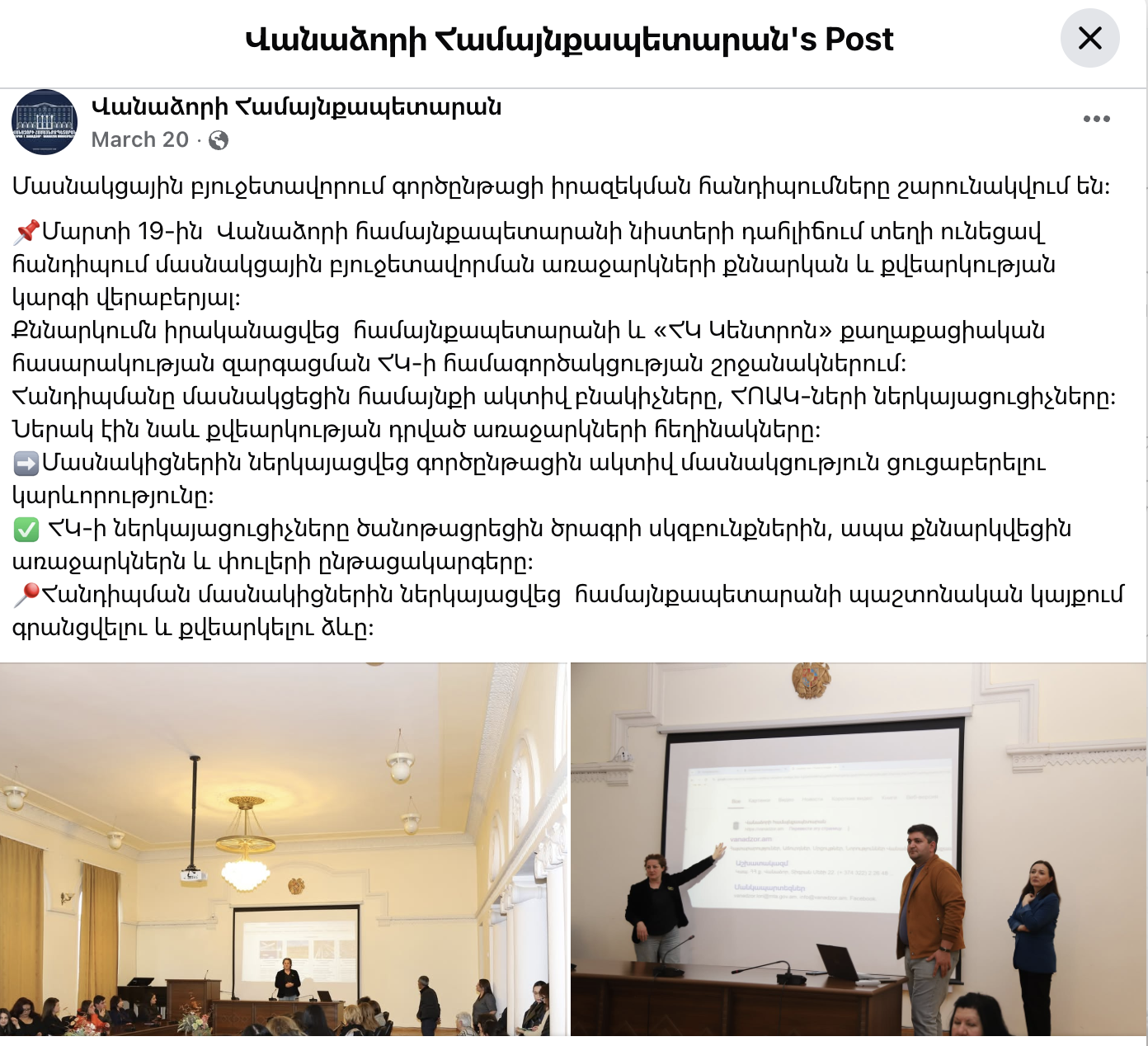
The participatory budgeting process significantly improved access to information by making detailed project descriptions, eligibility criteria, submission procedures, and voting deadlines publicly available on the Vanadzor municipal website and through in-person public meetings. Residents received clear instructions on how to register, submit proposals, and vote, including guidance from municipal staff and CSO representatives during meetings such as the one held on March 19, 2025. This transparency allowed citizens to track which projects were being considered, understand the decision-making criteria, and follow implementation progress after projects were approved. By providing multiple channels of information, including online portals, announcements, and direct consultations, residents are now better informed and empowered to participate in budgeting decisions. The process also increased trust in local governance, as citizens could see how their votes translated into tangible projects, such as playgrounds in Gugark and Shahumyan, reinforcing accountability and engagement.
Evidences:
- Vanadzor Municipality website and participatory budgeting portal
- March 19, 2025, meeting documentation with the NGO Center
Provide evidence for your answer:
Community Meeting PB.png
PB in Vanadzor Documentation1.zip
Links Participatory Budget Vanadzor1.docx

2.1.2. – Did the government create new opportunities to seek feedback from citizens/enable participation inform or influence decisions; improve existing channels or spaces to seek feedback from citizens/enable participation/ inform or influence decisions; create or improve capabilities in the government or the public aimed to improve how the government seeks feedback from citizens/enables participation/ or allows for the public to inform or influence decisions?
Yes
Degree of result:
Outstanding
Explanation: In narrative form, what has been the impact on people or practice.
Residents actively submit project proposals, vote online, and participate in monitoring the implementation of approved projects, ensuring their voices are directly reflected in municipal decision-making. Public meetings, such as the one held on March 19, 2025, emphasize the importance of active engagement, explaining procedural steps, eligibility criteria, and the impact of citizen involvement on final outcomes. The process intentionally includes both urban and rural communities, allowing smaller villages to compete fairly alongside larger neighborhoods. For example, in 2025, proposals from rural areas such as Gugark and Shahumyan successfully passed the voting stage and received funding, demonstrating that equitable participation is achievable. CSO representatives and municipal staff provide guidance and support throughout the process, helping residents understand technical aspects such as online registration, voting, and project monitoring. This inclusive approach strengthens civic engagement, builds trust in local governance, and ensures that diverse community needs are addressed in the municipal budget.
Evidences:
- Online voting portal and project submission system.
- March 19, 2025, public meeting post.
- 2025 approved projects: football field and playgrounds in Shahumyan, two playgrounds in Gugark village.
Provide evidence for your answer:
Minutes of the committee meeting-2.pdf
Links Participatory Budget Vanadzor2.docx
Community meeting PB1.png
2.1.3 Did the government create or improve channels, opportunities or capabilities to hold officials answerable to their actions?
Yes
Degree of result:
Marginal
Explanation: In narrative form, what has been the impact on people or practice.
Resident involvement in voting, proposal submission, and monitoring of projects has significantly increased municipal accountability, creating a direct link between citizens and local decision-making. Through online voting platforms and public meetings, residents can see which projects were selected, understand the criteria for approval, and track the allocation and use of municipal funds. For example, in 2025, approved projects such as the football field and playgrounds in Shahumyan, and two playgrounds in Gugark village were closely followed by residents and project authors, ensuring transparency at every stage. Civil society organizations (CSOs) provide additional oversight, facilitating discussions, clarifying procedures, and reporting on any irregularities, which strengthens trust in the process. This combination of citizen participationAccording to OGP’s Articles of Governance, citizen participation occurs when “governments seek to mobilize citizens to engage in public debate, provide input, and make contributions that lead to m... More, public monitoring, and CSO involvement helps ensure that municipal resources are used efficiently, priorities reflect community needs, and local authorities remain accountable for their decisions. By giving residents concrete ways to observe and influence outcomes, the process promotes a culture of transparency and responsiveness in local governance.
Provide evidence for your answer:
Minutes of the committee meeting-1-2024.pdf
Minutes of the committee meeting to summarize the voting results_2-2024.pdf
2.1.4 Other Results
Not Applicable
2.2 Did the commitment address the public policy problem that it intended to address as described in the action plan?
Yes
Provide a brief explanation of your answer:
The commitment effectively addressed the public policy problem by enhancing municipal transparency and citizen participation in budgetary decisions. Participatory budgeting enhanced citizen participation and municipal transparency. Residents have a direct impact on budget decisions, improving project effectiveness and public trust. Rural and urban projects were both successful, demonstrating inclusive decision-making.
The process aligns with the broader framework of participatory budgeting in Armenia, as outlined by the Ministry of Territorial Administration and Infrastructure and the Ministry of Finance. These institutions emphasize the importance of citizen engagement in local governance, aiming to improve transparency and accountability.
Evidences:
- Government decision:
Ministry of Finance
Decision - Council of Elders’ decision
Provide evidence for your answer:
Section 3.
Lessons from
implementation
3. Provide at least one lesson or reflection relating to the implementation of this commitment. It can be the identification of key barriers to implementation, an unexpected help/hindrance, recommendations for future commitments, or if the commitment should be taken forward to the next action plan.
- Participatory budgeting is highly effective, engaging citizens in decision-making and increasing municipal accountability.
- Awareness campaigns are essential, particularly in rural areas, to increase participation.
- Online registration and voting should be simplified to ensure broad access.
- Committee decisions must follow clear criteria to prevent conflicts.
- Experience shows that smaller communities can succeed alongside larger ones.
- Successful implementation may lead to a significant portion of the municipal budget being allocated through participatory mechanisms, creating long-term positive impacts.
Leave a Reply