Heads of State Mark 15 Years of Government Openness at the UN General Assembly

Open Government Partnership Releases New Report, Welcomes New Leadership
NEW YORK, September 23, 2026 – Heads of state and government from nearly 10 countries, as well as ministers, and civil society leaders marked the 15th anniversary of the Open Government Partnership (OGP) with a high level roundtable at the 81st United Nations General Assembly.
Hosted at Ford Foundation Center for Social Justice and moderated by former Prime Minister of New Zealand Helen Clark, the event kicked off with messages from leaders in Albania, Armenia, Costa Rica, Dominican Republic, Guatemala, Ghana, and the Philippines. Showing the breaths of political leadership across the Partnership, the messages highlighted the growing global commitment to transparency, participation and accountability, and the role of open government in building stronger, more responsive institutions.
President John Dramani Mahama of Ghana noted that “Open government is not just a cliche in our governance lexicon. It is the foundation of trust. It is the engine of sustainable development and the key to shared prosperity. Let us move forward with renewed ambition.”
H.E. Luis Abinader, President of the Dominican Republic, stated that for democracies to thrive, leaders must foster citizen trust. “The future of our democracies will not depend solely on the strength of our governments. It will depend on the trust that governments are capable of building with their citizens. That’s why, being a part of OGP has meant so much more than just joining an international initiative. It has been a way to understand how to enact power. A State that informs, that dialogues, that is held accountable, and that recognizes that a participatory society will always make the best decisions.”
The President of Guatemala, Bernardo Arevalo, also noted that “OGP’s technical and strategic support has been crucial in enabling us to have seven national open government action plans in place today.” The President also called on fellow leaders in government to “continue to strengthen citizen participation. Let us continue to demand tangible results and make public trust the foundation of the democracies of the future.”
The Roundtable also brought together ministers and senior government representatives from across the OGP community, including Brazil, Canada, Dominican Republic, Guatemala, Kenya, Netherlands, Philippines, and the United Kingdom, alongside civil society representatives and international organizations like Transparency International, International IDEA, ECLAC, Club de Madrid, and more.
The discussion focused on how transparency, participation and accountability can help governments respond to some of the most pressing challenges facing societies today, including declining trust in institutions, pressure on civic space and rapid technological change.
“Fifteen years after we posited the notion that government should serve the people, we have built a Partnership that gave it life: political will, a strong civil society, committed partners, reformers who keep getting up, showing up and speaking up.,” said Aidan Eyakuze, Chief Executive Officer of the Open Government Partnership. “The past fifteen years were about proving that positive change through open government is possible. The next fifteen are about making that change inevitable. Let us do it together.”

Access the full collection of photographs here.
Fifteen years after OGP was launched at the United Nations, the Roundtable also provided an opportunity for political leaders and civil society to reflect on the Partnership’s progress and identify where greater ambition, collaboration and political leadership were needed to advance open government in the years ahead.
“Looking ahead, areas like inclusive and resilient institutions and societies, democratic digital governance, and prosperity and economic growth will play a central role in OGP and the Open Gov Challenge,” said Eyakuze. The updated Challenge will make it easier for institutions across government to participate. “We are also sharpening our focus on ambitious results through a new benchmarking system that will bring together more than 100 existing indicators from over a dozen partner organizations to measure how well members are implementing different areas of the Challenge.”
New Co-Chairs Take the Helm
As OGP enters its next chapter, the Government of the United Kingdom and Laura Neuman will take on the role of Co-Chairs of the OGP Steering Committee, succeeding the Government of Brazil and Steph Muchai. The incoming Co-Chairs will guide the Partnership through its next phase, building on the leadership and contributions of the outgoing Co-Chairs and strengthening collaboration between governments and civil society.
The Government of Brazil and Steph Muchai played an important role in advancing OGP’s mission and strengthening cooperation across the Partnership during their term.
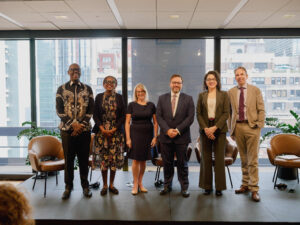
“As the Open Government Partnership marks its 15th year, the United Kingdom is honoured to take on the role of co-chair alongside Laura Neuman,” said Minister for Multilateral, Human Rights, Latin America and the Caribbean of the United Kingdom, Chris Elmore. “I want to thank Brazil and Steph Muchai for their leadership and ambition. Together, they have shown how open government can make a difference to people’s lives and the power of international cooperation. Open government is how we rebuild trust, strengthen democratic resilience and deliver shared prosperity. Our ambition is clear: more open, more accountable governments that deliver for the people they serve. Together with our partners across governments, local leaders and civil society, we will strengthen civic space, deepen participation, promote access to trustworthy information, and tackle corruption and illicit finance”.
At the OGP Leaders Roundtable, the incoming Co-Chairs issued a global call to action for OGP members and partners to turn 15 years of experience into renewed ambition and concrete reforms. The Co-Chairs called on every OGP member, national and local, as well as civil society, multilateral and funding partners, to use OGP as a platform for ambitious action across three priority areas:
- Inclusive and resilient societies: Protect and expand civic space, citizen participation, media freedom and access to information, while ensuring reforms reach women, young people and under-represented communities.
- Democratic digital governance: Govern emerging technologies, including artificial intelligence, digital public infrastructure, information and data, in ways that harness their potential while safeguarding rights and democratic oversight.
- Prosperous and competitive economies: Use openness to fight corruption, strengthen fiscal transparency and support fair, sustainable growth and credible responses to climate and environmental challenges.
The Co-Chairs also called on partners and funders to invest in reformers through sustained and predictable support, align resources behind the three priority areas, and champion open government across international networks and institutions.
Laura Neuman, Senior Advisor at The Carter Center, said: “We issue this call in a moment when we look back with confidence at what open government has achieved and forward with urgency at what remains to be done. The challenges are real. The tools exist. The coalition is vibrant. Fifteen years in, the case for open government is proven. The task now is to scale it and make it meaningful for all.”
The full Co-Chairs Global Call to Action is available here.
15 Years of Progress
OGP is also launching 15 Years of Progress, a new publication that looks back at the people, reforms and movements that have shaped the Partnership since its founding, while examining how open government can help address some of the most pressing challenges facing societies today.
The publication documents progress across areas including the fight against corruption, public participation, access to information, fiscal transparency, open contracting and more inclusive public services. It also looks ahead, identifying three frontiers for the next phase of open government: strengthening inclusive institutions, advancing democratic digital governance, and pursuing shared, transparent prosperity.
The evidence gathered over 15 years demonstrates that open government can deliver concrete results.
- 62 OGP countries have achieved concrete public participation outcomes, with 51 institutionalizing citizen consultation in policymaking.
- 43 countries have advanced open contracting reforms, producing measurable economic impacts in at least 10 countries. In Nigeria, for example, beneficial ownership data helped authorities recover more than USD 105 million in 2024.
- Eight countries passed their first-ever right to information laws through OGP, while nearly
- 60 countries have improved fiscal transparency, including through public budget platforms.
“Fifteen years later, the experience of OGP members shows that this promise is being delivered,” said Aidan Eyakuze, Chief Executive Officer of OGP. “Across countries and communities, openness has strengthened institutions, improved public services, fought corruption, and delivered reforms that endure.”
The findings come at a pivotal moment for multilateral cooperation. As the international community gathers for the 81st UN General Assembly amid institutional, financial and geopolitical pressures, OGP’s founding proposition, that governments and citizens can work together to solve shared problems, is more relevant than ever.
As trust in institutions comes under pressure, civic space faces growing constraints and new technologies reshape the relationship between citizens and government, OGP is calling for renewed action to ensure that openness remains at the heart of effective and democratic governance.
The publication 15 Years of Progress is available here.
Explore the OGP anniversary campaign here.
About the Open Government Partnership
The Open Government Partnership (OGP) is a global partnership of governments and civil society leaders working together to create governments that are more transparent, participatory and accountable. Since its founding in 2011, OGP has grown to include more than 70 national governments and 130+ local governments, representing millions of people around the world. Together, OGP members have made more than 5,600 commitments to advance open government.
Leave a Reply