From Principles to Practice: How Co-Creation Shaped the Dominican Republic’s Code of Ethics for AI

As approved by the government on 3 November 2026, Dominican Republic’s new Code of Ethics for AI exemplifies how integrating open government approaches into policy can create the right conditions to maximize the benefits of AI, while safeguarding against possible harms.
About the Code of Ethics
The Government Office of Information and Communication Technologies (OGTIC, in Spanish) and the General Directorate of Ethics and Government Integrity (DIGEIG, in Spanish) developed the Code as one of the action lines of the national civic space strategy outlined through an Open Gov Challenge commitment. Its drafting was led by Dr. Carla Bonina, a technical consultant funded by the UK Foreign, Commonwealth, and Development Office. Its development offers a broad lesson: a strong policy framework is shaped not only by the ethical principles it contains, but by the process used to draft it.
The result is a Code that is simple, short, and ambitious, while addressing current issues such as the everyday use of generative AI by public servants, the protection of children, and the environmental footprint of data centers.
The participatory process used in the Dominican Republic surfaced demands for human oversight, accessible appeals, algorithmic transparencyAccording to OGP’s Articles of Governance, transparency occurs when “government-held information (including on activities and decisions) is open, comprehensive, timely, freely available to the public,... More, independent auditing, data sovereignty, and institutional accountability. The final Code of Ethics for AI includes the translation of these principles into substantive provisions such as:
- a public register and transparency portal of AI systems used by the state
- mandatory ethical impact assessments before any high-impact system is deployed
- procurement rules that bar contracts preventing the state from auditing the systems it buys
- a list of prohibited uses including social scoring and indiscriminate biometric surveillance
- a permanent Citizen AI Ethics Council
This exemplifies best practices in ensuring that the feedback from participants becomes more than general aspirations.
Recommendations to Create an AI Governance Policy or Code of Ethics
Based on the experience of the Dominican Republic, the OGP Support UnitThe OGP Support Unit is a small, permanent group of staff that work closely with the Steering Committee and the Independent Reporting Mechanism to advance the goals of the Open Government Partnership.... recommends the following four approaches for members looking to adopt similar reforms.
1. Combine international principles with people’s lived experiences
The process in the Dominican Republic drew on the UNESCO Recommendation on the Ethics of Artificial Intelligence as well as and the OECD AI Principles as foundations for the Code’s principles. Combined with diagnostic research and regional benchmarking, the team was able to build on established standards rather than starting from scratch.
The drafting team translated these international principles into eight realistic scenarios for focused deliberation during a co-creation workshop. In one scenario, a woman is denied a housing subsidy because an algorithm judged the payment history of her neighbourhood rather than her own. Several participants recognized such cases as already happening in other jurisdictions, or likely to happen soon in their institutions. This grounded international principles in distinctly Dominican experiences and concerns, including inequality, limited appeal mechanisms, reliance on foreign technology providers, and the need for data sovereignty.

2. Ground the process in local institutional ownership
While international partners and practitioners such as UNESCO, OGP, and public sector digital governanceAs evolving technologies present new opportunities for governments and citizens to advance openness and accountability, OGP participating governments are working to create policies that deal with the ... More experts contributed research and feedback and Dr. Bonina led the technical drafting, the Dominican Republic government remained the intended owner and adopter of the Code. Ownership from the OGTIC and DIGEIG enabled strong participation from ministry staff in the co-creation processCollaboration between government, civil society and other stakeholders (e.g., citizens, academics, private sector) is at the heart of the OGP process. Participating governments must ensure that a dive..., ensuring that the final Code both embedded local expertise and remained realistic about institutional capacity.
3. Treat co-creation as an iterative process, not a single consultation
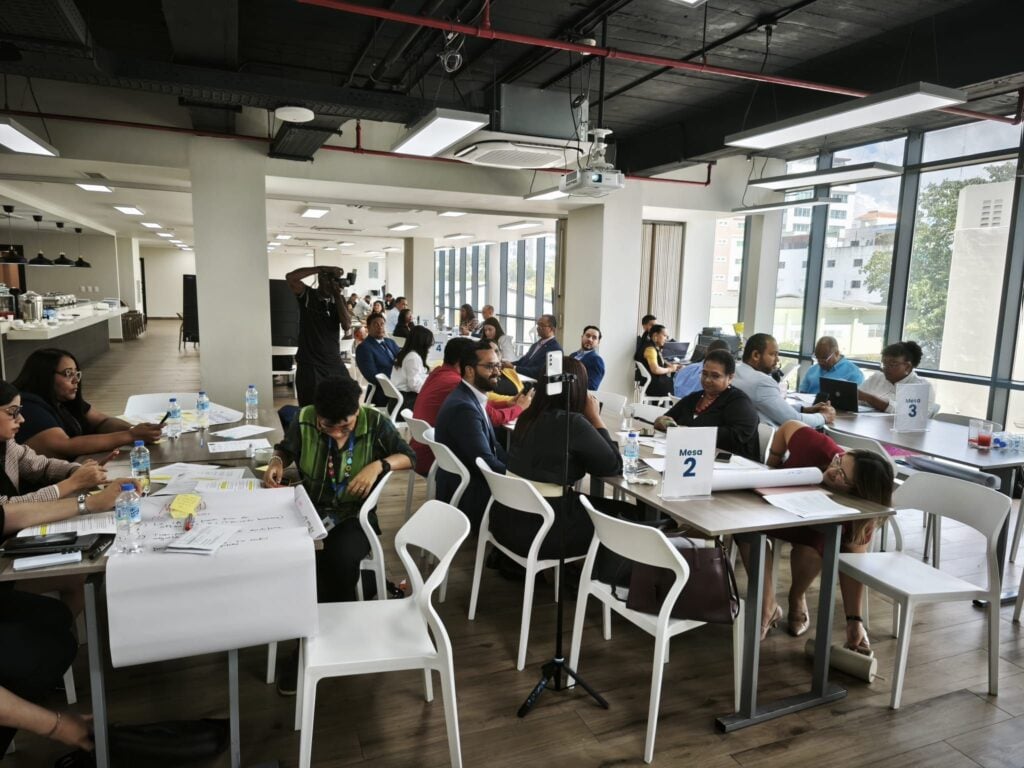
The Dominican Code of Ethics moved through several stages, including: diagnostic research, an initial technical draft, government input, a hybrid co-creation workshop with around 90 participants across eight thematic tables, a public consultation with 76 responses, and the publication of revised drafts. Further expert and regional community review was received through versions opened for comment online. Each successive draft of the Code of Ethics took participant feedback into account, documented what was changed and why, and was iterated upon in the subsequent stages of co-creation.

4. Show participants how their input changed policy
Feedback from the workshop and the consultation made the draft more precise and concrete, with clearer obligations and an expanded list of prohibited uses and enforcement mechanisms, while keeping the text short. To close the loop, the drafting team produced a “what we heard” report, returning participants’ own words, scenarios, and non-negotiables to them, and classified every comment received on the drafts, documenting whether and how it was incorporated. The results are visible in the final text: participants’ concern that algorithms judge people by the history of their neighbourhood became an explicit equity provision; demands for real appeal channels became a right to human review; and 66% of consultation respondents asked for a citizen ethics council, which the Code now establishes.
This report and the final Code of Ethics was accompanied by an implementation roadmap with three phases over 30 months, defining responsibilities and indicators for each action.
Looking Ahead
Reflecting on the process, Dr. Carla Bonina said: “The challenge was never to write more principles. It was to write a Code that a public servant could read in one sitting and apply the next day. Every line was tested against what Dominicans told us in the workshop and the consultation, which is why the Code is short, and why it is ambitious.”
The Dominican experience shows that a strong AI ethics framework is shaped as much by how it is written as by what it says. When people can see their concerns reflected in the final text, the framework has a better chance of being used.
Leave a Reply