
Jamaica Action Plan Review 2024–2026
- Action Plan: Jamaica Action Plan 2024-2026
- Dates Under Review: 2024-2026
- Report Publication Year: 2026
Jamaica’s second action planAction plans are at the core of a government’s participation in OGP. They are the product of a co-creation process in which government and civil society jointly develop commitments to open government ... aims for promising reforms on open dataBy opening up data and making it sharable and reusable, governments can enable informed debate, better decision making, and the development of innovative new services. Technical specifications: Polici..., access to information, climate change, and environmental impact assessments. This plan takes up the uncompleted reforms of the first plan and could be strengthened by incorporating milestones to address challenges that prevented implementation during the previous cycle.
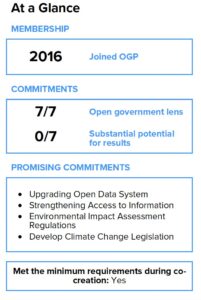
Jamaica’s second OGP action plan consists of seven commitments. These address transparencyAccording to OGP’s Articles of Governance, transparency occurs when “government-held information (including on activities and decisions) is open, comprehensive, timely, freely available to the public,... More through access to information and open data and apply open government principles to policy areas like climate and environment. Many of the commitments align with broader national and subnational policies and strategies. These include the Open Data Policy, Vision 2030 Jamaica National Development Plan, and Sustainable Development Goal 16.
The plan’s most promising commitments focus on open data, access to information (ATI), environmental impact assessment (EIA) regulations, and climate change. They aim to issue new, binding regulations or overhaul existing practices. The open data commitmentOGP commitments are promises for reform co-created by governments and civil society and submitted as part of an action plan. Commitments typically include a description of the problem, concrete action... seeks to upgrade the existing portal, while the ATI and EIA commitments aim to develop new legislationCreating and passing legislation is one of the most effective ways of ensuring open government reforms have long-lasting effects on government practices. Technical specifications: Act of creating or r.... The EIA commitment also intends to improve and codify practices in the executive branch. The impetus for the commitments on open data and climate change come from relevant government strategies.
This action plan is nearly identical to the previous one—as 86% of the previous plan’s milestones were not accomplished.[1] The thrust of the commitments remains the same, though some milestones were adjusted to reflect a more realistic assessment of time and resources available to carry out activities. While previous commitments on open data, ATI, and EIA were assessed as having substantial potential for results, they were assessed in this review as having modest potential for results. The IRM review has not found adequate evidence that lessons learned or challenges from the previous versions of these commitments have been sufficiently addressed to mitigate roadblocks in their implementation. The main thrust of the IRM recommendations in the Results Report for the previous action plan concerned staffing constraints and lack of sufficient resource allocations blocking progress in many commitments.
Civil society reported that during the co-creation process the Government of Jamaica’s OGP team was very communicative and actively engaged.[2] The team facilitated participation by offering flexible arrangements, such as allowing participants to designate proxies[3] However, some civil society representatives noted that the process was invite-only[4] and that the commitments could have been more specific.[5] Jamaica’s OGP team invited representatives from the public, private, and civil society sectors across each OGP NAP commitment area. In addition, the team shared the draft action plan broadly for public review and feedback during two-week periods in February and June 2024, through email outreach and publication on the Ministry of Finance and the Public Service website.[6]
Table 1. Promising Commitments
| Commitment 2 aims to regularly publish relevant datasets through the consolidation and upgrading of the country’s open data portal. |
| Commitment 3 promises to strengthen access to information through the amendment of the Access to Information Law. |
| Commitment 5 intends to increase avenues for the public’s participation in Environmental Impact Assessment processes. |
| Commitment 6 proposes to develop legislation on climate change and adopt a participatory approach to deciding on the Nationally Determined Contributions (NDCs). |
[1] “Jamaica Results Report 2021-2023,” Open Government Partnership, accessed 9 June 2025, https://www.opengovpartnership.org/documents/jamaica-results-report-2021-2023.
[2] Dahvia Hylton (Policy and Research Lead of Jamaica Climate Change YouthRecognizing that investing in youth means investing in a better future, OGP participating governments are creating meaningful opportunities for youth to participate in government processes. Technical ... More Council), interview by IRM researcher, 6 February 2025.
[3] Hylton, interview.
[4] Hylton, interview.
[5] Danielle Andrade (Attorney-at-Law), interview by IRM researcher, 18 February 2025.
[6] Internal correspondence shared with the IRM, 21 November, 2025.
Leave a Reply