The UN Cannot—and Need Not—Wait for Consensus
This opinion piece was originally published by Project Syndicate.
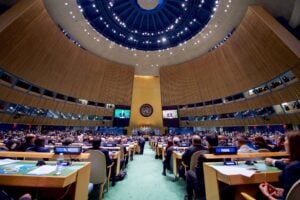
AUCKLAND—When leaders from around the world meet in New York for the United Nations’ 81st General Assembly this month, it will be no ordinary gathering. Member states will be close to choosing the next secretary-general, who will immediately be confronted not only by many global crises, but also by the UN’s diminished finances. With some Member States not fully meeting their financial obligations to the organization, the UN has already had to slash its 2026 budget by 9% and eliminate around one-fifth of its workforce, leading outgoing Secretary-General António Guterres to warn that “the current trajectory is untenable.”
Yet the UN remains essential. It was created to help us maintain peace, prevent wars, protect human rightsAn essential part of open government includes protecting the sacred freedoms and rights of all citizens, including the most vulnerable groups, and holding those who violate human rights accountable. T..., support sustainable development, set global norms, and uphold international law. No other international organization can claim the same degree of universal legitimacy. But universal membership and legitimacy come with tradeoffs. Reaching a consensus takes time, and negotiations can produce compromises that do not adequately address the problems they were supposed to solve. Given these limitations, the UN system needs partners that can complement its work.
That is why governments and their citizens have long turned to smaller “coalitions of the willing”—under the banner of “plurilateralism”—in cases where consensus is not possible. Plurilateral organizations have emerged to address everything from climate-related issues and extractive industries to human rights and trade. Because the members of such coalitions share values, goals, or interests, they can agree, innovate, and act together more quickly. It was such pragmatic arrangements which Canadian Prime Minister Mark Carney had in mind in his landmark “middle powers” speech in Davos in January.
Of course, not all plurilateral organizations are the same. Some are mere talking shops, but others have emerged as effective platforms for experimentation and coordinated policymaking. Some provide concrete standards for how countries should act, while others let members choose their own commitments. Some open the conversation to the public, while others remain behind closed doors. And some hold their members accountable for delivering on their promises, while others don’t.
But often absent from discussions about our new “variable geometry,” as Carney calls it, is the question of whether plurilateral institutions strengthen or weaken democracy. Having witnessed firsthand the importance of strong plurilateral arrangements during my time as chair of the Extractive Industries Transparency Initiative (EITI) and as Administrator of the United Nations Development Programme, I can attest that this is no academic question.
Consider the critical minerals that will power the next generation of clean energyEnsuring universal access to sustainable, dependable, and affordable energy is critical to every aspect of prosperity. Increasing public oversight and transparency in the energy sector can help to ens... More. Because the issue touches on everything from climate, trade, and energy to security and human rights, no fewer than eight plurilateral initiatives are in the works to secure future supplies. Some have clear standards—like bans on child slavery or mining in war-torn areas—and requirements for independent auditsInstitutional and legal frameworks are necessary for providing assurance of the integrity of financial information and of compliance with budgetary rules and procedure. Technical specifications: These..., civil-society participation, and parliamentary oversight. But others are just exclusive trade deals—the lowest common denominator of critical-minerals governance.
Many governments and much of the private sectorGovernments are working to open private sector practices as well — including through beneficial ownership transparency, open contracting, and regulating environmental standards. Technical specificatio... More of course want their clean energy to come with minimal environmental costs and no human exploitation. But hoping for these standards to be upheld is not enough. If their payments are ultimately pocketed by warlords, or if human-right standards are not consistently monitored and enforced, we will repeat some of the worst mistakes of the fossil-fuel era.
Throughout the developing world, dependence on fossil-fuel extraction has been a strong predictor of poverty, corruption, authoritarianism, and conflict. To prevent our inevitable critical-minerals dependency from reproducing the same outcomes, we must establish clear, strong safeguards from the outset.
What’s true for critical minerals is also true for many other areas of global governance. Instead of leaving more positive outcomes to chance, we need to insist that plurilateral arrangements focus on three things: promoting concrete actions (such as coordinated environmental and laborTransparent workforce data and increased representation of workers in labor policy-making lead to policies that better protect workers’ rights and remove barriers for underrepresented groups in the wo... regulations); encouraging participation by a wide variety of stakeholders; and establishing independent monitoring mechanisms. In each case, the core objective should be to enhance democracy. If these values are upheld, plurilateral arrangements can support the UN’s mission, rather than unwittingly undermining or substituting for it.
I say this as someone who has helped lead plurilateral initiatives which did strengthen democracy. For example, the Open Government PartnershipThe Open Government Partnership (OGP) is a multi-stakeholder initiative focused on improving government transparency, ensuring opportunities for citizen participation in public matters, and strengthen... More (OGP), where I serve as an ambassador, has had a greater impact precisely because it embraces a democratic approach. Across its 73 member countries, governments and civil-society groups draft reform commitments together, thereby building domestic support, legitimacy, and buy-in for the final result. In this way, the OGP has made public procurementTransparency in the procurement process can help combat corruption and waste that plagues a significant portion of public procurement budgets globally. Technical specifications: Commitments that aim t... More more transparent and budgets easier to review, as well as helping to identify the anonymous companies used to launder ill-gotten gains from lower-income countries.
Similarly, plurilateral organizations like the EITI require transparency across the oil, gas, and mining sectors, and the Financial Action Task Force (FATF) helps countries update their anti-corruption and counterterrorism systems to meet international standards. What the OGP, the EITI, and the FATF share are the three foundational principles I listed above: they promote concrete, coordinated action, include many different stakeholders, and provide for independent monitoring.
The UN-centered multilateral system remains the foundation of global governance. But in an era of deepening polarization, reduced funding, and attacks on democracy, its capacity to drive domestic implementation of urgently needed reforms and regulations is stretched thin. Plurilateralism can help, but only if it is explicitly designed to strengthen democracy.
We don’t have to make a choice between multilateralism and plurilateralism. But we do need to complement multilateralism, as embodied by the UN, with the right kind.
No comments yet
Related Content
 Insights
 Africa’s Anti-Corruption Efforts Need to Move Beyond the President’s Office
On African Anti-Corruption Day, OGP CEO Aidan Eyakuze argues that lasting anti-corruption reforms require more than executive commitments. Stronger independent institutions and active public participation are essential to building accountability,…
 Insights
 Towards a Collective Ownership of AI
Henri Verdier, Director General at Inria Foundation calls for a democratic response to AI, which can only be developed through close multi-stakeholder dialogue involving governments, civil society, researchers and businesses.
 Insights
 Towards Open, Resilient and Prosperous Futures
The past fifteen years were about proving that positive change is possible. The next fifteen are about making that change inevitable. Read an Open Letter from OGP's CEO.
Leave a Reply