
Open Government Journey
Introduction
Canada is a parliamentary democracy with a long-standing democratic tradition, a strong record of respect for political rights and civil liberties, and one of the world’s largest advanced economies. Since adopting its Access to Information Act and Privacy Act in 1983, Canada has been a global leader in transparency and open data governance and has consistently performed well on international measures of government openness and human development.
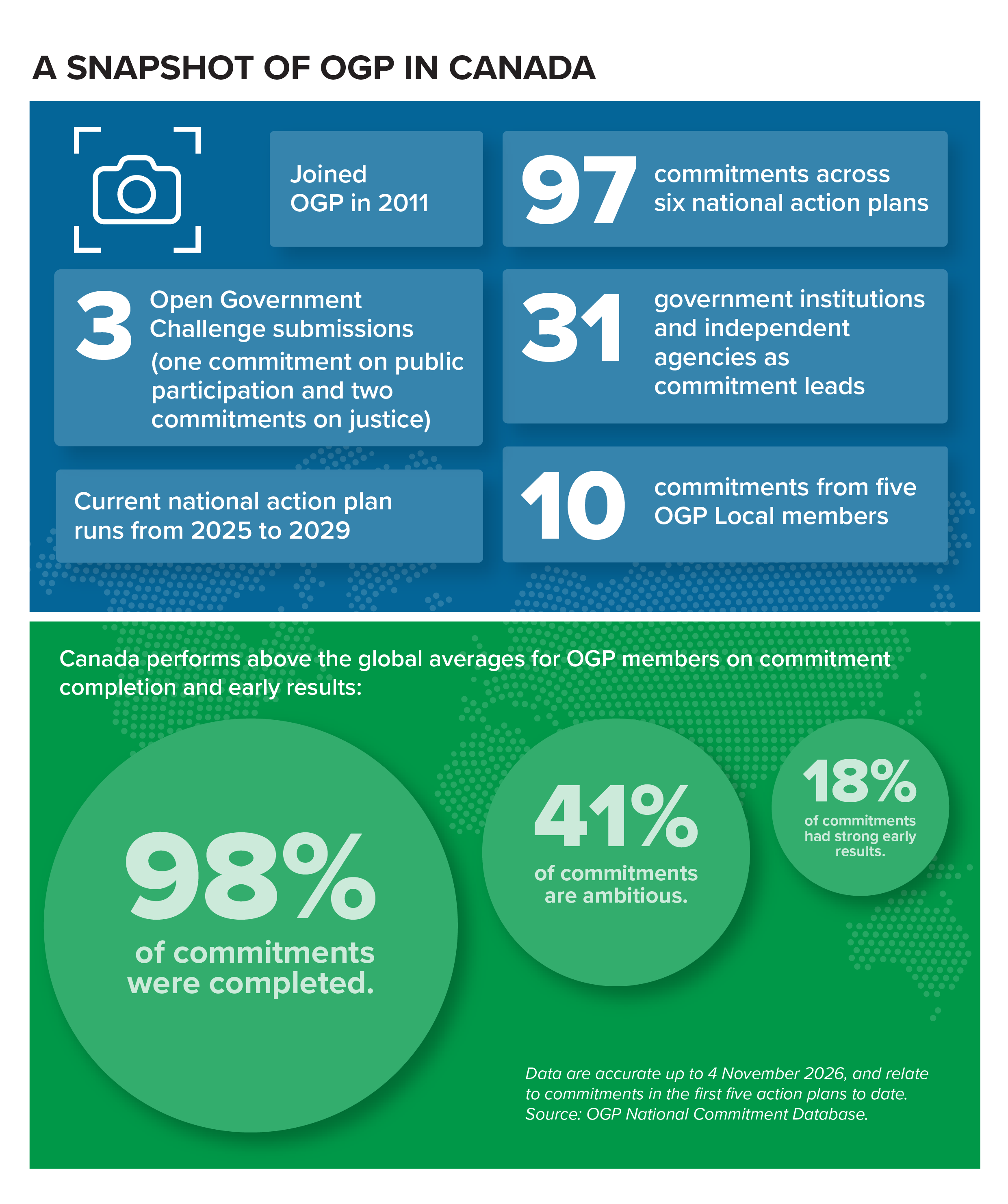
In 2011, Canada joined the Open Government Partnership (OGP). Since then, it has used OGP to advance domestic open government priorities and shape the global agenda. It consistently ranked as a top global performer across indices measuring open data performance: 8th on both the Open Data Barometer (2013) and Open Data Inventory (2016), and 5th on the Open Data Index (2016). As OGP co-chair in 2018–2019 and host of the 2019 OGP Global Summit in Ottawa, Canada helped put gender, inclusion, justice, and participation at the centre of the global open government agenda. Canada championed feminist open government across the Partnership through the Break the Roles Campaign launched in 2019, and in the same year established the OGP Coalition on Justice, which it co-chairs, to advance people-centred justice, ambitious justice reforms, peer learning, and support access to justice for all.
To date, the federal government of Canada has implemented 78 open government commitments under the OGP framework. It is currently implementing another 19 commitments under the country’s sixth OGP action plan (2025–2029). Its two most populous provinces—Ontario and Québec—are members of the OGP Local program.
This report explores Canada’s major achievements on open data and beneficial ownership transparency. Both represent areas of reform with the strongest progress for the country as an OGP member. Open data reforms, such as the Open Government Licence, the 2014 Directive on Open Government, as well as the launch and expansion of open.canada.ca have made proactive disclosure of government-held information a norm. Meanwhile, its federal beneficial ownership register, launched in 2024, marks a major milestone in anti-corruption efforts.
In 2024, Canada became one of the first OGP members to adopt a national open government strategy: the Trust and Transparency Strategy. It integrates federal efforts on access to information, open data, and public participation under a single framework. Progress is systematically tracked through annual reporting and OGP’s Independent Reporting Mechanism (IRM) assessments. The strategy draws on recommendations and insights from the OECD Open Government Scan of Canada (2023), OGP peer networks, and Canada’s OGP multi-stakeholder forum (MSF).
Canada has strengthened open government practices across its public institutions while leaving its mark on the global stage over the past 15 years. This Open Government Journey explores the factors that enabled some of Canada’s most successful initiatives, including the development of its open government strategy. It also identifies ongoing challenges with these reforms, including how to meaningfully embed dialogue between government and civil society on open government at the federal level. Finally, it considers how Canada can leverage OGP to improve citizens’ lives through more transparent, participatory, and accountable government, while also projecting the country’s open government values on the global stage.
Institutionalizing Open Government Dialogue
This section explores the changes in the mechanisms for public engagement and quality of dialogue between government and civil society in Canada on open government reform since becoming an OGP member. These arrangements, including the establishment of the country’s multi-stakeholder forum (MSF) in 2018, have enabled the open government agenda to endure, despite changes in government in 2015 and minority governments in 2019, 2021, and 2025. Government and civil society stakeholders have increasingly sought to mainstream open government principles beyond the OGP process, also integrating them into wider policy and governance initiatives. This section ends with thoughts on building a stronger open government ecosystem in the future.
The Early Years of Government-Civil Society Engagement
The Treasury Board Secretariat (TBS) has coordinated Canada’s OGP process from the beginning. It has led 56 of Canada’s 97 OGP commitments to date and sustained the OGP process through political and administrative changes. TBS is the central agency that guides federal policy implementation, financial management, and service operations for the federal government. TBS has also developed an interdepartmental system around open government. This includes the Open Government Coordinators Working Group, established in 2013, and the Open Government Director General Committee, established in 2016. Both bodies have supported coordination and leadership on open government across the federal executive. From 2017 to 2023, the Canada Open Government Working Group also brought together public servants across jurisdictions beyond the federal level.
Canada had fertile ground for open government reform when it joined OGP. The federal government was already using the language of open government to frame its democratic, economic, and innovation reform agenda, which shaped Canada’s first two action plans (2012–2013 and 2014–2016). However, civil society argued that the agenda was disproportionately focused on open data, and that the government developed the plans with limited and inconsistent opportunities for their engagement.
The Creation and Evolution of the Multi-Stakeholder Forum
Following recommendations from OGP’s IRM and advocacy from domestic civil society, TBS establishedan MSF for Canada’s OGP process during its third action plan cycle (2016–2018). Canada’s MSF provides a permanent platform for dialogue and collaboration between government and civil society on open government and OGP national action plans, with a focus on inclusive consultation, consensus-building, and co-creation. As of 2026, the MSF has 12 members: eight from civil society and four from the federal government, with one co-chair from each side.
Compared to the first three action plans, the MSF significantly improvedgovernment-civil society dialogue in the OGP process. Civil society has emphasized the MSF’s value as a space to highlight open government successes while also playing a “watchdog” role. Government reformers, meanwhile, believe the MSF facilitates a strong collaborative relationship among members, characterized by regular dialogue, joint initiatives, and mutual trust. While civil society has used the MSF to advocate for ambitious priorities, government representatives note that the participation of public officials gives civil society a better understanding of government processes and constraints.
The MSF has also brought increasingly more diverse voices into OGP decision-making. In its early years, civil society members mainly came from organizations focused on open data and transparency, such as Open North, Powered by Data, and Publish What You Pay-Canada. More recently, organizations such as Institut du Nouveau Monde, Simon Fraser University’s Morris J. Wosk Centre for Dialogue, and the Samara Centre for Democracy have brought expertise on democratic participation and dialogue. The diversification of perspectives has helped expand Canada’s open government agenda beyond open data to address barriers to participation and inclusion. These priorities have increasingly influenced Canada’s action plans. For example, civil society members successfully advocated for a commitmenton feminist and inclusive dialogue in the 2018–2021 action plan, an initiative that also shaped Canada’s co-chair agenda and discussions across OGP.
In 2022, TBS commissioned a study to learn about MSFs across OGP. Its recommendations included giving Canada’s MSF a clearer role and authority, defining the responsibilities of its members, and considering a central group supported by smaller thematic groups to involve more people according to their expertise. It also recommended improving guidance and orientation for new members, sharing lessons from other OGP countries, keeping information about the MSF up to date, and consulting current and former members before making any adjustments. Since then, the MSF has updated its Terms of Reference with clearer roles and expectations.
Closing the Feedback Loop: Canada’s Good Practice in OGP Stakeholder FeedbackCanada has consistently provided reasoned responses to stakeholder feedback during its OGP co-creation process, which has since become a requirement of the OGP Participation and Co-creation Standards. Canada was one of the first OGP members to publish government feedback on proposed commitments collected during its first OGP action plan development in 2012, followed by the publication of a ‘What We Heard’ document for each action plan since 2014, summarizing input collected by TBS during co-creation. |
Future Engagement Efforts Inside and Beyond the Multi-Stakeholder Forum
Eight years after the creation of the MSF, the process for engaging diverse stakeholders on open government reforms could be further strengthened. For example, TBS could consider identifying public officials responsible for overseeing transparency, public participation, or accountability initiatives across the government, including those working on initiatives both within and outside the OGP action plan, to broaden engagement beyond the MSF. Stronger connections with these officials could help embed open government principles across government and create better support for implementation. The Open Government Coordinators Working Group also offers an opportunity to strengthen implementation capacity. Clear objectives and responsibilities could help ensure coordination across departments, both on action plan commitments and broader open government priorities. Outside government, identifying and involving civil society groups, professional associations, and academic institutions in the implementation of OGP commitments could strengthen reforms by bringing specialized expertise and diverse perspectives into the process, while also building broader awareness and ownership of reform efforts.
Canadian civil society values the MSF but recognizes its limits in facilitating citizen engagement with government processes. Civil society organisations have called for stronger leadership, accountability, participation, and investment in open government, alongside greater institutional capacity and coordination to strengthen democratic resilience and build a broader community of open government champions. Looking ahead, they have suggested going beyond a whole-of-government approach, in which government institutions primarily coordinate among themselves, toward a whole-of-society approach that brings citizens, civil society, and community institutions into decision-making more regularly. Such an approach could transform the relationship between government and citizens in the years ahead.
Canada offers many examples of mainstreaming open government principles in policy and in practice beyond the OGP MSF. For example, Public Safety Canada created the National Security Transparency Advisory Group (NS-TAG) in 2019, which facilitated dialogue between government representatives, civil society, and academics until 2026. The group advised on how the government could increase transparency while continuing to protect public safety across its policies, programs, and activities.
In the Pursuit of Improving Public EngagementWithin the OGP framework, Canada has successfully implemented specific consultation processes as commitments. For example, its 2016–2018 action plan saw consultations on public satisfaction with tax data, political activity rules for charities, and barriers to Indigenous uptake of tax benefits. However, across successive action plans, such one-off consultations have been more likely to be successfully implemented than permanent participatory mechanisms. For example, Canada’s first action plan (2012–2013) committed to exploring a new public engagement platform and piloting crowdsourcing initiatives for public consultations, but implementation remained largely exploratory. In its second action plan (2014–2016), Canada renewed and expanded these ambitions by committing to next-generation consultation tools, though implementation remained limited. Going further, a 2023 OECD Open Government Scan of Canada identified scope for integrating more robust participatory approaches, such as deliberative processes, into a coherent national open government agenda. |
From Global Leadership to Domestic Strategy
Canada has shown that opportunities and enthusiasm from high-level international leadership can mobilize government and civil society to develop a unified domestic vision on open government.
Canada became OGP co-chair in 2018 and hosted the OGP Global Summit in 2019. These roles gave Canada significant opportunities for multilateral leadership and to use political capital to shape the global open government agenda toward reconciliation with Indigenous peoples, gender equality, and anti-racism. The OECD Recommendation on Open Government, adopted by Canada in 2017, advocates for the development of open government strategies and identifies a need for a stronger, unified vision around open government. In 2024, the federal government launched its Trust and Transparency Strategy, connecting previously separate initiatives and keeping open government visible in broader policy conversations that seek to mainstream transparency, participation, and accountability across public institutions.
Elevating the Open Government Agenda: Canada as OGP Co-Chair
Canada’s open government agenda accelerated following the election of a new government in 2015. In an unprecedented move, then-Prime Minister Justin Trudeau released ministerial mandate letters—traditionally secret documents—thus creating an expectation that ministers deliver open government with information made open by default. This signaled that openness was now a core governing commitment rather than a technical initiative at the highest political level. This commitment was followed up with financial resources for sustained change. Canada’s 2016 budget allocated C$11.5 million over five years to strengthen TBS’ capacity for public engagement, open government, and digital content, and C$12.9 million to improve Canadians’ access to government and personal information.
Canada was then elected co-chair of the OGP Steering Committee in 2018, presenting itself as a norm-setter seeking to shape the global OGP agenda, complemented by the Treasury Board President’s enthusiasm and commitment. Canada articulated an overarching vision to improve collaboration between governments and citizens, build trust, and demonstrate that open government can meaningfully improve people’s lives, and empower marginalized and under-represented communities.
This period (2018–2019) spotlighted the strengths of multilateral leadership. Canada leveraged its co-chair role to project domestic governmental priorities onto the global stage and raise the country’s international profile. This heightened visibility, in turn, gave domestic reformers greater leverage to advance those priorities at home. With a distinct emphasis on inclusion and feminist approaches, Canada positioned itself as a values-driven leader within OGP and helped expand international conversations about equity in governance. This approach reflected a wide-ranging domestic agenda that included commitments in the fourth action plan (2018–2021) on dialogue with Indigenous peoples, gender equality, and anti-racism.
Feminist Open GovernmentResponding to civil society priorities, Canada’s co-chair vision promoted gender-responsive open government, setting the global agenda and building important peer networks on the topic. The Feminist Open Government (FOGO) initiative, launched by the OGP Support Unit and supported by Canada’s International Development Research Centre (IDRC) and other funders, produced research across multiple OGP governments, catalyzed new partnerships with groups such as Women Deliver and the United Nations Development Programme (UNDP), and informed the Break the Roles campaign. Gender rapidly emerged as a priority across OGP action plans, becoming the fastest-growing thematic area by 2019, with a total of 41 members having made 127 gender-related commitments. Several countries made their first gender commitments in 2019, while others actively sought to involve women’s organizations in leadership roles and multi-stakeholder forums. With the growing momentum, an early IDRC study in 2021 highlighted the need for more consistent engagement of women in OGP processes, particularly of grassroots women’s organizations during the co-creation of action plans. Support from IDRC has encouraged a growth of gender diversity at the OGP co-creation table (such as in Mexico and the Philippines, and working groups focused on gender and inclusion outcomes in Indonesia and Nigeria). Across OGP, it has also increased universal resources and targeted support for commitments that address the needs of underrepresented communities, including women, girls, and minorities through technical assistance, sub-grants, and partnerships. Finally, cross-sectoral peer exchanges, technical assistance, and financial support have enabled OGP members to incorporate gender and inclusion considerations into OGP commitments about other policy areas such as anti-corruption, civic space, and justice. |
Canada’s Trust and Transparency Strategy: Towards a Unified Open Government Agenda
During Canada’s co-chair period, open government benefited from strong political backing, international attention, and dedicated resources, culminating in Canada hosting the 2019 OGP Global Summit in Ottawa. Besides creating momentum behind the FOGO agenda, the summit also served as the scene where the OGP Youth Collective was launched. However, political attention to the open government agenda declined after the summit amid the COVID-19 pandemic, fiscal constraints, and changing governments. In 2023, TBS’ Open Government Team reduced in size and its responsibilities shifted to the Access to Information Policy and Performance Division (ATIOGDP), later changed to the Transparency and Information Management Division. Amid competing government priorities, these developments frustrated some civil society stakeholders who remained engaged in the process with the hope of influencing the broader open government agenda.
Acknowledging the need for a coherent open government vision, TBS launched Canada’s Trust and Transparency Strategy in 2024. It emerged from the need for a stronger, unified open government vision, particularly around public participation. The 2023 OECD Open Government Scan was a catalyst for the government to think beyond national OGP action plans toward a framework encompassing all federal open government activities.
The strategy also addressed a branding problem: Canada’s successful open data initiatives overshadowed the broader open government agenda. Reframing efforts around “Trust and Transparency” aimed to provide a more comprehensive picture of its domestic agenda. The strategy anchored open government within broader discourse on public trust and democratic resilience, seeking not only to strengthen public appeal, but also to sustain attention and investment in open government over time.
The strategy has three objectives: fostering openness, modernizing transparency and accountability policies, and enhancing public participation. The government delivers it through OGP National Action Plans and the Access to Information Modernization Action Plans. This structure explicitly links Canada’s domestic agenda to OGP commitments and review mechanisms. To track progress, the government publishes an annual “Trust and Transparency” report. It also uses the OGP’s Independent Reporting Mechanism reports and its own commitmenttracker to assess progress on OGP commitments, while the Access to Information Modernization Action Plan Tracker monitors the implementation of access to information reforms.
Government officials involved in creating the strategy recognize that OGP helped shape its content. They drew on workshops at OGP summits, peer networks, and consultations with Canada’s OGP MSF. Government representatives also emphasize the strategy’s value as a common reference point across federal agencies and ministries that connects separate federal initiatives and keeps open government visible in broader policy conversation. The strategy acts as an anchor to prevent open government from being forgotten amid competing priorities, including digital services and budget pressures. Some civil society stakeholders warn that the strategy lacks resources, implementation guidance, and measurable indicators, while its non-binding status limits its ability to guide government action beyond the specific commitments and timelines in the action plan.
Putting a coordinated approach into practice across departments remains challenging. Access to information and open data are well understood within the federal government, supported by years of mandatory requirements and established systems. Technical reforms such as developing standards, datasets, and centralized platforms have been most successfully implemented, while sustained leadership among government champions, changing how public officials work, coordinating decisions across institutions, and maintaining engagement with citizens have proven more challenging. Implementation may also face further challenges from core public administration reductions and the need to align its objectives and activities with the current government’s seven priorities.
Leadership on People-Centered JusticePeople-centred justice gained momentum in Canada following the adoption of the UN Sustainable Development Goals (SDGs) in 2015, particularly SDG 16 on peaceful and inclusive societies, access to justice, and accountable institutions. With the OECD emerging as a leading voice on access to justice, Canada aligned its federal justice policies with the OECD’s approach by adopting people-centred frameworks, hosting international forums, and integrating SDGs into its legal programs. The Department of Justice Canada has increasingly recognized access to justice as a core system value, shifting toward more user-focused information, programs, and inclusive policies. This approach has also shaped Canada’s open government agenda. Through its role as co-chair of the OGP Coalition on Justice, which Canada helped establish with the Task Force on Justice at the 2019 OGP Global Summit in Ottawa, Canada encouraged other OGP members to pursue more ambitious people-centred justice commitments. In its current action plan, Canada is implementing two Open Gov Challenge commitments on justice, both of which aim to make the justice system more accessible, inclusive, and responsive to the needs of underserved populations by improving the availability, accessibility, and use of disaggregated justice data to inform government decision-making and public understanding. |
Canada’s 2025–2029 OGP Action PlanCanada’s governmental budget cycles and approval processes have not always aligned with OGP’s two-year action plan cycles. As a result, the action plans tended to focus on what was feasible within a short implementation window rather than what was most ambitious. This often led to commitments with narrower scope than civil society stakeholders preferred. In 2025, Canada adopted its first four-year action plan. This was intended to enable more complex reforms, deeper public engagement, and improved tracking of results and outcomes, in response to IRM assessments. The plan is designed to be flexible and responsive to feedback, with updates to be made as needed to assess whether initiatives are achieving their intended effects and to incorporate new opportunities. The submitted 2025–2029 action plan has 19 commitments. One of its three Open Gov Challenge commitments seeks to go beyond existing federal practices and previous OGP efforts to strengthen public participation. It aims to make participation in government decision-making more inclusive and effective, particularly for underrepresented groups. Key activities include establishing the MSF, creating consultation and feedback mechanisms with Indigenous peoples and racial and ethnic minority communities, improving access to government data, testing a public participation maturity model across departments, and promoting citizen science to strengthen public input into policies, programs, and services. |
Advancing Open Data
International assessments, including the Global Data Barometer and the OECD’s OURdata Index, consistently rank Canada among the strongest performers in making government data publicly available. Over time, the federal government has moved from reactive transparency of information towards proactive disclosure. While these efforts began before Canada joined the partnership, OGP has helped to consolidate these efforts.
This section looks at the development and outcomes of Canada’s OGP commitments on open data across successive action plans. It explores how strong central leadership from the Treasury Board Secretariat (TBS) through OGP action plans has advanced domestic open data efforts in Canada, building a strong track record toward standardizing expectations around government transparency domestically and aligning with international best practices.
The Legal Basis and Broader Open Data Context in Canada
The legal basis for open data in Canada is the federal Access to Information Act and Privacy Act of 1983. The Access to Information Act created the right to request federal government records, while the Privacy Act set rules for how the government handles personal information. Together, they established a balance between access and privacy that still shapes Canada’s open data policies today. Subsequent reforms, including an OGP commitment to amend the Access to Information Act, improved access mechanisms and disclosure practices, but did not result in substantive changes to the access to information regime.
TBS has played a central role in driving the open data agenda and using OGP action plans to align open data across federal institutions, provinces, and other jurisdictions. Canada also benefits from a well-established open data community that has helped maintain momentum for open government reforms, including organizations such as Open North, the Canadian Open Data Society, and academic and professional networks such as the Digital Governance Council. These experts provide not only technical expertise but also help in monitoring government commitments and advocating for stronger transparency and data access policies.
Open Data in Canadian OGP Action Plans
Thirty-one of Canada’s 97 commitments through OGP have aimed to advance open data. These commitments have made government-held data available in accessible and reusable formats, consequently improving public reporting on spending, procurement, budgets, and contracting. They helped ensure detailed information on where the data comes from, how it was created, and how it can be used appropriately.
An early achievement in Canada’s first OGP action plan (2012–2013) was to adoptand issue a universal Open Government Licence in 2013, which reduced barriers to reusing federal data, websites, publications, and other information. It made government resources easier to access, laying the groundwork for a single approach that all levels of government could adopt. Most provinces, territories, and major cities have copied and adopted it for their own portals, leading to country-wide harmonization.
In 2014, Canada adopted the Directive on Open Government. It institutionalized proactive disclosure by default, standardized how data is released, and required federal bodies to contribute to a central open data portal. It modernized public access to government information in the digital age by obliging the use of open data, including by replacing the previous data portal with open.canada.ca. It improved technical functionality, added over 500 new datasets, and increased the number of contributing institutions from 24 to 56. The Directive has not been substantially updated since its adoption, however, limiting the extent to which this policy framework has evolved alongside Canada’s broader open government agenda. Canadian stakeholders identify this period during the second OGP action plan (2014–2016) as one of strong reform momentum, driven in part by the election of a new government in 2015 that advanced an open data agenda linked to broader commitments to transparency.
The federal government officially adopted the Open Data Charter in 2018, aligning Canada’s approach with international standards and supporting coordination across Canadian jurisdictions, helping open.canada.ca incorporate provincial-level data. It also enabled the City of Edmonton and the Government of Alberta to host a national summit on open data coordination and learning. Canada became a Lead Steward of the Open Data Charter during the third OGP action plan (2016–2018), and chaired its implementation group. In this role, Canada created tools and shared resources to help governments apply the Charter’s principles and worked with partners around the world to identify and promote useful existing resources.
In its fifth OGP action plan (2022–2024), Canada sought to ensure transparent and strategic data management, strengthening the open government and open data ecosystem and prioritizing the use of disaggregated data. Important results included forming the Open Data Advisory Group (ODAG), which provides a forum for dialogue between the Government of Canada and civil society, academia, and other levels of government on open data. It advises on policies and priorities, identifies emerging issues, and supports collaboration among stakeholders to advance Canada’s open data agenda.
Canada’s Open Government PortalFrom January through September 2026, Canada’s open government portal, open.canada.ca, received an average of 899,390 visits per month, peaking at approximately 1.7 million visits in September 2026. From October 2025 through September 2026, users downloaded over 800,000 datasets. The most downloaded datasets cover employment, socio-economic benefits, and immigration metrics. For example, in May 2026, visitors to the site downloaded a dataset with details about the Guaranteed Income Supplement—a monthly, tax-free payment Canadians can receive if they are 65 or older—over 3,000 times. This illustrates strong demand for information on government programs and benefits.At the same time, the catalogue remains particularly rich in geographic and statistical data, with nearly half of its datasets provided by Natural Resources Canada and Statistics Canada alongside substantial holdings from several provincial governments. Additionally, contributions from departments such as Health Canada and Global Affairs Canada focus on unstructured information content such as webpages and reports. |
Several factors contributed to these achievements. Canada’s longstanding transparency and privacy laws provided solid groundwork to build upon, supplemented by strong leadership from TBS, which coordinated departments around a shared vision, including a single portal, common licensing rules, and standardized data practices. Alignment between Canada’s domestic reforms and international best practices, such as the Open Data Charter and the Beneficial Ownership Data Standard, helped ensure Canadian data met global expectations for quality and consistency. Finally, broad political and civil society support strengthened momentum by framing open data as a practical, non-partisan tool to promote innovation, improve public services, and increase transparency. As such, policy changes over the past 15 years now mean that data of “business value” held by federal departments must be made publicly available as open data free of charge in standardized, machine-readable formats and without restrictions on commercial and non-commercial reuse.
Canada’s Open Data Leadership and Ongoing Challenges
TBS continues to engage in international open data collaboration through the Open Data Charter’s Implementation Working Group, which convenes monthly calls for charter adopters, endorsers, practitioners, and other members of the open-data community to exchange practices, discuss implementation experience and emerging issues, and support peer learning. Its agenda is developed collaboratively, typically at the beginning of each year.
While Canada has made significant progress in open data, several challenges remain. Different levels of government follow different rules due to Canada’s federal system, making it challenging to align provincial data with federal systems, particularly when implementing bilingual labels and machine translation. Legacy computer systems, budget constraints, uneven technical capacity within departments, and varying capabilities across provinces and local governments also make it difficult to adopt open-source tools or maintain data in common formats.
Efforts to make public services more transparent often rise and fall with election cycles and depend heavily on a small number of committed reformers. Stakeholders noted that many open data measures endured because supporters embedded them into laws and regulations while political support was strong. Without those legal safeguards, many initiatives might not have lasted. Although open data portals remain operational, there are concerns about their long-term sustainability, even as some digital and open data reforms continue under broader government technology strategies.
Applying the Open Data Agenda at the Local LevelWhile TBS coordinates Canada’s open government agenda at the federal level, the responsibility for implementing local governance and public participation lies with provinces, territories, and municipalities. In this decentralized context, the OGP model has helped federal and provincial governments share knowledge, adopt formal action plans, and advance practical reforms. Over time, open data has become more prominent at the provincial and local levels. Stakeholders noted that provincial governments that were once hesitant to release information now routinely publish datasets and, in some cases, actively expand public access to information. Government and civil society stakeholders attributed the longevity of these reforms to the institutionalization of open data through federal legislation, regulations, and administrative standards developed and advanced by TBS. In 2016, Ontario joined the OGP Local Program, followed by Québec in 2021. To date, Ontario has completed five commitments across two action plans through 2022, while Québec completed five with its 2021–2023 plan. Ontario’s OGP commitment to make data open by default led to the province adopting the International Open Data Charter and a framework to oversee its implementation. The commitment also led to the creation of an advisory committee of government and civil society stakeholders to advance four key milestones, including staff training on opening data and the creation of a mechanism for users to share their views on how to improve data quality at the provincial level. These efforts helped bring open government closer to residents by making government information more accessible and usable in areas directly connected to public services and local governance. Québec and Ontario also linked open data to broader modernization agendas. Québec used its 2021–2023 OGP plan to advance its digital transformation agenda, including action to help speed up implementation across government. Similarly, Ontario used its OGP action plans to advance its Building a Digital Ontario Strategy as well as its AI Guidance. |
Advancing Beneficial Ownership Transparency
Canada has made significant strides in strengthening corporate transparency. As of 2026, federally incorporated private companies are required to report information on their beneficial owners to Corporations Canada, the federal corporate regulator. Canada’s beneficial ownership registry covers roughly 645,000 federally incorporated private companies and requires disclosure of individuals who directly or indirectly control 25% or more of a company. This represents a significant improvement in the accessibility of corporate ownership information, thus providing law enforcement, tax authorities, journalists, and civil society organizations with data that was previously difficult or impossible to obtain. By making ownership structures more transparent, the registry raises the cost of using shell companies or nominee structures to conceal control.
This section explores more than a decade of cumulative policy development and how successive OGP action plans helped sustain momentum for beneficial ownership transparency.
Beneficial Ownership in OGP Action Plans
In its third OGP action plan (2016–2018), Canada launched a pilot business registry search service that connected federal, provincial, and territorial registries and provided coordinated access to information on Canadian corporations. During this period, the End Snow-Washing Coalition—comprising Canadians for Tax Fairness, Publish What You Pay Canada, and Transparency International Canada—emerged as a prominent advocate for beneficial ownership transparency. Rather than framing anonymous companies solely as a corruption issue, the coalition connected the issue to broader public concerns, including housing affordability, organized crime linked to the fentanyl trade, and large-scale fraud. It also developed detailed policy proposals, including legal analysis on the compatibility of public registries with Canadian law and recommendations to strengthen Canada’s anti-money laundering framework.
Canada’s fourth OGP action plan (2018–2021) committed the government to public consultations on the creation of a beneficial ownership registry. Around the same time, the Financial Action Task Force (FATF) warned that Canadian corporate structures could obscure real ownership through mechanisms like nominee shareholders and trusts, creating money-laundering and terrorist-financing risks. These findings contributed to federal reforms in 2019 that required federally incorporated companies to maintain information on their beneficial owners as well as financial institutions and regulated entities to collect similar information as part of their due diligence obligations.
The following OGP action plan (2022–2024) included a commitment that resulted in Canada’s federal public beneficial ownership registry. In November 2023, Parliament adopted Bill C-42 with broad cross-party support, after which the registry became operational in 2024, marking the transition from privately held beneficial ownership records to a publicly accessible federal registry. In parallel, additional reforms included information-sharing agreements with law enforcement and financial oversight agencies, as well as new anti-money laundering requirements obliging reporting entities to identify and report material discrepancies in beneficial ownership information. Entities that report to the Financial Transactions and Reports Analysis Centre of Canada (FINTRAC), which include banks, credit unions, real estate professionals, and life insurance brokers, must now compare beneficial ownership information for certain higher-risk corporations against Corporations Canada’s registry and report material discrepancies.
Government officials and civil society stakeholders attributed the adoption of the beneficial ownership framework to a combination of domestic advocacy, international commitments, and sustained coordination across government. Among them, OGP requirements for engagement with civil society and the public helped government officials to point to continued public demand for reform. During the co-creation of each OGP action plan from 2016 to 2022, civil society organizations consistently identified beneficial ownership transparency as a priority, contributing to its inclusion across three consecutive action plans. Government officials also noted that reforms undertaken by other OGP members helped demonstrate the feasibility of public beneficial ownership registries and informed Canada’s own approach.
Canada’s role as co-host of the 2019 OGP Global Summit further heightened expectations for progress on anti-corruption reforms, while also providing a venue for the launch of the Beneficial Ownership Leadership Group. The Multi-Stakeholder Forum (MSF) and the Treasury Board Secretariat (TBS) encouraged Finance Canada and Innovation, Science, and Economic Development Canada (ISED) to develop and implement beneficial ownership commitments. The MSF also created a forum for coordination across departments that did not routinely work together, helping build agreement around successive commitments. Since those commitments were publicly adopted, civil society organizations have monitored implementation and advocated for continued legislative and policy action.
The Current State and What’s Ahead
Canada’s federal beneficial-ownership regime remains limited in coverage and accessibility as it applies only to federally incorporated companies and requires users to navigate the general corporate search system rather than a dedicated registry. Currently, only about 14.5 percent of Canadian corporations are federally incorporated. Limited search functions, the absence of trade names, and reliance on self-reported information also make it difficult to identify ownership connections and verify information, particularly across provincial, territorial, foreign, and complex ownership structures. This creates an opportunity for future reforms to expand and align coverage across provinces and territories so that companies do not evade transparency because of where they are incorporated.
Progress at the provincial and territorial levels is also evolving. Québec has established a beneficial ownership registry, British Columbia has passed enabling legislation and is due to operationalize its system, and Ontario has committed to implementation by 2027. Several other jurisdictions have yet to introduce comparable measures, including Alberta, the Northwest Territories, and Nunavut. These discrepancies underscore the importance of inter-jurisdictional coordination as the reform agenda moves forward.
Civil society requires support for effective and independent monitoring. In 2025, Transparency International Canada was selected as one of 11 global recipients of OGP’s Helen Darbishire Fund for Civil Society. The grant supports work to re-engage civil society in Canada’s OGP process and advance beneficial ownership transparency through public webinars, a Business Integrity Forum, advocacy for a pan-Canadian public registry, a Corporations Canada insights report, and the overdue five-year review of the Proceeds of Crime (Money Laundering) and Terrorist Financing Act.
Future efforts could focus on expanding coverage and ensuring coherence across systems, such as common data and interoperability standards as well as verification mechanisms, to facilitate cross-border investigations, research, and policy analysis. Systematic evaluations of whether these reforms have effectively reduced corruption risks or improved enforcement outcomes will also help drive further improvements.
The Real-World Impacts of Beneficial Ownership TransparencyBritish Columbia’s Land Owner Transparency Registry (LOTR) provides one of the clearest Canadian examples of how beneficial ownership transparency can support real-world investigations. In a documented case, the registry was used to trace property holdings linked to a fraud network operating through numbered companies, enabling investigators to identify assets and share evidence with law enforcement. Early use of the system shows meaningful uptake by lawyers, regulators, and other users conducting due diligence and related checks. While the registry has been actively used, it has also faced criticism for weak or inconsistent penalty enforcement, thus raising concerns that compliance gaps may reduce its deterrent effect. The British Columbia experience illustrates both the practical value of beneficial ownership data and the need for stronger enforcement to fully realize its impact. |
Opportunities, Momentum, and the Path Forward
Over the last 15 years, Canada has facilitated important domestic transparency reform through the Open Government Partnership framework and shaped the global open government priorities of advancing inclusion and participation.
Open data and beneficial ownership transparency stand out as two of the most visible results of Canada’s open government reforms, making open-by-default the norm across Canadian institutions and the federal public beneficial ownership registry a concrete transparency and anti-money laundering tool.
Common factors that have enabled the success of these reforms include the adoption of legal frameworks to provide the mandate and institutional incentives for government action, ongoing civil society engagement and advocacy, and sustained leadership and coordination by the Treasury Board Secretariat (TBS). Canadian stakeholders aligned OGP commitments with broader political priorities and used international frameworks and models, such as the International Open Data Charter, to guide implementation.
The OGP process has also served as a soft-power lever within Canada’s federal system, creating structured timelines, public reporting mechanisms, and international visibility that collectively generated pressure for reform. Iterative action plan cycles, independent progress assessments, and high-level international milestones provided officials with external deadlines and reputational incentives that have been used to advance reforms. In practice, these mechanisms have helped strengthen the ability of reformers in both government and civil society to secure senior-level attention and accelerate decision-making by making delays more visible and consequential. OGP membership has also connected Canada to a wider community of reformers, offering the benefits of comparative experience, technical expertise, and peer exchange, to inform domestic reforms.
Despite challenges such as affordability, workplace issues, public administration staff turnover, priority shifts, political leadership transitions, and the COVID-19 pandemic, Canadian reformers have been able to keep the open government agenda alive. Leveraging Canada’s tenure as OGP co-chair (2018–2019), its hosting of the OGP Global Summit in Ottawa, as well as more recently its chair position of the OECD Working Party on Open Government have helped build momentum and anchor its domestic reforms within an international peer framework. All in all, Canada has demonstrated how an international platform like OGP can ensure continuity in a country’s open government agenda, even when political attention shifts, budgets shrink, and dedicated personnel are reduced. As an OGP co-chair, Canada used the partnership to advance its domestic priorities on the international stage and shape the global open government agenda too.
Looking ahead, through the Trust and Transparency Strategy, the Canadian federal government has a new opportunity to institutionalize open government reforms across Canada. It could help address the challenges posed by Canada’s decentralized federal system by bringing together a shared vision and stronger leadership for open government, while encouraging reforms across federal and provincial governments in areas such as access to information, climate data, justice, beneficial ownership disclosure, and the governance of AI-related data.
Provinces leading the adoption of reforms could showcase their benefits, create pressure for other provinces to follow, and provide a roadmap for doing so while still respecting provincial control over their data. It can also be used to better leverage and make the most of an engaged civil society with thematic expertise on a variety of open government issues. For example, Canadian civil society have long advocated for updates to the legal frameworks governing Canada’s access to information regime, greater transparency, and access to beneficial ownership data. Civil society stakeholders also recommend developing Canada-specific performance metrics to complement international indices, enabling more concrete tracking of outcomes such as access-to-information performance and data publication quality. While acknowledging the global challenges for the open government agenda, civil society organisations in Canada’s MSF called upon the government to strengthen its domestic commitment to values of transparency, participation, and accountability in the foreword of Canada’s 2025–2029 action plan.
Canada’s open government agenda over the last 15 years is a story of institutional resilience that shows how support for sustained open government reform comes from political, administrative and civil society reformers, institutions, international networks, and frameworks to ensure accountability. As Canada embarks on this next phase, a strategic domestic approach that successfully leverages its ecosystem of reformers to develop and implement ambitious, targeted, and impactful open government reform will elevate Canada’s international reputation as a central player in the global open government movement.
 Stanley Park in Vancouver (Credit: Kyle Thacker via Unsplash)
Appendix
About this Report
As the Open Government Partnership implements its 2023–2028 Strategy, changes in approaches, ways of working, and learning are key in achieving the organization’s strategic goals. The Independent Reporting Mechanism (IRM) continues to contribute towards this through its vital role in producing and disseminating evidence-based research.
The scope of IRM reports has focused on the activities during an action plan cycle. This research has created useful data and provided valuable information to the Partnership and open government community. However, since the analysis is largely restricted to developments within an action plan cycle, IRM reports are less able to answer some of the longer-term questions which OGP wishes to learn from, as part of this new strategy.
In 2026, the IRM committed to producing a report reflecting on Canada’s 15 years of participation in OGP. This Open Government Journey report explores Canada’s open government evolution and achievements across action plans, government, and civil society to distill learnings from the work of reformers, OGP Support Unit, and partners. This report focuses on the evolution of Canada’s open government ecosystem and the top areas where open government efforts brought into the OGP process have yielded the best results: open data and beneficial ownership transparency.
Methodology
This report was written by Juan Collazos and Andreas Pavlou with support from Matthew Tramonti. Interviews and research were conducted by Merlin Chatwin.
It was reviewed by Adna Karamehic-Oates, Alessandro Bellantoni, José Antonio García, Mary Francoli, Merlin Chatwin, Renzo Falla, Riana Bucceri, Paula Perez, and Tinatin Ninua. It was also reviewed by key stakeholders in government and civil society in Canada. Many thanks go out to others who have contributed towards the report.
To produce this report, the IRM interviewed and received written feedback from 14 individuals from government and civil society in Canada. These included: Cara Scarfone (Analyst, Open Government team, Transparency and Information Management, Treasury Board of Canada Secretariat); Christine Hagyard (Director, Business Intelligence and Insights, Ontario Digital Services, Government of Ontario); Daniel Paré (Associate Professor, University of Ottawa); Jaimie Boyd (Partner, National Central Government Leader, Deloitte Canada); Jean Cardinal (Director, Open Government, Treasury Board of Canada Secretariat); Jury Konga (Director, Advocacy & Community Engagement, GO Open Data Association); Kelly Villeneuve (Director, Lean and Continuous Improvement Office, Province of Ontario); Lucas Beal (Manager, Open Government Team, Transparency and Information Management, Treasury Board of Canada Secretariat); Mary Francoli (Professor, Carleton University); Mike Tarr (Senior Analyst, Global Affairs Canada); Robin Prest (Senior Director, Democratic Participation and Innovation, Simon Fraser University’s Morris J. Wosk Centre for Dialogue); Sasha Caldera (Campaign Director, Beneficial Ownership Project, IMPACT); Shannon Baker (Analyst, Open Government team, Transparency and Information Management, Treasury Board of Canada Secretariat); Tracey Lauriault (Associate Professor, Carleton University).
Previous IRM products and reports covering all six of Canada’s action plans were also used, as well as information sourced from desk research.
 Yoho National Park in British Columbia (Credit: Andy Holmes via Unsplash)