Action plan – Detmold, Germany, 2026 – 2030
Overview
At-a-Glance
Action PlanAction plans are at the core of a government’s participation in OGP. They are the product of a co-creation process in which government and civil society jointly develop commitments to open government ...: Action plan – Detmold, Germany, 2026 – 2030
Action Plan Submission: 2026
Action Plan End: July 2030
Lead Institution: City Administration, Team Sustainability, City Administration, Team YouthRecognizing that investing in youth means investing in a better future, OGP participating governments are creating meaningful opportunities for youth to participate in government processes. Technical ... More, City Administration, Team Public Affairs
Description
Duration
Sep 2030
Date Submitted
14th September 2026
Foreword(s)
The city of Detmold and the civil society partners of the Sustainability Steering Group are jointly pursuing the goal of becoming an open, learning, and climate-friendly municipality by 2030, in which citizens play a central role in shaping municipal policy, with a special focus on young people. Open governance should not be seen as an additional project, but rather as a working method anchored in administration and politics.
To achieve this, Detmold is focusing on three key areas: climate-neutral and resilient urban development, and the right to informationThe legal right to request information from the government allows the public to follow government decision-making, participate in ensuring better decisions, and hold the government accountable. Techni... and participation. The Sustainability Steering Group acts as a central multi-stakeholder forumRegular dialogue between government and civil society is a core element of OGP participation. It builds trust, promotes joint problem-solving, and empowers civil society to influence the design, imple... that co-creates, supports, and publicly communicates the development, implementation, and review of OGP commitments.
Open Government Challenges, Opportunities and Strategic Vision
What is the long-term vision for open government in your context and jurisdiction?
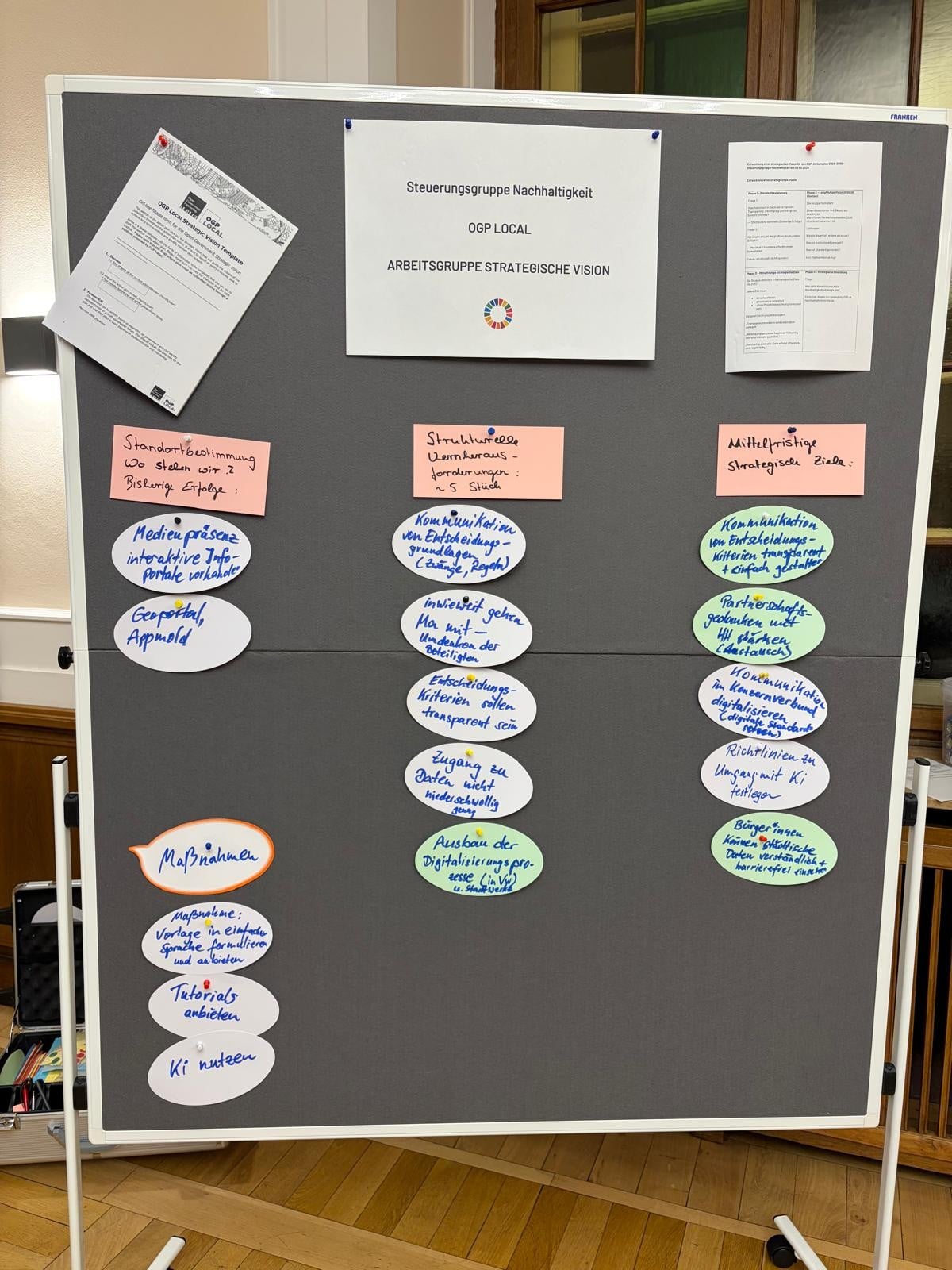
Detmold is establishing itself as a municipality in which relevant climate, budget, and decision-making data is made available in an open, understandable, and reusable format as standard, and citizens are systematically involved in planning and monitoring through digital and analog participation formats. Integrity, transparencyAccording to OGP’s Articles of Governance, transparency occurs when “government-held information (including on activities and decisions) is open, comprehensive, timely, freely available to the public,... More, and accountability are ensured through clear rules, open registers, and regular reports, resulting in a measurable increase in trust in administration and politics.
What are the achievements in open government to date (for example, recent open government reforms)?
- Establishment of a sustainability steering group as a permanent platform between administration, politics, and civil society.
- Initial experience with indicator-based climate and budget reporting and participation formats; Detmold 2035 as an implementation alliance to reach climate neutrality in 2035
- Development of a toolbox for outreach and citizen participationAccording to OGP’s Articles of Governance, citizen participation occurs when “governments seek to mobilize citizens to engage in public debate, provide input, and make contributions that lead to more ... More
- Future use of a data platform (Urban Stack) as a digital ecosystem for analyzing, visualizing, and cross-referencing urban data
What are the current challenges/areas for improvement in open government that the jurisdiction wishes to tackle?
Progress towards climate neutrality has so far been limited in terms of transparency, comparability, and digital accessibility for citizens.
Opportunities for participation are sporadic, do not reach all population groups, and have so far been linked to open dataBy opening up data and making it sharable and reusable, governments can enable informed debate, better decision making, and the development of innovative new services. Technical specifications: Polici... and digital governanceAs evolving technologies present new opportunities for governments and citizens to advance openness and accountability, OGP participating governments are working to create policies that deal with the ... More to a limited extent.
InclusionOGP participating governments are working to create governments that truly serve all people. Commitments in this area may address persons with disabilities, women and girls, lesbian, gay, bisexual, tr... More and the right to information: political decisions are not always transparent, easily accessible, or available in simple language.
What are the medium-term open government goals that the government wants to achieve?
Climate: By 2030, targets, measures, and progress toward municipal climate neutrality will be displayed in a publicly accessible, digital climate dashboard with clear indicators.
Participation: By 2030, binding standards for citizen participation will be in place, combining both in-person and digital formats as well as low-threshold offerings for underrepresented groups and youth.
Right to information: By 2030, the most important political decisions will be accessible, comprehensible, and presented in simple language.
How does this action plan contribute to achieve the Open Government Strategic Vision?
This action plan translates the strategic vision into concrete commitments that improve the transparency, accessibility, and usability of municipal decisions. It pilots digital participationMany governments are creating online mechanisms for citizens to petition, call for action, and participate in making decisions on issues they care about. Technical specifications: Refers to public pa... More tools, strengthens inclusive formats in easy language, and establishes clear rules and indicators for citizen participation. In addition, the plan links climate, budget, and participation processes, so that climate neutrality pathways, investments, and social impacts become comparable and reviewable for all residents, especially for young people.
How does the open government strategic vision contribute to the accomplishment of the current administration’s overall policy goals?
The open government strategic vision supports the administration’s goals of climate neutrality, social cohesion and digital transformationGovernments are working to increase access to and quality of government services, improve transparency, and create opportunities for participation by using information and communications technologies.... More by embedding participation, transparency and accountability into day‑to‑day governance. Open, comprehensible information and inclusive formats enable more informed political decisions, strengthen trust in local democracy and help to align administrative action with the needs and ideas of Detmold’s diverse urban society. In this way, open government becomes a core approach for implementing key strategies such as the city’s sustainability agenda.
Engagement and Coordination in the Open Government Strategic Vision and OGP Action Plan
Please list the lead institutions responsible for the implementation of this OGP action plan.
- City Administration, Team Sustainability
- City Administration, Team Youth
- City Administration, Team Public Affairs
What kind of institutional arrangements are in place to coordinate between government agencies and departments to implement the OGP action plan?
Multi-stakeholder governance: The Sustainability Steering Group acts as a central coordinating body in which administration, politics, civil society, and other partners jointly develop commitments, evaluate progress, and make adjustments.
Regular meetings, thematic round tables (e.g., climate/right to information), online consultations, and public reports as an integral part of the OGP process.
What kind of spaces have you used or created to enable the collaboration between government and civil society in the co-creation and implementation of this action plan? Mention both offline and online spaces.
We used regular meetings of the Sustainability Steering Group, thematic workshops and public events at city venues as key offline spaces for co‑creation. In addition, we relied on the municipal website, online surveys and videoconferences to collect ideas, share documents and make draft texts available for comment.
What measures did you take to ensure diversity of representation (including vulnerable or marginalized populations) in these spaces?
To ensure diverse representation, we invited a broad range of organizations and explicitly addressed youth, migrant and disability stakeholders through targeted outreach. Meetings were held at accessible locations, offered in plain language where possible and complemented by low‑threshold digital formats so that people with limited time, mobility or language skills could still participate.
Who participated in these spaces?
Participants included representatives from city administration and politics, civil society organizations, neighborhood and climate initiatives, youth representatives and educational institutions. The Committee for Equal Chances and Integration also participated in the co-creation processCollaboration between government, civil society and other stakeholders (e.g., citizens, academics, private sector) is at the heart of the OGP process. Participating governments must ensure that a dive...
How many groups participated in these spaces?
3
How many public-facing meetings were held in the co-creation process?
1
How will government and non-governmental stakeholders continue to collaborate through the implementation of the action plan?
During implementation, the Sustainability Steering Group will meet regularly to review progress, discuss challenges and propose adjustments to the commitments. The city will complement these meetings with public events, online updates and consultations to gather feedback, while working groups on topics such as climate and inclusion will involve stakeholders in the design of concrete tools, standards and participation formats.
Please describe the independent Monitoring Body you have identified for this plan.
Lippe im Wandel is a civil society organization based in Detmold that promotes sustainable development, climate action, participation and social transformation. As an independent local civil society actor, it brings practical experience, local knowledge and a citizen-centered perspective to the implementation of the Detmold OGP Local Action Plan 2026–2030.
Within the Action Plan, Lippe im Wandel will act as an independent monitoring body, accompanying the implementation of the commitments from a civil society perspective. Its role is to regularly review progress, assess whether agreed activities and milestones are being implemented, and identify challenges, delays or gaps.
The monitoring will also assess whether implementation remains aligned with the principles of open government, particularly transparency, participation, inclusion and accountability. Lippe im Wandel may provide feedback and recommendations to the City of Detmold and relevant stakeholders and, where appropriate, communicate monitoring results publicly.
By involving an independent civil society organization, Detmold strengthens transparency and accountability in the implementation of its OGP commitments. Lippe im Wandel’s monitoring role supports co-creation, mutual accountability and continuous learning throughout the 2026–2030 implementation period.
Provide the contact details for the independent monitoring body.
- Dr. Manuel Zimmer, Dr., [email protected]
What types of activities will you have in place to discuss progress on commitments with stakeholders?
We will use regular Sustainability Steering Group meetings, thematic working sessions, and public events to review progress on commitments. In addition, we plan online updates and short feedback surveys to collect stakeholder views on implementation challenges and necessary adjustments.
How will you regularly check in on progress with implementing agencies?
The coordinating units in the city administration will organize periodic check‑ins with the responsible departments using brief progress reports and indicator overviews. These check‑ins will focus on timelines, resource needs, and possible support from other units or external partners.
How will you share the results of your monitoring efforts with the public?
Monitoring results will be summarized in easily understandable progress reports and published on the municipal website and relevant online portals. Where possible, data and indicators will be visualized on dashboards and presented at public events or committee meetings to allow discussion and follow‑up questions.
Endorsement from Non-Governmental Stakeholders
- Paul Kirchgässner, Sparkasse Paderborn-Detmold-Höxter, Bank of Detmold
- Anika Hendricks, Lippe im Wandel e.V., civil society association
- Eva Ellminger, , Stadtwerke Detmold GmbH, Detmold public utilities
- Andreas Schmidt, Social democratic party
- Steven Förster, Christ democratic party
- Uta Bellion, Green Party
Leave a Reply