Canada Results Report 2022-2024
- Action Plan: Canada Action Plan 2022-2024
- Dates Under Review: 2022-2024
- Report Publication Year: 2025
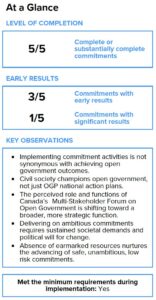
Canada’s 2022–2024 National Action PlanAction plans are at the core of a government’s participation in OGP. They are the product of a co-creation process in which government and civil society jointly develop commitments to open government ... (NAP) delivered early resultsEarly results refer to concrete changes in government practice related to transparency, citizen participation, and/or public accountability as a result of a commitment’s implementation. OGP’s Independ... More, particularly across fiscal transparencyAccording to OGP’s Articles of Governance, transparency occurs when “government-held information (including on activities and decisions) is open, comprehensive, timely, freely available to the public,... More and justiceTo address barriers that prevent citizens from having their justice needs met, OGP participating governments are working to expand transparency, accountability, and inclusion into all systems of justi... reform. Ninety-eight of the 106 activities were either completed or showed substantial progress in their implementation. However, the co-creation and implementation processes revealed opportunities to strengthen civil society engagement and high-level political ownership.
Implementation
Canada’s fifth national action plan delivered early results in three commitments.
The two commitments identified in the Action Plan Review as promising – fiscal, financial, and corporate transparency, and justice – saw the most progress.
The fiscal, financial, and corporate transparency commitmentOGP commitments are promises for reform co-created by governments and civil society and submitted as part of an action plan. Commitments typically include a description of the problem, concrete action... saw the enacting of legislationCreating and passing legislation is one of the most effective ways of ensuring open government reforms have long-lasting effects on government practices. Technical specifications: Act of creating or r... implementing a national, public, and searchable registry of information about beneficial owners of federal corporations. The justice commitment saw the implementation of important foundational work in promoting transparency in the Royal Canadian Mountain Police (RCMP), the country’s national police force. Meanwhile, the open dataBy opening up data and making it sharable and reusable, governments can enable informed debate, better decision making, and the development of innovative new services. Technical specifications: Polici... commitment saw moderate early results.
The three commitments recording progress covered distinct areas. Two commitments shared the common characteristic of building upon commitments from prior action plans. This was the fifth consecutive NAP involving a commitment focusing on making government data easier to access and use, with much weight placed upon delivering information, reports, and analyses, facilitating user engagement with data and information, and managing data standards. It was also the third NAP that included a commitment on fiscal, financial, and corporate transparency. The progress it recorded in the current NAP marked the culmination of work carried out in the 2016–2018 and 2018–2021 action plans, combined with domestic and international political pressure and the political will to enact change. Under the justice theme, police reform was the most notable element with foundational progress also resulting from domestic political pressure and political will.
Eighty-three of the action plan’s 106 activities were completed.[1] This level of progress parallels that which was achieved for Canada’s third (2016–2018)[2] and fourth (2018–2021)[3] NAPs. However, as with previous action plans, there remained a tendency to equate the implementation of activities with the achievement of intended outcomes.
Participation and Co-Creation
Prior to September 2023, responsibility for overseeing and implementing Canada’s OGP action plans fell under the remit of the Open Government Team of the Treasury Board of Canada Secretariat (TBS), with individual federal departments and agencies being responsible for delivering on the commitments and milestones. As part of an intra-departmental restructuring in the third and fourth quarters of 2023, the Open Government Team was merged with the Access to Information Policy and Performance Division (AIPPD) of the TBS.
In line with public health guidelines in force at the time, the co-creation process took place entirely through online channels between July 2021 and February 2022. The agenda for the fifth NAP was developed with limited iterative dialogue with non-government actors. During the co-creation phase, this dialogue took the form of online public consultations and requests for feedback.[4] Although the MSF was kept up to date about the implementation of commitments and provided opportunities to offer feedback, neither its civil society members nor members of the public were directly implicated in their implementation.[5]
The most notable result arising from the fifth NAP emerged in parallel with, rather than because of, its implementation. Specifically, civil society members of the MSF actively and purposefully turned their foremost attention away from matters of action plan implementation and administration, directing their efforts instead at drawing upon open government tools offered by the Organization for Economic Co-operation and Development (OECD) to advance principles they identified as necessary for ensuring the implementation of open government strategies at home that affect meaningful progress.[6] These efforts, which included publishing a policy brief titled “Success Factors For Open Government Strategies in Canada,”[7] were driven in response to the findings of an internal 2021 evaluation carried out the TBS Internal Audit and Evaluation Bureau which pointed the “need for a strong vision of open government in the Government of Canada,”[8] and by OECD recommendations calling for Canada to develop “a holistic federal open government strategy.”[9]
There was a consensus among civil society MSF members that they: (i) did not view focusing narrowly on implementing action plan commitments as particularly important to affecting meaningful open government progress in Canada; (ii) lacked sufficient knowledge about individual commitments and their intended beneficiaries to meaningfully contribute to their implementation; and (iii) did not possess the requisite skills and competencies to monitor and engage with implementing action plan commitments outside of their areas of expertise. The relative detachment of civil society members from a narrow focus on action plan commitments is similar to the experiences with previous NAPs but with one notable difference. Previously, civil society members of the MSF identified the lack of time and resources, combined with the need to start working on preparations for the next NAP, as a primary reason for their relative lack of focus on commitment implementation. Over the lifetime of the 2022–2024 NAP, civil society members viewed the implementation of action plan commitments and activities as a constituent element of advancing open government in Canada but not as the driving factor in realizing open government.[10]
Implementation in Context
Several factors hindered the implementation of Canada’s fifth NAP. The first was the global Covid-19 pandemic which reportedly delayed the start of certain commitment activities. Second, in the wake of the pandemic, budgetary constraints were imposed by the federal government in the third and fourth quarters of 2023. Among other things, these financial restrictions limited the participation of Canadian representatives in regional and international open government meetings,[11] and were tied to structural changes in government including a discontinuity in the persons holding ministerial and other senior positions. The third was the limited visibility of senior government members championing open government.[12] This has led some civil society and government MSF members to question the level of priority OGP holds for the Government of Canada.[13]
[1] “Search National Action Plan on Open Government Tracker,” Government of Canada, accessed March 2025, https://search.open.canada.ca/nap5.
[2] Michael Karanicolas, “IRM End-of-Term Report: Canada 2016-2018,” Open Government Partnership, March 2019, https://www.opengovpartnership.org/wp-content/uploads/2019/03/Canada_End-Term_Report_2016-2018_EN.pdf.
[3] Daniel J. Paré, “IRM Transitional Results Report: Canada 2018–2021,” Open Government Partnership, 1 May 2024, https://www.opengovpartnership.org/wp-content/uploads/2024/05/Canada_Transitional-Results-Report_2018-2021_EN.pdf.
[4] “What We Heard Report,” Government of Canada, 11 January 2024, https://open.canada.ca/en/content/what-we-heard-report; “Consultation Data for Canada’s 2022–24 National Action Plan (NAP) on Open Government,” Government of Canada, accessed March 2025, https://open.canada.ca/data/en/dataset/35fa8dc5-e9c5-4434-8e29-967ee9b90618.
[5] Representatives of civil society and Government of Canada, correspondence with IRM researcher, March 2025.
[6] Representatives of civil society and Government of Canada, correspondence with IRM researcher, March 2025.
[7] Civil Society Members of Canada’s Multi-Stakeholder Forum on Open Government, “Success factors for open government strategies in Canada – A policy brief,” Morris J. Wosk Centre for Dialogue, 10 March 2025, https://www.sfu.ca/content/dam/sfu/dialogue/ImagesAndFiles/KnowledgePractice/StrengtheningCanadianDemocracy/SuccessFactorsforOpenGovernment-20250314.pdf.
[8] Internal Audit and Evaluation Bureau, “Evaluation of the Open Government Program,” Treasury Board of Canada Secretariat, 7 June 2021, https://www.canada.ca/en/treasury-board-secretariat/corporate/reports/evaluation-open-government-program.html.
[9] “Open Government Scan of Canada: Designing and implementing an open government strategy,” Organization for Economic Co-operation and Development, 27 February 2023, https://www.oecd.org/en/publications/open-government-scan-of-canada_1290a7ef-en/full-report/component-3.html#section-d1e124-0d7fc61da4.
[10] Representatives of civil society and Government of Canada, correspondence with IRM researcher, March 2025.
[11] For example, no Government of Canada representatives attended OGP’s América Abierta (Open Americas) meeting in Brasilia, Brazil (December 2024) or the OECD Open Government Working Party meeting in Seoul, Republic of Korea (September 2024). Government representatives did attend the OGP Global Summit in Tallinn, Estonia (September 2023), the 9th Meeting of OECD Expert Group on Open Government Data, and the 10th Meeting of the Expert Group on Open Government Data in Paris, France (October 2024).
[12] Representatives of civil society and Government of Canada, correspondence with IRM researcher, March 2025.
[13] Representatives of civil society and Government of Canada, correspondence with IRM researcher, March 2025.
Leave a Reply