End of Commitment Report – Introduction of an interactive budget. Increasing the transparency of the community budget on the principle of
- Action Plan: Action plan – Gyumri, Armenia, 2021 – 2026
Overview
Name of Evaluator
Arpine Hakobyan (“NGO Center” civil society development NGO)
[email protected]; [email protected]
Member Name
Gyumri, Armenia
Action PlanAction plans are at the core of a government’s participation in OGP. They are the product of a co-creation process in which government and civil society jointly develop commitments to open government ... Title
Action plan – Gyumri, Armenia, 2021 – 2026
CommitmentOGP commitments are promises for reform co-created by governments and civil society and submitted as part of an action plan. Commitments typically include a description of the problem, concrete action...
Introduction of an interactive budget. Increasing the transparencyAccording to OGP’s Articles of Governance, transparency occurs when “government-held information (including on activities and decisions) is open, comprehensive, timely, freely available to the public,... More of the community budget on the principle of
Title
Introduction of an interactive budget. Increasing the transparency of the community budget on the principle of “open data”.
Action
The introduction of an electronic “interactive budget” system will enable not only the expenditure part to show in an interactive way, but also the actual revenues according to the sources of production. Using the appropriate improved tools to search for specific data (e.g. distribution of budget expenditures within the community, etc.), also makes the information available to the user for further processing (Machine-readable). It will ensure the availability of access to information on the budgets of Gyumri and Vanadzor communities, will improve the transparency of information on actual budget expenditures and revenues collected.
Problem
Currently, citizens of communities have the opportunity to become familiar with the structure of the Community Budget of the Vanadzor and Gyumri and the estimated and actual expenditures.The disadvantage of the system is that even though it provides users with the above-mentioned information on the Communities Budget, it is not built upon the “open data” principles. The system does not provide users with an opportunity to download the information and process it for own purposes.
Section 1.
Commitment completion
1.1 What was the overall level of progress in the commitment implementation at the time of this assessment?
complete
Provide a brief explanation of your answer:
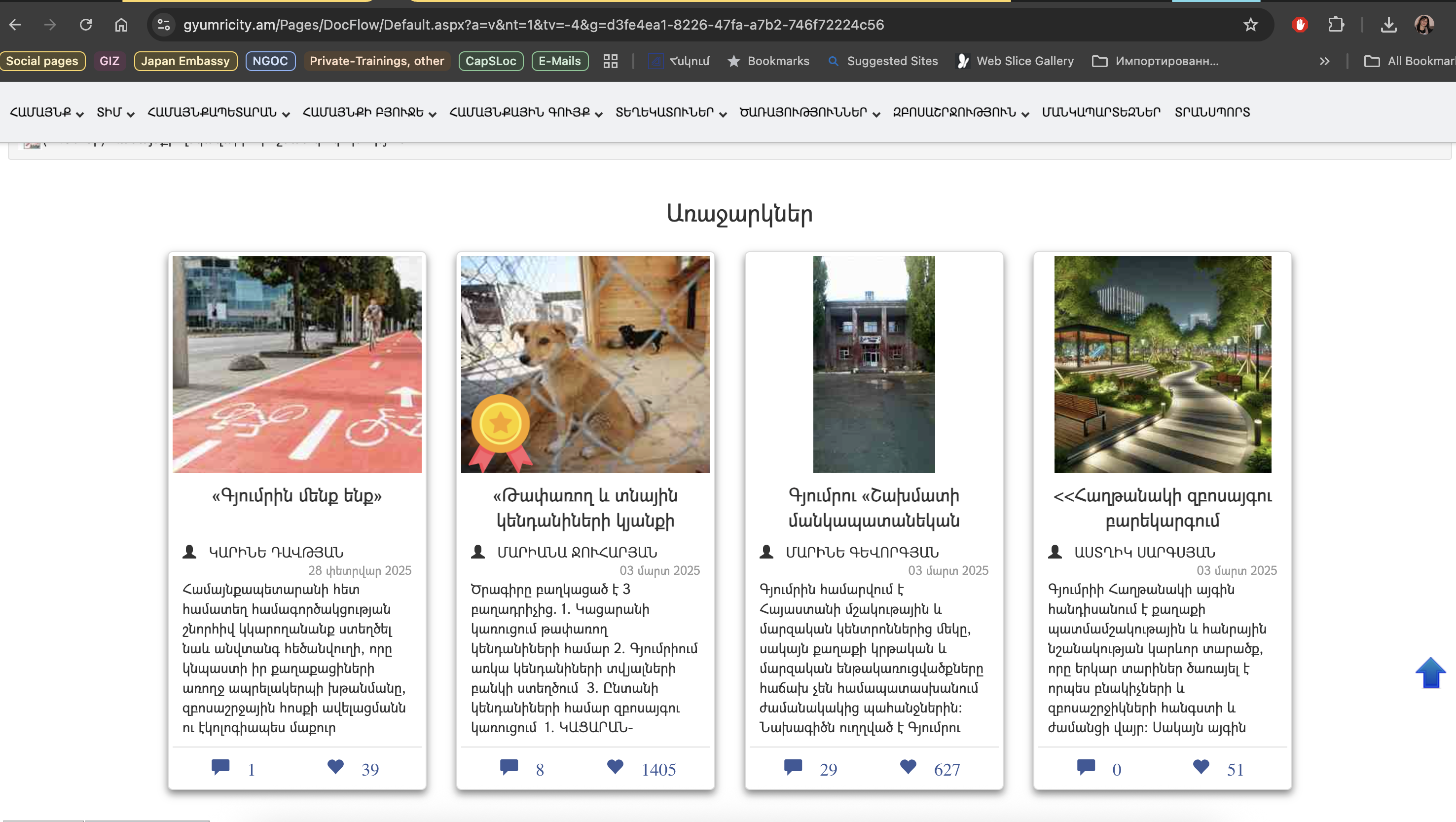
Gyumri Municipality officially committed to participatory budgeting in 2021 but did not allocate funds in the local budget until 2024. Gyumri voluntarily joined the nationwide participatory budgeting initiative in 2024, allocating around €15,000 from the municipal budget. Sixteen proposals were submitted by residents, of which eight met the criteria and were presented for a public vote. The winning project, proposed by the “Araks” NGO, was the construction of a playground in the Mush district. In 2025, six new proposals were submitted, three of which overlapped and were merged, resulting in four projects presented to the vote. The winner was “Improving the Quality of Life for Stray and Domestic Animals,” which included creating a shelter for stray dogs, building a pet park, and introducing an animal registration system. Unlike 2024, this project was financed not only by the municipal budget but also supported by a state subsidy.
Provide evidence that supports and justifies your answer:
Community Comm Decision.pdf
Links Participatory Budget Gyumri.docx
Approval of the Application by the RA Territorial Administration and Infrastructure.docx
1.2 Describe the main external or internal factors that impacted implementation of this commitment and how they were addressed (or not).
Several internal and external factors influenced the implementation of participatory budgeting in Gyumri. Political instability played a major role: in October 2024, the mayor and council members resigned, leaving an institutional gap. The acting mayor, appointed in December, did not receive full information about ongoing obligations, and even the deputy mayor admitted she was unaware of the commitments related to participatory budgeting. This lack of continuity slowed momentum until April 2025, when stable leadership was finally restored.
Citizen skepticism was another barrier. Many residents distrusted the online voting system, which required entering personal data, and were hesitant to engage. A municipal employee noted that people do not yet have the culture of believing their vote directly shapes the budget. For those with limited digital literacy, the registration process was especially difficult. Volunteers and NGOs provided support, but long-term improvements such as simpler registration and stronger data protection are needed to build trust and participation.
At the same time, the active involvement of civil society ensured higher accountability. The “Araks” NGO played a central role in 2024, both as a project initiator and watchdog. When a newly installed playground slide was found unsafe, the NGO formally requested corrections, ensuring adherence to safety standards. Such interventions demonstrated how CSOs can guarantee quality outcomes.
In 2025, the winning project “Improving the Quality of Life for Stray and Domestic Animals” expanded the scope of participatory budgeting. It introduced a shelter, a pet park, and an animal registration system, and was co-financed by municipal and state resources. This showed that participatory budgeting can mobilize multiple funding sources and strengthen sustainability. According to a CSO representative, this is one of the few mechanisms where all citizens can propose initiatives, regardless of status.
1.3 Was the commitment implemented as originally planned?
The commitment implemented was completely different from the plan
Provide a brief explanation of your answer:
The commitment was not implemented as originally planned. Gyumri had pledged to introduce an “interactive budget” aimed at improving transparency through open dataBy opening up data and making it sharable and reusable, governments can enable informed debate, better decision making, and the development of innovative new services. Technical specifications: Polici... publication, but instead, the municipality joined the nationwide participatory budgeting process in 2024. This shift changed the focus from passive access to information toward active citizen participationAccording to OGP’s Articles of Governance, citizen participation occurs when “governments seek to mobilize citizens to engage in public debate, provide input, and make contributions that lead to more ... More. Residents could propose projects, vote online, and monitor implementation. In 2024, the “Araks” NGO initiated and supervised the Mush playground project, ensuring accountability. In 2025, citizens supported a multi-component project on improving the quality of life for stray and domestic animals, co-financed by municipal and state budgets. The transition thus moved from transparency to co-decision-making, making the process more inclusive and impactful, though different from the initial design.
Provide evidence for your answer:
Community Comm. Decision1.pdf
Links Participatory Budget Gyumri1.docx
Participatory Budgeting Guide1.docx
Section 2.
Did it open government?
2.1.1. – Did the government disclose more information; improve the quality of the information (new or existing); improve the value of the information; improve the channels to disclose or request information or improve accessibility to information?
Yes
Degree of result:
Outstanding
Explanation: In narrative form, what has been the impact on people or practice.
The participatory budgeting process in Gyumri significantly improved access to information by providing detailed project descriptions, eligibility criteria, submission procedures, and voting deadlines. Residents were informed through public announcements and guidance from municipal staff. In 2024, sixteen proposals were submitted, eight of which met the criteria and were presented for public voting. The winning project, a playground in the Mush district, was implemented by the municipality. In 2025, six proposals were submitted, three of which were merged, and four proceeded to voting. The winning project, “Improving the Quality of Life for Stray and Domestic Animals,” received municipal funding and state subsidies. Information transparency allowed residents to track which projects were considered and how decisions were made, fostering trust despite challenges from political instability and leadership changes in 2024–2025.
Provide evidence for your answer:
Approval of the Application by the RA Territorial Administration and Infrastructure1.docx
Community-comm.-decision2.pdf
Links Participatory budget Gyumri2.docx
2.1.2. – Did the government create new opportunities to seek feedback from citizens/enable participation inform or influence decisions; improve existing channels or spaces to seek feedback from citizens/enable participation/ inform or influence decisions; create or improve capabilities in the government or the public aimed to improve how the government seeks feedback from citizens/enables participation/ or allows for the public to inform or influence decisions?
Yes
Degree of result:
Outstanding
Explanation: In narrative form, what has been the impact on people or practice.
Residents actively submitted proposals, participated in public voting, and monitored project implementation. In 2024, the process included sixteen project submissions, with eight proceeding to public voting. The winning Mush playground project was implemented with continuous oversight by “Araks” NGO, which ensured quality standards and addressed design issues, such as slide slope adjustments. In 2025, six new proposals were submitted, merged into four, and voted on by residents. The winning “Improving the Quality of Life for Stray and Domestic Animals” project demonstrates the expanded scope and inclusivity of the process. CSO representatives emphasized that “Participatory budgeting is one of the rare cases when everyone at the same level can submit proposals; it is a very effective mechanism of citizen engagement. Gyumri is solving a very serious problem through participatory budgeting.”
Provide evidence for your answer:
Approval of the Application by the RA-Territorial Administration and Infrastructure2.docx
Focus Group Gyumri Participant list9.pdf
Links Participatory Budget Gyumri3.docx
2.1.3 Did the government create or improve channels, opportunities or capabilities to hold officials answerable to their actions?
Yes
Degree of result:
Marginal
Explanation: In narrative form, what has been the impact on people or practice.
Citizen participation in proposal submission, voting, and project monitoring has introduced some accountability in municipal decision-making. Residents could observe the selection and implementation of projects such as the Mush playground (2024) and the 2025 animal welfare project. CSOs, particularly the “Araks” NGO, played a critical role in oversight, raising issues like the non-compliant playground slide and ensuring corrective action. However, technical challenges, including the need for residents to submit personal data for online voting and widespread distrust of the system, limited participation and reduced the overall accountability effect. Many residents lack a culture of understanding that their vote directly impacts budget allocation, which constrains the potential of holding officials fully accountable.
Provide evidence for your answer:
Schedule.pdf
PB Gyumri Voting.png
Links Participatory budget Gyumri4.docx
2.1.4 Other Results
Not Applicable
2.2 Did the commitment address the public policy problem that it intended to address as described in the action plan?
Yes
Provide a brief explanation of your answer:
Participatory budgeting in Gyumri directly addressed municipal transparency and citizen participation. Residents had the opportunity to submit proposals, vote on municipal spending, and monitor implementation. The 2024 Mush playground project demonstrates tangible outcomes. The process included active CSO oversight, ensuring fairness and transparency. Despite initial political instability and technical challenges, participatory budgeting improved inclusivity, strengthened public trust, and allowed citizens to influence budgetary priorities.
Provide evidence for your answer:
Section 3.
Lessons from
implementation
3. Provide at least one lesson or reflection relating to the implementation of this commitment. It can be the identification of key barriers to implementation, an unexpected help/hindrance, recommendations for future commitments, or if the commitment should be taken forward to the next action plan.
The implementation of participatory budgeting in Gyumri revealed several important lessons about sustaining citizen engagement and institutional continuity at the local level.
A key barrier was the lack of institutional memory within the municipality. Leadership changes in late 2024 disrupted the process and showed that commitments relying heavily on individual champions can lose momentum when political transitions occur. Future action plans should include formal documentation, staff training, and handover mechanisms to safeguard continuity and ensure that participatory processes are embedded institutionally rather than dependent on specific officials.
Another major lesson concerned citizen trust and digital inclusionPrioritizing digital inclusion — such as by expanding broadband access to remote areas or removing barriers to affordable internet — helps ensure all citizens have the opportunity to participate. Tec... More. While participatory budgeting opened new channels for engagement, skepticism toward online voting and low digital literacy limited participation, especially among older or less-connected residents. Building confidence through awareness campaigns, offline voting alternatives, and stronger data-protection assurances would broaden inclusionOGP participating governments are working to create governments that truly serve all people. Commitments in this area may address persons with disabilities, women and girls, lesbian, gay, bisexual, tr... More and legitimacy.
The active involvement of civil society organizations, notably “Araks” NGO, proved essential for accountability and quality assurance. Their role in monitoring implementation demonstrated that CSOs can serve as both partners and watchdogs, ensuring transparency and adherence to standards. Institutionalizing CSO participation in future cycles could strengthen oversight and sustainability.
Overall, Gyumri’s experience shows that participatory budgeting can successfully move from transparency to co-decision-making, but it requires stable leadership, inclusive participation mechanisms, and structured collaboration between authorities and civil society to ensure long-term impact.
Leave a Reply