
Inception Report – Action plan – Dar Chaabane El Fehri, Tunisia, 2024 – 2027
Overview
Name of Evaluator
Ahmed Gorrab
Member Name
Dar Chaabane El Fehri, Tunisia
Action PlanAction plans are at the core of a government’s participation in OGP. They are the product of a co-creation process in which government and civil society jointly develop commitments to open government ... Title
Action plan – Dar Chaabane El Fehri, Tunisia, 2024 – 2027
Section 1.
Compliance with
co-creation requirements
1.1 Does a forum exist?
Yes
Provide a brief explanation of your answer:
There is a well-established multi-stakeholder forumRegular dialogue between government and civil society is a core element of OGP participation. It builds trust, promotes joint problem-solving, and empowers civil society to influence the design, imple.... The action plan explicitly mentions the existence of a “Steering CommitteeThe Steering Committee is OGP’s executive decision-making body. Its role is to develop, promote and safeguard OGP’s values, principles and interests; establish OGP’s core ideas, policies, and rules; a...” composed of the Municipality’s Media Office (Information Office), the person in charge of municipal management, and the Tunisian Association for a Better Future. This committee has a clear governance structure and meets at least once per quarter to assess progress, communicate needs and challenges, and oversee the implementation of the OGP action plan.
Provide references here (e.g. interviews):
1.2 Is the forum multi-stakeholder?
Yes
Provide a brief explanation of your answer:
The forum is clearly multi-stakeholder. It includes government representatives (Municipality of Dar Chaâbane El Fehri, Information Office) and non-governmental representatives from civil society. The action plan lists the non-governmental organizations that approved the plan: Tunisian Association for a Better Future, Association of Environmental Lovers of Dar Chaabane El Fehri, Fawj Dar Chaabane El Fehri – Tunisian Scouts, Local Committee for Social Solidarity of Dar Chaabane El Fehri, Retirees Office of Dar Chaabane El Fehri, Has Cultural Artistic and Animation Association, City Maintenance Association of Dar Chaabane El Fehri, Yanabii Al-Khair Association (Springs of Good), UTSS, FutureMag, JCI, FNCT, ATPE, Tomouh, and NDI. These organizations cover various sectors: charitable, environmental, educational, development, youthRecognizing that investing in youth means investing in a better future, OGP participating governments are creating meaningful opportunities for youth to participate in government processes. Technical ... More, scouting, social action, retirees, cultural and artistic, urban maintenance, and citizen journalism.
Provide references here (e.g. interviews):
1.3 Does the forum hold at least one meeting with civil society and non-governmental stakeholders during the co-creation of the action plan?
Yes
Provide a brief explanation of your answer:
The co-creation processCollaboration between government, civil society and other stakeholders (e.g., citizens, academics, private sector) is at the heart of the OGP process. Participating governments must ensure that a dive... involved several meetings and consultations. The action plan indicates that 2 public meetings were organized specifically during the co-creation process. In addition, 16 different groups participated in these spaces, representing a wide diversity of actors including charitable, environmental, educational, artistic, cultural, and sports associations; youth centers; schools at different levels; national organizations; public figures; and bloggers/electronic press.
Provide references here (e.g. interviews):
1.4 Has the action plan been endorsed by the stakeholders of the forum or steering committee/group?
Yes
Provide a brief explanation of your answer:
The action plan was officially approved by the forum’s non-governmental stakeholders. The document explicitly mentions a section titled “Approval by non-governmental stakeholders,” where 10 civil society organizations formally approved the plan. An official letter of support was submitted with the action plan, demonstrating consensus and stakeholder commitmentOGP commitments are promises for reform co-created by governments and civil society and submitted as part of an action plan. Commitments typically include a description of the problem, concrete action... to the OGP Local process.
Section 2.
Recommended practices
in co-creation
2.1 Does the government maintain a Local OGP website or webpage on a government website where information on the OGP Local process (co-creation and implementation) is proactively published?
Yes
Provide a brief explanation of your answer:
The municipality maintains several active digital platforms to proactively and regularly publish information about the OGP Local process. These include:
- The municipal data portal elbaladiya.tn, which publishes all data related to the municipal budget and completed and proposed projects;
- The official municipal website to share minutes of council meetings;
- A highly active official Facebook page that livestreams municipal council sessions;
- A dedicated YouTube channel to broadcast assembly meetings;
- Electronic forms allowing citizens to submit opinions and suggestions.
The full action plan is also accessible on the official OGP website.
Provide references here (e.g. interviews):
2.2 Did the government provide information to stakeholders in advance to facilitate informed and prepared participation in the co-creation process?
Yes
Provide a brief explanation of your answer:
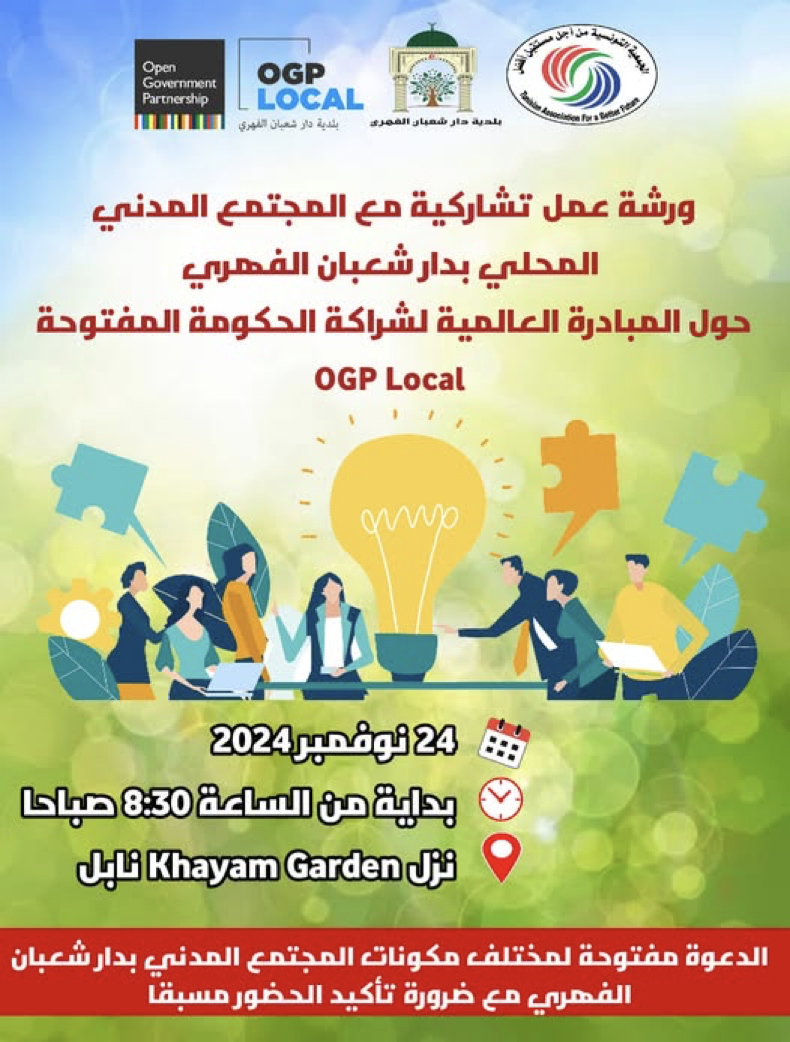
The municipality systematically provided information prior to meetings. According to available information, the municipality communicates necessary data and documents before each session through multiple channels: various communication programs (WhatsApp, email), the municipal website, social media, and particularly the official Facebook page. Official invitations are sent to all civil society organizations and relevant government bodies. In addition, comprehensive communication plans were developed to reach all groups, including banners displayed in city streets and video flashes published on official channels.
Provide evidence for your answer:
2.3 Did the government ensure that any interested member of the public could make inputs into the action plan and observe or have access to decision-making documentation?
Yes
Provide a brief explanation of your answer:
The municipality ensured full openness of the process. Several mechanisms were put in place:
- The municipality’s doors remain open to all citizen initiatives and proposals;
- The project team is open for anyone to join;
- A digital form was developed to facilitate citizen interaction and gather opinions;
- Meeting minutes are published on the official municipal website;
- Municipal council sessions are livestreamed on Facebook and YouTube, allowing public observation;
- Field campaigns were conducted in both urban and rural areas to inform about the Open Government Initiative.
The process explicitly allows participation from any interested non-governmental stakeholder.
Provide references here (e.g. interviews):
2.4 Did the government proactively report back or provide written feedback to stakeholders on how their contributions were considered during the creation of the action plan?
Yes
Provide a brief explanation of your answer:
The municipality established an active feedback system. The action plan itself demonstrates the integration of stakeholder contributions, as reflected in the section on the co-created strategic vision. The process includes:
- Electronic surveys and QR codes for data collection and satisfaction assessment;
- Use of SMS/email to respond to citizen complaints and suggestions;
- Feedback mechanisms through digital platforms;
The final action plan reflects shared ownership between government and civil society, demonstrating that contributions were effectively taken into account.
2.5 Was there an iterative dialogue and shared ownership between government and non-governmental stakeholders during the decision making process, including setting the agenda?
Yes
Provide a brief explanation of your answer:
Genuine iterative dialogue was established. The co-creation process involved:
- Two formal public meetings with stakeholders;
- Ongoing consultations via digital platforms (WhatsApp, email, Facebook);
- A multi-stakeholder steering committee including civil society members responsible for developing the action plan, organizational model, and implementation procedures;
- The establishment of an independent monitoring committee composed of representatives of associations and public figures.
The action plan explicitly states that government and civil society worked together to establish the agenda and draft the final selection of commitments. The presence of the Tunisian Association for a Better Future as a lead institution alongside the municipality demonstrates this shared ownership.
2.6 Would you consider the forum to be inclusive and diverse?
Moderately
Provide a brief explanation of your answer:
The forum demonstrates moderate to good inclusionOGP participating governments are working to create governments that truly serve all people. Commitments in this area may address persons with disabilities, women and girls, lesbian, gay, bisexual, tr... More.
Strengths:
- Participation of women’s associations and persons with disabilities explicitly mentioned;
- Strong representation of youth associations (JCI – Dar Chaabane El Fehri, Youth Center);
- Sectoral diversity: charitable, environmental, educational, artistic, cultural, sports, development associations;
- Inclusion of non-traditional actors such as bloggers and citizen journalists (FutureMag);
- Participation of schools at various levels (primary, intermediate, high schools);
- Specific campaigns conducted to reach rural and urban populations.
Areas for improvement:
Although the inclusion of women and persons with disabilities is mentioned, there are no formally guaranteed positions for these groups in the governance structure. The plan could benefit from more formalized representation of marginalized groups.
Section 3.
Initial evaluation
of commitments
1 Commitment :
Implement online mechanisms to increase participation in decision-making
1.1 Is the commitment verifiable?
Yes
Provide a brief explanation of your answer:
The commitment is verifiable with clear and measurable milestones. It includes 5 specific milestones with defined start and end dates:
- Electronic ticketing service (12/2024–12/2027);
- Activation of geographic information systems and training (01/2025–12/2027);
- Creation of a solidarity digital creation hub (01/2025–12/2027);
- Improve access to information (12/2024–12/2027);
- Improve accessibility to public buildings (03/2025–12/2027).
Each milestone represents a concrete and measurable deliverable that can be objectively verified.
1.2 Does the commitment language/activities clearly justify relevanceAccording to the OGP Articles of Governance, OGP commitments should include a clear open government lens. Specifically, they should advance at least one of the OGP values: transparency, citizen partic... to OGP values?
Yes
Provide a brief explanation of your answer:
Yes, the commitment clearly aligns with the three OGP values:
TransparencyAccording to OGP’s Articles of Governance, transparency occurs when “government-held information (including on activities and decisions) is open, comprehensive, timely, freely available to the public,... More: Improve access to information and make decision-making processes visible via online platforms;
Civic participation: Create interactive mechanisms (idea submission portals, voting mechanisms, interactive surveys, discussion forums) allowing citizens to directly contribute to decisions;
Accountability: Establish real-time feedback loops and monitoring mechanisms enabling citizens to hold the government accountable.
The commitment explicitly aims to “strengthen democratic processes with active and meaningful citizen participationAccording to OGP’s Articles of Governance, citizen participation occurs when “governments seek to mobilize citizens to engage in public debate, provide input, and make contributions that lead to more ... More” and to “create a more inclusive, transparent, and effective decision-making process.”
1.3 Please select one option that best describes the commitment:
a new regulationGovernment reformers are developing regulations that enshrine values of transparency, participation, and accountability in government practices. Technical specifications: Act of creating or reforming ..., policy, practice or requirement.
Provide a brief explanation of your answer:
This commitment represents a new practice that goes beyond existing initiatives. While the municipality had already begun using electronic forms and Facebook broadcasts since 2018, this commitment formalizes and significantly expands these efforts by creating:
- A structured electronic ticketing system;
- Geographic Information Systems (GIS) with specific training;
- A solidarity digital creation hub;
- Formal mechanisms for public building accessibility.
These elements constitute a new institutionalized approach to digital citizen participation, going well beyond previous ad hoc practices.
1.4 Please select one option that best describes the commitment:
will result in a change of the rules, practices or policies that govern a policy area, public sector and/or relationship between citizens and is binding or institutionalized across government or specific institution(s).
Provide a brief explanation of your answer:
This commitment has significant structural change potential. Expected results include:
- A fully functional online platform that will become permanent infrastructure for citizen engagement;
- Institutionalized processes for collecting and analyzing public contributions;
- More informed policy decisions systematically reflecting public needs;
- A more inclusive and responsive governance system.
The commitment explicitly aims to “strengthen democratic processes” and create “faster feedback loops,” suggesting a transformation of governance mechanisms rather than a one-time improvement. The three-year duration (2024–2027) and scope of milestones indicate intent toward institutionalization.
1.5 Are there any recommended changes to the design of the commitment to help improve its implementation?
Although well designed, improvements could strengthen implementation:
Clarify quantitative success indicators (e.g., increase citizen participation by X%);
- Allocate specific budgets and dedicated human resources per milestone;
- Establish ongoing training schedules for municipal staff;
- Integrate regular feedback mechanisms (e.g., quarterly surveys);
- Develop communication strategies to encourage adoption, especially among elderly or less digitally literate citizens;
- Establish personal data protection protocols to build citizen trust.
Foreseeable challenges:
- Digital divide;
- Budget constraints;
- Resistance to change among administrative staff;
- Need for staff and citizen training;
- Cybersecurity and data protection concerns.
2 Commitment :
Co-create and implement a sustainability program with stakeholders
2.1 Is the commitment verifiable?
Yes
Provide a brief explanation of your answer:
The commitment is verifiable. It aims to create a concrete sustainable development program with identifiable stakeholders. It is linked to climate and sustainable management, including specific actions such as the “Citizen participatory questionnaire for sustainable waste management,” which has already been published and documented. Expected deliverables include a co-created program with climate adaptation and mitigation measures and measurable awareness-raising actions. The implementation period (2024–2027) is clearly defined.
2.2 Does the commitment language/activities clearly justify relevance to OGP values?
Yes
Provide a brief explanation of your answer:
This commitment aligns with OGP values through:
Civic participation: Active involvement of citizens and environmental organizations (Association of Environmental Lovers, ATPE);
Transparency: Dissemination of climate-related information through awareness campaigns;
Accountability: Strengthening municipal responsibility in addressing environmental challenges.
The action plan states that the municipality “works hard to make its citizens resilient by raising awareness and promoting adaptation and mitigation.”
2.3 Please select one option that best describes the commitment:
a new regulation, policy, practice or requirement.
Provide a brief explanation of your answer:
This commitment represents a new integrated approach to sustainable development. Although environmental initiatives existed previously, co-creating a comprehensive sustainable development program with stakeholders—including climate adaptation and mitigation measures—constitutes a new policy. The participatory waste management questionnaire also represents a new consultation mechanism on environmental issues.
2.4 Please select one option that best describes the commitment:
is a positive change to a process, practice or policy but will not generate a binding or institutionalized change across government or specific institution(s).
Provide a brief explanation of your answer:
This commitment represents a significant positive change but lacks clear binding mechanisms. It introduces:
- A systematic participatory approach to environmental issues;
- Climate awareness programs;
- Citizen integration in sustainable planning.
However, no mandatory municipal regulations, sanctions, or formal legal changes are specified. Institutionalization could be strengthened by adopting municipal regulations on waste management or formally integrating environmental policies into official urban planning documents.
2.5 Are there any recommended changes to the design of the commitment to help improve its implementation?
Recommendations:
- Define specific measurable milestones (dates, deliverables, indicators);
- Identify priority adaptation/mitigation measures with quantified targets;
- Establish regular public consultations on environmental issues;
- Create a permanent multi-stakeholder environmental committee;
- Allocate a dedicated budget;
- Integrate monitoring and evaluation with periodic public reports;
- Consider adopting municipal regulations to institutionalize changes;
- Develop partnerships with academic or technical institutions.
Foreseeable challenges:
- Implementation costs;
- Need to change citizen behaviors;
- Coordination with regional/national authorities;
- Availability of technical expertise;
- Measuring real climate resilience impact.
Leave a Reply