
Those Who Keep Showing Up
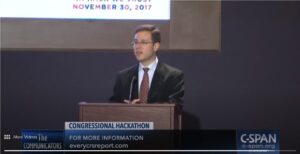
In March 2026, at the OGP’s Washington D.C. offices a short distance from the US Capitol, I met Daniel Schuman, a man who had spent fifteen years quietly transforming how Congress shares information with its own people. Although I had been leading the OGP for a year, and had been a Steering CommitteeThe Steering Committee is OGP’s executive decision-making body. Its role is to develop, promote and safeguard OGP’s values, principles and interests; establish OGP’s core ideas, policies, and rules; a... member for several years before that, I had barely heard of Dan.
But I took from my conversation with him a sense of hope, admiration and inspiration. Dan persevered in his important work despite funding pressures, political headwinds, years when progress was imperceptible and recognition absent.
Daniel Schuman and what he saw
Dan is the co-founder of the Congressional Data Coalition and founder of the American Governance Institute. He has testified before Congress dozens of times. His work has been covered by the New York Times, the Washington Post and NPR.
Dan was always interested in the machinery of how big institutions work. This led him to a job as a Congress staffer in 2001. As his career progressed, Dan looked at Congress and noticed something that was hidden in plain sight: the institution responsible for law-making in America was producing information that everyday citizens, journalists, and researchers could barely use.
Laws and bills existed alongside voting records and amendment histories. But they lived in formats designed to be displayed rather than analyzed, to be seen rather than used. People ended up doing work by hand that could be automated but wasn’t because they didn’t have
access to the data and tools. The hyperlinks on THOMAS, the site for legislative information, broke frequently, meaning links to legislationCreating and passing legislation is one of the most effective ways of ensuring open government reforms have long-lasting effects on government practices. Technical specifications: Act of creating or r... could not be shared.
When legislative data is locked away, people pay the price. The journalist cannot trace a bill’s evolution, the researcher cannot analyze voting patterns and the citizen is blind to what their representative did this week. Legislative transparencyAccording to OGP’s Articles of Governance, transparency occurs when “government-held information (including on activities and decisions) is open, comprehensive, timely, freely available to the public,... More creates the practical conditions under which citizens can hold power to account.
Dan decided that was a problem worth fixing.
“If we open up the data,” he told me, “we can address problems people haven’t thought of before. This realization was eye-opening.”
Building a congressional coalition for openness
Dan and his colleagues first organized the Congressional Data Coalition, an alliance of transparency advocates, technology companies, libraries, and research organizations. Then, through sustained advocacy, the Legislative Branch Bulk Data Task Force was created as a formal mechanism inside Congress. It later expanded and was renamed the Congressional Data Task Force.
The task force did something Washington is not always renowned for. It brought together people who had little reason to work alongside each other; House staff, Senate staff, the Library of Congress, the Government Publishing Office, civil society, into a forum where problems could be surfaced and solved practically. This became a primary vehicle for collaboration across the legislative branch.
However, resistance was real and progress was slow. The work required returning, year after year, to the same tables to push where there was an opening, and to wait when there was none. It meant dogged persistence. When decision-makers said no, Daniel and his team built the infrastructure anyway, to demonstrate the need for and power of open dataBy opening up data and making it sharable and reusable, governments can enable informed debate, better decision making, and the development of innovative new services. Technical specifications: Polici....
It worked. The result was both better data, and a new way of government and civil society working together. The website that crashed often was replaced by real time access to structured legislative data for millions of Americans. A new generation of civic tools now rests on the foundation the coalition built.
The bipartisan hackathons
The most vivid expression of this work is the Congressional Hackathon, which started in 2011 and is now in its seventh iteration. Congressional staff, technologists, and civic innovators gather in the Capitol to identify problems and propose solutions. The event is bipartisan by design and by culture made possible by the staff who dedicate time and energyEnsuring universal access to sustainable, dependable, and affordable energy is critical to every aspect of prosperity. Increasing public oversight and transparency in the energy sector can help to ens... More to make it work.
Representative Steny Hoyer, who first organized it alongside Eric Cantor in 2011, described it plainly in 2025: “The Hackathon isn’t about politics. It is about improving this institution, and its ability to serve the American people.”
In a city where almost everything is filtered through a partisan lens, that is special. The concrete results include a centralized House calendar that solved chronic scheduling conflicts, digital signatures for casework, more than 500 House websites made accessible to Americans with disabilities, and compliance scores rising from 50 to 95 percent.
The Hackathons are powered by the quarterly task force meetings that keep the momentum going. Stakeholders meet to find ways to build relationships and work with one another. The Hackathons are a highly visible manifestation of that work, an entry point for the broader public.
Dan has sustained this work through tough times, including financial pressure that would have choked many efforts, and a political environment increasingly hostile to the values this work embodies. He has stayed.
Choosing to remain at the table, even as it becomes harder, is an inspiring act of quiet courage. In his own words, “information is power, and it’s humbling to be part of a process that is part of opening up who gets access to legislative information and when.”
Change happens when we show up
At OGP, we celebrate when governments make formal commitments: when countries join, when action plans are adopted, when reform ambitions are met. That work certainly matters.
But Dan’s soft-spoken, humble narrative reminded me that open government is a deeply human story that transcends formal membership or high-level declarations. It relies on everyday people tenaciously building the infrastructure of transparency, inclusionOGP participating governments are working to create governments that truly serve all people. Commitments in this area may address persons with disabilities, women and girls, lesbian, gay, bisexual, tr... More and accountability, often with few resources and none of the recognition they deserve.
An OGP partner recently wrote about Hungary’s almost two decades of democratic backsliding, and the civil society organizations that kept going anyway: documenting corruption, building data tools that made it visible, defending civil liberties through courts growing steadily less independent. When the political moment shifted, that patient work became the foundation for
something new.
Washington and Budapest are undeniably different, but the principle holds across cities, countries and continents. Change happens because of the ones who keep showing up. Rather than wait for the perfect moment, they decide, again and again, that the work is worth continuing.
Dan Schuman decided that fifteen years ago. He keeps showing up. Millions of Americans are better for it.
Leave a Reply