
United Kingdom Results Report 2023-2025
- Action Plan: United Kingdom Action Plan 2023-2025 (December)
- Dates Under Review: 2023-2025
- Report Publication Year: 2026
The United Kingdom (UK)’s sixth national OGP action planAction plans are at the core of a government’s participation in OGP. They are the product of a co-creation process in which government and civil society jointly develop commitments to open government ... produced substantial early resultsEarly results refer to concrete changes in government practice related to transparency, citizen participation, and/or public accountability as a result of a commitment’s implementation. OGP’s Independ... More in public procurementTransparency in the procurement process can help combat corruption and waste that plagues a significant portion of public procurement budgets globally. Technical specifications: Commitments that aim t... More transparencyAccording to OGP’s Articles of Governance, transparency occurs when “government-held information (including on activities and decisions) is open, comprehensive, timely, freely available to the public,... More through the implementation of the 2023 Procurement Act. The action plan also led to improvements in the availability and usability of international aidMore and better information about aid helps partner countries and donor institutions plan and manage aid resources more effectively, parliaments and civil society to hold governments accountable for t... data. Collaboration between government and civil society continued to be strong throughout the implementation period despite institutional disruptions following the General Election in July 2024.
Implementation
The UK’s sixth national action plan (NAP6) included four commitments which were all fully or substantially co
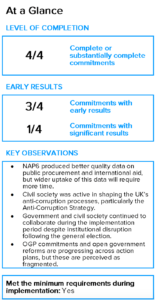
mpleted during the implementation period.
CommitmentOGP commitments are promises for reform co-created by governments and civil society and submitted as part of an action plan. Commitments typically include a description of the problem, concrete action... 1 successfully built on earlier UK commitments to advance transparency in public procurement th
rough the implementation of the Procurement Act 2023, which entered into force in February 2025. This commitment resulted in a new central platform for publishing procurement information across the contracting lifecycle and increased the volu
me and improved the structure of procurement data. It also led to new notice requirements that improve the visibility of contracting opportunities and oversight of government spending. Commitment 2 improved the quality, completeness, and regularity of UK international aid data reporting. More departments now publish aid data in standardised formats. These efforts contributed to improvements in the UK’s performance in the 2024 Aid Transparency Index and strengthened internal monitoring of aid data quality.
Commitments 3 and 4 helped to formalise civil society involvement in the UK’s domestic and international anti-corruption efforts, such as the UK Anticorruption Strategy (ACS) and in the UK’s involvement in the United Nations Co
nvention against Corruption processes. Civil society was actively engaged in anti-corruption processes during NAP6, particularly in developing and launching the ACS.
Participation and Co-Creation
Civil society and government representatives acknowledged that the co-creation processCollaboration between government, civil society and other stakeholders (e.g., citizens, academics, private sector) is at the heart of the OGP process. Participating governments must ensure that a dive... for NAP6 was an improvement compared to the previous action plan (2021-2023). The scope of NAP6 was limited to four commitments that would
be feasible to implement during the two-year implementation period. Government and civil society representatives attributed the lack of broader outreach primarily to resource constraints, insufficient time under OGP’s action plan delivery windows, as well as the resourcing and capacity limitations of the UK Open Government Civil Society Network.
Responsibility for coordinating the OGP process transitioned to the Civil Service Strategy Unit (CSSU) within the Cabinet Office in April 2025, while the government Point of Contact remained unchanged. Following the General Election in July 2024, there were institutional changes which resulted in the Multi-Stakeholder Forum (MSF) not meeting again until December 2025.[1] However, engagement continued at the level of individual commitments, where civil society organisations and policy leads met in advisory groups, thematic networks, and through direct collaboration.[2] This approach helped sustain implementation-level collaboration, but the absence of MSF meetings during this period reduced opportunities for cross-commitment learning and broader strategic dialogue.
Implementation in Context
Implementation of NAP6 took place during a period of significant institutional change. Following the 2024 general election, the change in government led to the transfer of OGP coordination responsibilities from the Central Digital and Data Office (CDDO) ultimately to the CSSU within the Cabinet Office. This transition created internal coordination and capacity challenges that contributed to the MSF being paused for 17 months, reflecting broader difficulties in re-establishing coordination under the new arrangement. The CDDO, together with the Government Digital Service, was moved to the Department for Science, Innovation and Technology as part of a machinery of government change. In the months that followed, it was agreed for the OGP remit to be returned to a suitable business unit within the Cabinet Office. Throughout this period, there was no designated ministerial lead for open government, which was deemed essential to restarting the MSF meetings due to the change of government.
At the same time, several developments during NAP6 helped institutionalise open government principles in the UK in the future. These include the development of the Civil Society Covenant in July 2025 which provides a set of principles to help build effective partnerships across civil society and government, as well as the introduction of the Public Office (Accountability) Bill to Parliament in September 2025 which will introduce a legal duty for public servants to act with candour and transparency and criminal sanctions for egregious breaches.[3] Additionally, the UK Government was elected to serve as co-chair of OGP for the period of October 2026 to September 2027, which could bring high-level political support for the open government agenda in the UK.
[1] Matthew Donnelly and Ben Gittins (Cabinet Office), interview by the IRM, 2 March 2026.
[2] Kevin Keith (UK OGN Chair), interview by the IRM, 9 March 2026.
[3] GOV.UK, “Hillsborough Law to ensure truth never concealed by state again,” press release, 15 September 2025, https://www.gov.uk/government/news/hillsborough-law-to-ensure-truth-never-concealed-by-state-again.
Leave a Reply