
Ireland Results Report 2023-2025
- Action Plan: Ireland Action Plan 2023-2025 (December)
- Dates Under Review: 2023-2025
- Report Publication Year: 2026
Ireland’s fourth action planAction plans are at the core of a government’s participation in OGP. They are the product of a co-creation process in which government and civil society jointly develop commitments to open government ... significantly improved public access to government datasets. It also began to strengthen the justiceTo address barriers that prevent citizens from having their justice needs met, OGP participating governments are working to expand transparency, accountability, and inclusion into all systems of justi... sector’s policymaking process, a national forum for government-civil society dialogue, and the diversity of candidates in local electionsImproving transparency in elections and maintaining the independence of electoral commissions is vital for promoting trust in the electoral system, preventing electoral fraud, and upholding the democr... More. Whilst civil society engagement was seen in implementation of individual commitments, oversight by the Open Government Roundtable faced limitations.
Implementation
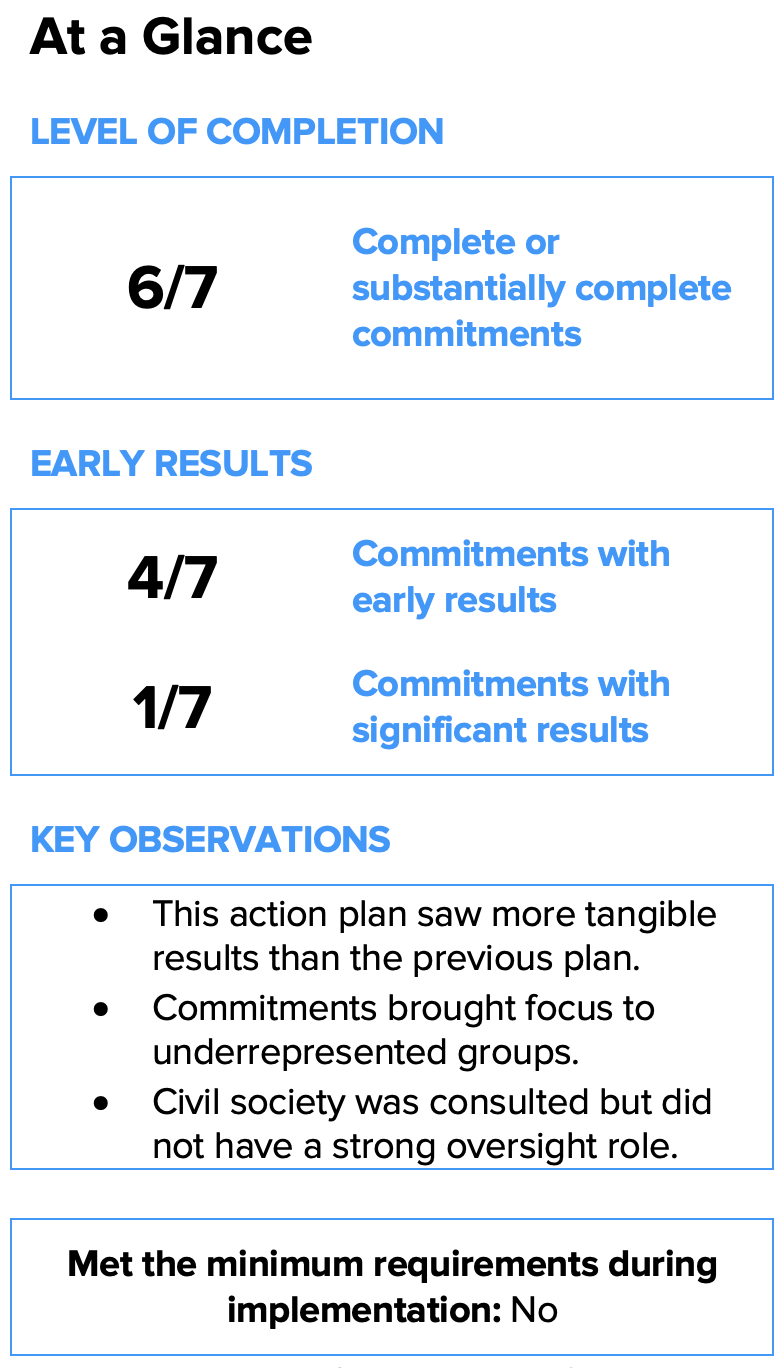
Ireland’s fourth OGP action plan had a strong implementation rate, and four of its commitments achieved early resultsEarly results refer to concrete changes in government practice related to transparency, citizen participation, and/or public accountability as a result of a commitment’s implementation. OGP’s Independ... More. CommitmentOGP commitments are promises for reform co-created by governments and civil society and submitted as part of an action plan. Commitments typically include a description of the problem, concrete action... 1 significantly strengthened public access to government data. With nearly 22 thousand datasets available by the end of 2025, many put the data to use, whether making data-based decisions on childcare funding or business planning. The commitment offered support through funding, capacity-building, and improved interoperability and publishing standards. In addition, Commitment 2 began to strengthen academics’ participation in the justice sector policymaking process, as well as usage of criminal justice data. Commitment 4 improved collaborative development of National Civic Forums, an existing venue for government-civil society dialogue. Meanwhile, Commitment 6 saw a marked increase in the number of female candidates and candidates from migrant backgrounds running for local office – although they remained underrepresented on local councils.
The other commitments addressed important policy areas but did not produce notable early results in open government. Commitment 7 completed planned efforts on domestic violence prevention, but didn’t introduce mechanisms to strengthen government transparencyAccording to OGP’s Articles of Governance, transparency occurs when “government-held information (including on activities and decisions) is open, comprehensive, timely, freely available to the public,... More, participation, or accountability. Commitments 3 and 5 were still pending by the end of the implementation period, with next steps on participation guidelines and legislationCreating and passing legislation is one of the most effective ways of ensuring open government reforms have long-lasting effects on government practices. Technical specifications: Act of creating or r... on ethics in public life expected in 2026. Overall, commitments that made the most progress were clearly scoped and aligned with existing policy frameworks, while those that stalled were more dependent on cross-government coordination or legislative processes.
Participation and Co-Creation
Ireland’s OGP process is led by the Department of Public Expenditure, Infrastructure, Public Service Reform and Digitalisation. The co-creation process included a public consultation and a series of workshops, offering structured opportunities for engagement. Some commitments included civil society directly in implementation (2, 4, and 7). A civil society stakeholder noted that broader civil society-government engagement has become more normalised over successive cycles, with increasing regularity of civil society invitations to government workshops and policy processes. The stakeholder also highlighted that a positive feature of the Irish OGP process is civil society’s access to senior civil servants.[1]
However, Open Government Roundtable oversight continued to face obstacles. Some civil society members expressed frustration with limited input into agenda-setting, the final design of certain commitments, and oversight of implementation, leading to disengagement in a few cases.[2] Like the previous cycle,[3] the Roundtable’s momentum slowed during implementation. Its schedule fell short of the OGP Participation and Co-Creation StandardsCollaboration between government, civil society and other stakeholders is at the heart of the OGP process. The Participation and Co-Creation Standards are intended to support this collaboration throug... minimum requirement to meet at least every six months – as did online updates on action plan implementation. Due to the grace period for implementing OGP’s updated Participation and Co-Creation Standards, this does not affect Ireland’s OGP status. To address recurrent challenges to engagement, Ireland could refresh the Open Government Roundtable’s role — ensuring regular meetings, joint decision-making on commitment design, and joint oversight of implementation.
Implementation in Context
The 2024 general election and subsequent change in government contributed to delays in legislative commitments. For Commitment 5 on ethics legislation, complex policy issues combined with shifting political priorities meant no legislative outputs materialised during the implementation period. For Commitment 3, the complexity of cross-departmental collaboration and internal approval processes delayed publication of the public participationGiving citizens opportunities to provide input into government decision-making leads to more effective governance, improved public service delivery, and more equitable outcomes. Technical specificatio... toolkit.
Ireland’s commitments in its OGP action plan represented a subset of the country’s wider open government efforts. Continued implementation of the Open Data Strategy 2023–2027 and alignment with EU open data requirements supported progress in transparency and data accessibility. With low levels of corruption, Ireland remained near the top of the Corruption Perceptions Index by 2025, ranked 12 of 182 countries.[4] In addition, the country’s civic space continued to be assessed as open by Civicus.[5]
[1] Johnny Sheehan (The Wheel), interview by the IRM, 8 June 2025.
[2] Shana Cohen (Think Tank for Action on Social Change), interview by the IRM, 9 March 2026; Kathryn McCabe (the Change Agency), correspondence with the IRM, 6 March 2026.
[3] “Ireland Results Report 2021–2023,” Open Government Partnership, 5 June 2024, https://www.opengovpartnership.org/documents/ireland-results-report-2021-2023/.
[4] “Corruption Perceptions Index 2025,” Transparency International, accessed 17 August 2026, https://www.transparency.org/en/cpi/2025.
[5] “Ireland,” CIVICUS, accessed 17 June 2026, https://monitor.civicus.org/country/ireland/.
Leave a Reply