
Estonia Action Plan Review 2025-2029
- Action Plan: Estonia Action Plan 2025-2029
- Dates Under Review: 2025-2029
- Report Publication Year: 2026
Estonia’s seventh action planAction plans are at the core of a government’s participation in OGP. They are the product of a co-creation process in which government and civil society jointly develop commitments to open government ... aims to develop the skills and create the infrastructure for open government. The most promising commitments seek to improve transparencyAccording to OGP’s Articles of Governance, transparency occurs when “government-held information (including on activities and decisions) is open, comprehensive, timely, freely available to the public,... More and participation in the legislative process and strengthen multi-stakeholder collaboration on open government policy. While focusing on incremental improvements to ongoing reforms is a strategic choice, reformers could use the midterm refresh to identify opportunities to deepen reforms.
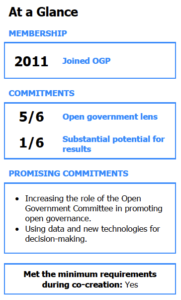 Estonia’s seventh action plan contains six commitments,[1] grouped into two broad themes.[2] It is the country’s first four-year action plan and carries forward central themes from previous action plans. The government continues to take incremental steps to strengthen policymakers’ skills in collaboration and public engagement while building digital participationMany governments are creating online mechanisms for citizens to petition, call for action, and participate in making decisions on issues they care about. Technical specifications: Refers to public pa... More and transparency tools. The action plan also introduces an expanded OGP multi-stakeholder forumRegular dialogue between government and civil society is a core element of OGP participation. It builds trust, promotes joint problem-solving, and empowers civil society to influence the design, imple... (MSF) and new requirements for the government’s legislative drafting process.
The IRM identified two promising commitments. CommitmentOGP commitments are promises for reform co-created by governments and civil society and submitted as part of an action plan. Commitments typically include a description of the problem, concrete action... 2.1 seeks government-wide adoption of a new digital co-creation environment for drafting legislationCreating and passing legislation is one of the most effective ways of ensuring open government reforms have long-lasting effects on government practices. Technical specifications: Act of creating or r... and policies, as well as expanded public access to open research and language data. The co-creation environment has been developed across three previous action plans and has now reached the stage of formal adoption by the central government. If successful, this would constitute a substantial change in public transparency and participation by offering a single platform for the public to monitor and participate in the legislative drafting process.
Commitment 1.2 seeks to reform the Open Government Development Committee (‘Avatud riigivalitsemise arengukomisjon’ or ARVAK), which also serves as Estonia’s OGP MSF. The reform aims to involve more diverse stakeholders in ARVAK’s work and strengthen its role in coordinating government-wide open government policies. As written, it promises modest advances in transparency and participation. However, the impact could be substantial if the government grants ARVAK a strong mandate and redesigns its work processes to support meaningful open government dialogue and innovation.
Other commitments assessed as having modest potential for results include Commitment 1.1, which aims to continue developing policymakers’ skills in cooperation and inclusionOGP participating governments are working to create governments that truly serve all people. Commitments in this area may address persons with disabilities, women and girls, lesbian, gay, bisexual, tr... More, and pilot new public participationGiving citizens opportunities to provide input into government decision-making leads to more effective governance, improved public service delivery, and more equitable outcomes. Technical specificatio... formats; Commitment 2.2, which aims to increase transparency in public decision-making by facilitating the submission and disclosure of lobbyingLobbying transparency allows the public to ensure that there is diversity of participation and contribution to public decision-making. Technical specifications: Policies and actions affecting lobbying... data and interest declarations and clarifying legislative drafting rules to encourage policymakers to inform the public of new policy initiatives early in the process; and Commitment 2.4, which aims to reduce public sector bureaucracy in collaboration with the private sectorGovernments are working to open private sector practices as well — including through beneficial ownership transparency, open contracting, and regulating environmental standards. Technical specificatio... More.
Estonia can take advantage of its first four-year action plan to focus on implementing ambitious and complex reforms. The OGP Point of Contact stated that the longer timeframe was chosen to allow limited staff to focus on implementation rather than co-creation and reporting.[3] While this is a strategic choice, many commitments currently advance incremental improvements to ongoing reforms. Reformers can use the midpoint refresh to identify opportunities to increase the ambitionAccording to OGP’s Articles of Governance, OGP commitments should “stretch government practice beyond its current baseline with respect to key areas of open government.” Ambition captures the potentia... of reforms in proportion to the four-year timeframe. Compared to the previous action plan (2022–2024) which was fully led by the Government Office, the current action plan involves more institutions, including different departments of the Ministry of Finance and Ministry of Economic Affairs and Communications.
The action plan co-creation process provided ample opportunities for civil society participation. These included MSF discussions, meetings of the OGP civil society roundtable,[4] a three-week online campaign to crowdsource commitment ideas, bilateral meetings between the Network of Estonian Non-Profit Organizations (NENO)[5] and the Government Office, and a full-day civil society engagement workshop in May 2025 to discuss civil society’s priorities for the new action plan.[6] According to a civil society representative, the action plan largely reflects civil society’s priorities. [7] However, they noted that civil society stakeholders would have preferred a stronger emphasis on implementing proposals from the Open Government Roadmap, a key result of the previous action plan.[8]
The Government Office and civil society also exchanged views on the inclusion of government efficiency reforms. During the final months of the co-creation process, the Government Office added several commitments that had not previously been discussed with civil society.[9] The Government Office did not accept a proposal to convene an MSF meeting to discuss these changes.[10] It did, however, hold a separate, informal meeting with the Estonian Cooperation Assembly and NENO to gather their feedback on the new commitments, and made changes to the draft action plan as a result.[11] Specifically, the Government Office removed a proposed commitment to establish performance bonuses for public officials who delivered savings in public expenditure and the bureaucracy reduction initiative (Commitment 2.4) from the list of ‘flagship projects’, replacing it with the co-creation environment (Commitment 2.1) as CSOs has suggested.[12] The Government Office noted that it also informed the MSF that none of the activities previously proposed by civil society had been withdrawn, and that the additions consisted only of government-led initiatives. Nonetheless, several activities that NENO does not consider relevant to open government remained in the published action plan.[13]
Compared with Estonia’s recent action plans, this seventh action plan contains more milestones, often managed by different departments and public officials. While wider involvement could foster broader commitment to OGP, the larger number of activities may create coordination challenges and increase the risks of fragmentation. During the midpoint refresh, the government could review the list of activities, clarify the open government lens of those that lack a public-facing element, and prioritize implementation of commitments that contribute to open government goals. For example, it could clarify how some activities—under Commitments 1.1, 2.1, and 2.4, as well as Commitment 2.3 on improving the quality of digital public services and developing the GovTech ecosystem—will promote government transparency, civic participation, or public accountability.[14]
Table 1. Promising Commitments
| Commitment 1.2 aims to expand the role of the Open Government Development Committee from a multi-stakeholder forum overseeing OGP action plans to a broad-based cooperation platform to promote and test innovative open government approaches. |
| Commitment 2.1 seeks to adopt a new digital co-creation environment for legislative drafting. It also aims to improve public access to open dataBy opening up data and making it sharable and reusable, governments can enable informed debate, better decision making, and the development of innovative new services. Technical specifications: Polici... in the areas of research and language data. |
[1] Since the six activities constitute specific lines of action and comprise 19 distinct sub-activities, this action plan review analyzes the six activities as separate commitments to allow for a more tailored analysis of each reform. The action plan defines altogether 22 milestones. Three are related to reforming the MSF (Commitment 1.2) and two to developing the GovTech ecosystem (Commitment 2.3). After clustering related activities, the milestones constitute 19 standalone activities with distinct objectives and outputs.
[2] Theme 1 (‘Commitment 1’ in the action plan) aims to foster open government skills in public administration, while Theme 2 (‘Commitment 2’ in the action plan) focuses on developing a supporting infrastructure for open government.
[3] Marten Lauri (Advisor at the Government Office & OGP Point of Contact), interview by IRM researcher, 10 March 2026.
[4] The OGP civil society roundtable is an informal network of civil society organizations interested in open government issues.
[5] NENO is Estonia’s largest civil society advocacy organization and a long-time member of Estonia’s OGP MSF.
[6] “Estonia’s Open Government Partnership Action Plan 2025–2029,” Government Office of Estonia, 15 January 2026, https://www.opengovpartnership.org/documents/estonia-action-plan-2025-2029.
[7] Marcus Ehasoo (Advocacy Lead at NENO), interview by IRM researcher, 31 March 2026.
[8] “IRM Results Report: Estonia 2022–2024,” Open Government Partnership, 4 June 2025, https://www.opengovpartnership.org/documents/estonia-results-report-2022-2024; Based on information from the MSF meeting in March 2026, the new action plan addresses seven of the 30 proposals in the roadmap, while ten have been integrated into other government processes; “ARVAKMinutes of Meeting, 11 March 2026,” ARVAK, 11 March 2026, https://dhs.riigikantselei.ee/avalikteave.nsf/documents/NT004103BA/%24file/ARVAK26P1.pdf; ARVAK meeting presentation, shared by Marten Lauri (Advisor at the Government Office & OGP Point of Contact), correspondence with IRM researcher, 24 March 2026.
[9] Ehasoo, interview; Külli Taro (Member of Supervisory Board of the Estonian Cooperation Assembly), correspondence with the Government Office, 6 November 2025.
[10] Taro, correspondence.
[11] The meeting took place on 20 November 2025, according to Marcus Ehasoo (Advocacy Lead at Network of Estonian Non-Profit Organizations), correspondence with IRM researcher, 14 April 2026; Marten Lauri, written comments during the report’s pre-publication period, 1 October 2026.
[12] Ehasoo, interview.
[13] According to NENO’s assessment, Commitments 2.3 on improving the quality of digital public services and developing the GovTech ecosystem, 2.4 on reducing government bureaucracy, and 2.1 on using data and new technologies for decision-making include milestones that do not seem to be relevant for open government.
[14] Commitments and milestones without a clear open government lens are not analyzed in depth in this review but may be revisited during the end-of-term assessment of the action plan results.
Leave a Reply