Uruguay Action Plan Review 2025-2029
- Action Plan: Uruguay Action Plan 2025-2029
- Dates Under Review: 2025-2029
- Report Publication Year: 2026
The sixth action planAction plans are at the core of a government’s participation in OGP. They are the product of a co-creation process in which government and civil society jointly develop commitments to open government ... consolidates the Open State approach and is the result of a robust co-creation processCollaboration between government, civil society and other stakeholders (e.g., citizens, academics, private sector) is at the heart of the OGP process. Participating governments must ensure that a dive... involving the three branches of government and civil society organizations. Notable highlights include advancements in institutional capacities and new thematic areas. For the mid-term review, it would be beneficial to promote the active use of open dataBy opening up data and making it sharable and reusable, governments can enable informed debate, better decision making, and the development of innovative new services. Technical specifications: Polici... and explore the coordination of complementary commitments to maximize their impact.
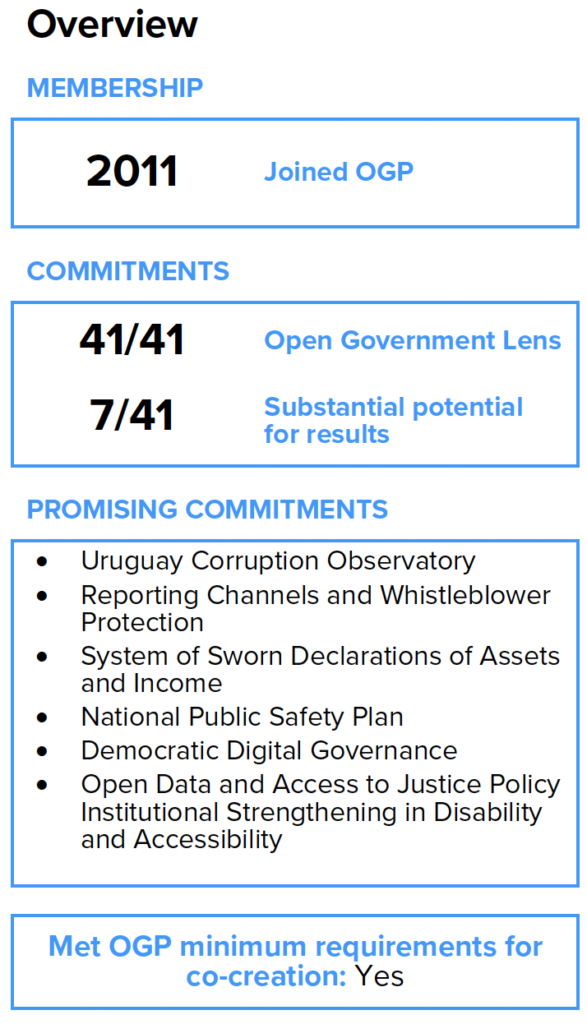
For its sixth action plan, Uruguay opted for a four-year timeframe (2025–2029), comprising 41 commitments grouped into nine lines of action. The plan introduces new thematic areas such as public security, housing, consumer prices, community broadcasting, culture, and issues concerning children and adolescents.
Additionally, it maintains an Open State approach, including commitments from all three branches of government. Four of these commitments align with the Open Parliament agenda—one led by the Senate (commitment 18) and three jointly implemented by the House of Representatives and the Senate (commitments 15, 16, and 17). Furthermore, the Supreme Court of Justice included an open data commitment. In some cases, commitments aim to update sector-specific plans introduced in previous cycles, such as the Gender and Climate Change Action Plan[1], the National Action Plan on Aging and Old Age[2], the National Human Rights Action Plan[3], and the Human Rights Education Plan[4]. All of these will be updated following co-creation guidelines for open government processes.
The commitments identified as promising by the IRM share a common focus on strengthening government capacities to implement public policies in key areas, such as public integrity, security, digital governanceAs evolving technologies present new opportunities for governments and citizens to advance openness and accountability, OGP participating governments are working to create policies that deal with the ... More, access to justiceAccessible justice systems – both formal and informal – ensure that individuals and communities with legal needs know where to go for help, obtain the help they need, and move through a system that of... More, and the rights of vulnerable groups. Particularly noteworthy are the commitments linked to strengthening the anti-corruption ecosystem. These include the Corruption Observatory (commitmentOGP commitments are promises for reform co-created by governments and civil society and submitted as part of an action plan. Commitments typically include a description of the problem, concrete action... 1), reporting channels (commitment 4), and the system of sworn asset declarations (commitment 5), as well as initiatives focused on public safety (commitment 10), digital governance (commitment 19), access to justiceTo address barriers that prevent citizens from having their justice needs met, OGP participating governments are working to expand transparency, accountability, and inclusion into all systems of justi... (commitment 28), and disability and accessibility (commitment 29), which collectively hold significant potential for generating sustained institutional changes.
The commitments identified as promising by the IRM share a common focus on strengthening government capacities to implement public policies in key areas, such as public integrity, security, digital governance, access to justice, and the rights of vulnerable groups. Particularly noteworthy are the commitments linked to strengthening the anti-corruption ecosystem.
These include the Corruption Observatory (commitment 1), reporting channels (commitment 4), and the system of sworn asset declarations (commitment 5), as well as initiatives focused on public safety (commitment 10), digital governance (commitment 19), access to justice (commitment 28), and disability and accessibility (commitment 29), which collectively hold significant potential for generating sustained institutional changes.
In the case of commitment 10, the proposal sets out an ambitious strategy, with a 10-year outlook, to address the safety and security challenges facing the country—one of the main concerns among citizens[5].
The Open Government Working Group led the plan’s co-creation process. Civil society organizations consulted by the IRM highlight the role of the Agency for Electronic Government and Information and Knowledge Society (Agesic) as the process lead[6]. For this cycle, Agesic faced the challenge of operationalizing co-creation in record time and with new government stakeholders, which was due to the consensus decision to draft the plan once the new government took office. As Agesic representatives explained, the strategy included a preliminary identification of thematic areas that guided the co-creation process after the new administration assumed power. The continuity of technical teams with knowledge of open government processes and the new administration’s commitment to OGP also contributed to this effort[7].
According to the action plan, 17 of the 41 commitments represent initiatives proposed fully or partially by civil society organizations that participated in the co-creation rounds. The Digital Citizen ParticipationAccording to OGP’s Articles of Governance, citizen participation occurs when “governments seek to mobilize citizens to engage in public debate, provide input, and make contributions that lead to more ... More Platform was the tool used to gather commitment proposals and to conduct consultations on those being considered for inclusionOGP participating governments are working to create governments that truly serve all people. Commitments in this area may address persons with disabilities, women and girls, lesbian, gay, bisexual, tr... More in the action plan.
While civil society organization participation in the co-creation process may appear limited based on the number of organizations involved, this largely reflects structural characteristics of the Uruguayan context. According to the Open Government Network (RGA) [8] representative consulted by the IRM, participation in the plan does not necessarily drop due to a lack of interest, but rather due to the existence of multiple alternative avenues for advocacy and participation in public policy. In this sense, the action plan is no longer the sole available channel, which reduces its relative weight while reflecting a greater institutionalization of open government practices across other arenas[9].
From the perspective of the National Association of Non-Governmental Development Organizations (ANONG)[10], the co-creation process offers opportunities for advocacy, but also faces barriers to sustained participation. These include the need to invest unpaid time, the existence of a significant learning curve to understand open government processes, and the difficulty of engaging organizations with limited resources or technical capacity. Furthermore, while the diversity of actors has been expanding progressively, challenges remain in incorporating grassroots organizations or those with lower levels of institutionalization[11].
Other civil society and academic voices agree that while the co-creation process was viewed positively, challenges persist regarding territorial reach and the inclusion of stakeholders outside the metropolitan area. The concentration of organizations in Montevideo, combined with limitations in outreach and timely access to participatory spaces, may have influenced the composition of participants. These factors help explain the difficulties in broadening the diversity of actors involved in the process[12].
For this implementation cycle, ANONG and the RGA[13] are driving a dedicated fund aimed at strengthening the monitoring and co-implementation of commitments. This is intended to facilitate the participation of new organizations during the implementation stage and lower barriers to entry into the process.
Some of the key opportunities in implementing the plan include incorporating activities that promote data use, such as civic innovation contests, data fairs, or thematic hackathons. While the publication of information helps reduce opacity across various public policy areas, by itself, it is not always sufficient to achieve the intended changes in certain commitments.
On the other hand, it would be timely to move toward greater coordination among thematically related commitments that are currently presented in a fragmented manner. Several agencies lead commitments tied to the same public policy issue, yet these were formulated independently. In the case of public integrity, JUTEP coordinates complementary initiatives on corruption, sworn asset declarations, and reporting channels, which together form an anti-corruption ecosystem. A similar dynamic occurs in public procurementTransparency in the procurement process can help combat corruption and waste that plagues a significant portion of public procurement budgets globally. Technical specifications: Commitments that aim t... More (ARCE) and the environmental sector. Although these commitments were designed separately, inter-agency coordination could enhance their impact. For the mid-term review, consideration could be given to how to coordinate these initiatives more effectively to maximize their potential.
Table 1. Promising Commitments
| Commitment 1: Creation of the Uruguay Anti-Corruption Observatory |
| Commitment 4: Strengthening Reporting Channels and Whistleblower Protection |
| Commitment 5: Strengthening the System for Asset and Income Declarations |
| Commitment 10: Creation of the National Public Security Plan |
| Commitment 19: Establishing Democratic Digital Governance |
| Commitment 28: Institutionalization of Open Data and Access to Justice Policies |
| Commitment 29: Institutional Strengthening for the Development of Public Policies on Disability and Accessibility |
[1] Gender and Climate Change Action Plan SNRCC – 2020/2024, Ministry of Environment of Uruguay. https://www.gub.uy/ministerio-ambiente/sites/ministerio-ambiente/files/2021-10/Plan%20de%20Acción%20y%20Género%20de%20CC%20Comp.pdf
[2] National Action Plan on Aging and Old Age, Ministry of Social Development of Uruguay. https://www.redprocuidados.org.uy/wp-content/uploads/2018/10/seguimiento-2do.-plan-nacional-de-envejecimiento-y-vejez.pdf
[3] National Human Rights Action Plan, Human Rights Secretariat of Uruguay. https://www.gub.uy/secretaria-derechos-humanos/comunicacion/publicaciones/plan-nacional-derechos-humanos?utm
[4] National Human Rights Education Plan, Human Rights Secretariat of Uruguay https://www.gub.uy/secretaria-derechos-humanos/sites/secretaria-derechos-humanos/files/documentos/publicaciones/Plan%20Nacional%20de%20Educación%20en%20Derechos%20Humanos%20%283%29.pdf
[5] Daniel Carranza, Open Government Network, IRM interview, December 5, 2025
[6] Marcelo Ventos, ANONG, IRM Interview, December 2, 2025.
[7] Open Government Point of Contact and Technical Team of the Agesic Open Government Division, IRM Interview, November 21, 2025.
[8] The Open Government Network in Uruguay is a coordination space for civil society actors that brings together more than 20 organizations and participates in the co-creation, implementation, and monitoring processes of open government action plans. Its primary role is to channel contributions from civil society, promote participation in dialogue roundtables, and contribute to the definition of commitments from an independent perspective. The network is also part of the process’s governance mechanisms, collaborating continuously with state actors, particularly Agesic, in promoting transparency, participation, and accountability practices. More information: https://rga.uy/sobre-rga
[9] Daniel Carranza, Open Government Network, IRM interview, December 5, 2025
[10] The National Association of Non-Governmental Development Organizations (ANONG) is a platform uniting over 80 civil society organizations in Uruguay, aiming to strengthen their capacity for public policy advocacy and promote social development. Within the open government framework, ANONG has taken an active role in the co-creation of action plans and in promoting initiatives to broaden the participation of other organizations, including efforts focused on the monitoring and co-implementation of commitments. More information: https://www.anong.org.uy
[11] Marcelo Ventos, ANONG, IRM Interview, December 2, 2025.
[12] Ioanna Grotiuz, Latin American Center for Human Economy University (CLAEH), IRM Interview, December 4, 2025.
[13] Open Government Partnership (OGP). OGP’s Helen Darbishire Fund for Civil Society 2025-27 https://www.opengovpartnership.org/es/ogps-helen-darbishire-fund-for-civil-society-2025-27
Leave a Reply