
Armenia Results Report 2022-2024
- Action Plan: Armenia Action Plan 2022-2024 (December)
- Dates Under Review: 2022-2024
- Report Publication Year: 2022
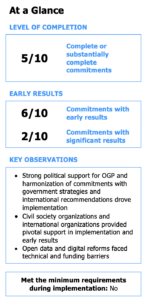
Armenia’s fifth action planAction plans are at the core of a government’s participation in OGP. They are the product of a co-creation process in which government and civil society jointly develop commitments to open government ... saw half of the commitments substantially or fully completed. Support from civil society and international organizations was key to the success of several commitments, particularly for introducing participatory budgeting in local communities. A new department in the Office of the Prime Minister will help to institutionalize the government’s future efforts towards more open and participatory governance.
 Implementation
Armenia’s fifth action plan (2022–2024) included 10 commitments, focused mostly on improving government transparencyAccording to OGP’s Articles of Governance, transparency occurs when “government-held information (including on activities and decisions) is open, comprehensive, timely, freely available to the public,... More. It introduced new commitments around government-held data, government communication, compliance with freedom of information regulations, participatory budgeting, and judicial transparency.
Six commitments showed early resultsEarly results refer to concrete changes in government practice related to transparency, citizen participation, and/or public accountability as a result of a commitment’s implementation. OGP’s Independ... More, including three identified as promising in the IRM Action Plan Review. Half of the commitments were substantially or fully completed, slightly lower than the fourth plan (2018–2020), in which seven out of 11 commitments were substantially or fully completed by the end of the implementation period. As a result of CommitmentOGP commitments are promises for reform co-created by governments and civil society and submitted as part of an action plan. Commitments typically include a description of the problem, concrete action... 5, in 21 out of Armenia’s 71 communities, the public can now participate in their community’s development by submitting project proposals and voting for their implementation by the local self-government (with funding allocated from the municipal and state budgets). Commitment 2 resulted in the establishment of the Department of Participatory and Open Governance in the Office of the Prime Minister, set up to institutionalize the government’s efforts toward open and participatory governance, including through future OGP action plans.
Many of the commitments envisaged digital platforms, such as a platform for participation in the budget processes (Commitment 4), an electronic gift registry for officials (Commitment 7), and a platform for e-procurement (Commitment 8). Some commitments failed in establishing their platforms due to technical, timing, or funding issues. However, Commitment 7 created a legal framework for registering and transferring gifts to the state, and public and internal oversight of gift restriction regulations, advancing the national anti-corruption strategy and addressing international recommendations.
Participation and Co-Creation
The Office of the Prime Minister (PMO) leads the OGP process in Armenia, with the government’s OGP point of contact coordinating activities and the Chief of Staff overseeing the process. Under Commitment 2, a Department of Participatory and Open Governance was established within the PMO to better organize and coordinate public participationGiving citizens opportunities to provide input into government decision-making leads to more effective governance, improved public service delivery, and more equitable outcomes. Technical specificatio... in an institutional manner and support OGP initiatives and other open government-related efforts.
The fifth action plan saw an active co-creation process that engaged a broad range of stakeholders through online and in-person meetings. However, participation during implementation was more limited. The government organized a public event in February 2023 to present the action plan and explore collaboration opportunities for implementation. At the end of the first year of implementation, the government amended the action plan to incorporate the feedback received from stakeholders and the IRM recommendations in the Action Plan Review.[1] The amendments provided more specific descriptions for some of the commitments, including data policy laws for Commitment 1, a new milestone on creating a participatory governance unit under Commitment 2, and a more extensive description of the e-procurement platform for Commitment 8. In August–September 2023, the amended action plan was posted on the legal draft publication (e-draft) platform for public discussion. Two online stakeholder meetings were held to report on implementation progress in mid-2023 and November 2024. At the same time, most commitments saw active engagement from civil society stakeholders (many of them supported by OGP grants), who provided public awareness-raising, analysis for draft legislationCreating and passing legislation is one of the most effective ways of ensuring open government reforms have long-lasting effects on government practices. Technical specifications: Act of creating or r..., and capacity-building. The PMO negotiated with international organizations to support OGP commitments through their cooperation with local CSOs. For example, participatory budgeting in communities (Commitment 5) benefited from strong support by international organizations and local CSOs raising awareness and providing technical assistance to municipalities.
Implementation in Context
Several domestic and international factors influenced the implementation of OGP commitments in Armenia. The displacement of the Armenian population from Nagorno-Karabakh in 2023 strained government resources and redirected attention toward humanitarian efforts. This shift in priorities delayed implementing some OGP initiatives, particularly those requiring substantial government coordination and investment. Another factor impacting the sustainability of the commitments beyond the action plan period could be the freezing of the US foreign assistance funding in early 2025, which further hindered the completionImplementers must follow through on their commitments for them to achieve impact. For each commitment, OGP’s Independent Reporting Mechanism (IRM) evaluates the degree to which the activities outlined... More of commitments reliant on external financial support. This could affect the creation of a gift register (Commitment 7) and the development of a strategic communication architecture (Commitment 2), which were unfinished at the end of the action plan period.
Additionally, broader political and institutional factors, such as government restructuring and shifting policy priorities, influenced implementation timelines. E.g., leadership changes and high staff turnover in the Ministry of JusticeTo address barriers that prevent citizens from having their justice needs met, OGP participating governments are working to expand transparency, accountability, and inclusion into all systems of justi... slowed progress on anti-corruption initiatives. Despite these challenges, the government’s commitment to advancing open and participatory governance remains evident, particularly through a dedicated department in the Office of the Prime Minister. This development offers an opportunity for Armenia to continue expanding access to information and government openness.
Leave a Reply