
Cabo Verde Results Report 2023-2025
- Action Plan: Cabo Verde Action Plan 2023-2025
- Dates Under Review: 2023-2025
- Report Publication Year: 2025
Cabo Verde advanced transparencyAccording to OGP’s Articles of Governance, transparency occurs when “government-held information (including on activities and decisions) is open, comprehensive, timely, freely available to the public,... More in the fisheries sector under their second OGP action planAction plans are at the core of a government’s participation in OGP. They are the product of a co-creation process in which government and civil society jointly develop commitments to open government .... Initial steps were also taken in increasing access to information around government spending and justiceTo address barriers that prevent citizens from having their justice needs met, OGP participating governments are working to expand transparency, accountability, and inclusion into all systems of justi... services. Implementation was inhibited by high turnover among implementers, coordination challenges, and lengthy bureaucratic processes. While Cabo Verde established a national multi-stakeholder forumRegular dialogue between government and civil society is a core element of OGP participation. It builds trust, promotes joint problem-solving, and empowers civil society to influence the design, imple..., opportunities remain to increase civil society participation.
Implementation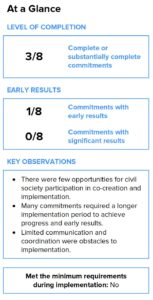
Three of the eight commitments in Cabo Verde’s second action plan were substantially or fully completed. By the end of the action plan cycle, two commitments had achieved moderate early resultsEarly results refer to concrete changes in government practice related to transparency, citizen participation, and/or public accountability as a result of a commitment’s implementation. OGP’s Independ... More in advancing government transparency. Similar to the previous plan, most commitments made incremental progress that reformers intend to continue in the next plan.
Commitment 4, aimed at making the fishing sector more transparent and inclusive by addressing information gaps, was the only one that achieved full completion and moderate early results. Going beyond the initial commitment, implementers published two Fisheries Transparency Initiative (FiTI) reports, making key information on fisheries management publicly available while engaging civil society actors and other national and international stakeholders to disseminate the information and gather feedback.[1]
Identified as promising in the Action Plan Review, commitments on open justice and open data faced lengthy bureaucracy, limited budgetary independence, institutional fragmentation, and resistance to change.[2] Modest progress was made in disseminating legal information under CommitmentOGP commitments are promises for reform co-created by governments and civil society and submitted as part of an action plan. Commitments typically include a description of the problem, concrete action... 7 and developing a fiscal transparency portal under Commitment 6. Cabo Verde has expressed a renewed commitment to achieving their open government objectives by continuing most commitments in the next plan.
Participation and Co-Creation
In the second action plan, responsibility for overseeing Cabo Verde’s OGP process was transferred to the Ministry of Modernization of the State and Public Administration (MMEAP). Importantly, the ministry established the national multi-stakeholder forum (FNM) for OGP in November 2022. The forum includes 22 government representatives alongside 1 from the private sector, 1 from academia, and 3 from civil society.[3] While the creation of the FNM marked progress, the over-representation of government actors, as highlighted in the Action Plan Review,[4] remains a challenge to inclusive participation. Limited involvement of civil society in implementing or monitoring commitments hindered meaningful contribution despite important efforts during the co-creation stage. Civil society stakeholders welcomed notable improvements during both the co-creation and implementation stages, but acknowledged that work remains to ensure that engagement with civil society is carried out on equal footing.[5] The Cabo Verde OGP Secretariat’s limited capacity also presented a challenge to their ability to provide guidance on the OGP process to implementing institutions. While Cabo Verde did not meet all the minimum requirements under the Participation and Co-Creation Standards, there are no implications as this action plan falls under a grace period.[6]
Implementation in Context
The MMEAP took responsibility of Cabo Verde’s second OGP action plan, establishing the FNM and overseeing development of the plan. However, coordination and communication waned during implementation. Several implementers cited barriers to implementation, including limited technical capacity within implementing teams and the absence of a structured monitoring mechanism.[7] These challenges were compounded by a lack of clarity regarding responsibilities for specific commitments and turnover of commitment implementers. However, a change in the MMEAP leadership in early 2025 helped to revitalize Cabo Verde’s OGP process. This was further signaled by Cabo Verde’s representation at the OGP Africa Regional Meeting in March 2025 and OGP Global Summit in Spain in October 2025.
Table 1. Commitments with Early Results
| Commitment 4: Increased transparency in fisheries management with the release of two key reports in 2023 and early 2025. |
[1] Iolanda Brites (Cabo Verde Focal Point for the Fisheries Transparency Initiative), correspondence with IRM researcher, 9 May 2025.
[2] Interviews and email correspondence with various stakeholders and commitment implementers.
[3] “Estatutos do Fórum Nacional Multissetorial para a Parceria de Governação Aberta em Cabo Verde,” [Cabo Verde’s OGP National Multistakeholder Forum Statute], Government of Cabo Verde, 15 November 2022, https://www.dropbox.com/ scl/fo/lgnhfojvi6d5u6m5v54cw/ALJqhbqJkLo3zpa2EWhxCwo/02-Steering%20Commitee_F%C3%B3rum%20Multissetorial? dl=0&preview=ESTATUTOS-DO-FOR%C3%9AM-NACIONAL-MULTILATERAL-PARA-A-OGP_15_11_2022_APROVADO.pdf&rlkey=qrq4o6uryfj3h3yoqj94p27nq&subfolder_nav_tracking=1%20.
[4] Independent Reporting Mechanism, “Action Plan Review: Cabo Verde 2023–2025,” Open Government Partnership, October 2023, https://www.opengovpartnership.org/wp-content/uploads/2023/10/Cabo-Verde_Action-Plan-Review_2023-2025_EN.pdf.
[5] Diego Alhinho (Former President of Lantuna Association Representative), interview by IRM researcher, 21 February 2025; Admilson Mendes (President of Praia Network of Community Associations and Social Movements), interview by IRM researcher, 6 May 2025.
[6] “OGP Participation and Co-Creation Standards,” Open Government Partnership, 24 November 2021, https://www.opengovpartnership.org/ogp-participation-co-creation-standards.
[7] Ricardina Lopes (National Directorate for State Modernization), correspondence with IRM researcher, 5 May 2025; João Cruz (National Director of State Modernization at the Ministry of Modernization of the State and Public Administration), correspondence with IRM researcher, 12 May 2025.
Leave a Reply