
Lithuania 2023-2025 Results Report
- Action Plan: Lithuania Action Plan 2023-2025 (December)
- Dates Under Review: 2023-2025
- Report Publication Year: 2026
Lithuania’s sixth action planAction plans are at the core of a government’s participation in OGP. They are the product of a co-creation process in which government and civil society jointly develop commitments to open government ... established a unified regulatory process for drafting legal acts across all public institutions and produced materials to help civil servants conduct effective consultation processes. While co-creation included a broader range of stakeholders compared to previous cycles, nongovernment stakeholders had limited opportunities to influence commitmentOGP commitments are promises for reform co-created by governments and civil society and submitted as part of an action plan. Commitments typically include a description of the problem, concrete action... implementation. Moving forward, there is opportunity to strengthen nongovernmental participation during implementation.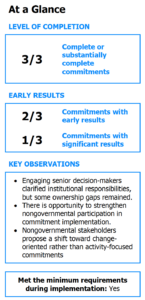
Implementation
Lithuania’s sixth action plan (2023–2025) included three commitments: establishing unified legislative standards for public involvement in the legislative process; building a customer-centric approach in the public sector; and making government decision-making more participatory at the national level. Two commitments achieved early results. Compared to previous action plans, completion levels remain similar.[1]
Commitment 1, identified as promising in the IRM Action Plan Review, had the strongest early resultsEarly results refer to concrete changes in government practice related to transparency, citizen participation, and/or public accountability as a result of a commitment’s implementation. OGP’s Independ... More. The Office of the Government and the Ministry of JusticeTo address barriers that prevent citizens from having their justice needs met, OGP participating governments are working to expand transparency, accountability, and inclusion into all systems of justi... introduced a legally binding unified legislative procedure for all ministries and subordinate bodies, addressing long-standing inconsistencies in lawmaking and strengthening the public consultation framework. The standardized framework has improved institutional coherence and legal predictability around public consultations on draft legislationCreating and passing legislation is one of the most effective ways of ensuring open government reforms have long-lasting effects on government practices. Technical specifications: Act of creating or r.... Under Commitment 3, the Office of the Government produced methodological guidance and consolidated a library of good practices and a peer exchange network in public engagement.
Participation and Co-Creation
The Office of the Government continued to coordinate Lithuania’s OGP process. The action plan was drafted and approved together with the new permanent multistakeholder forum, the Open Government Working Group (OGWG).[2] The OGWG originally comprised 24 members: 11 from the public sector, eight from civil society organizations, and five from the private sectorGovernments are working to open private sector practices as well — including through beneficial ownership transparency, open contracting, and regulating environmental standards. Technical specificatio... More and academia. Co-creation involved senior public-sector decision makers, which helped clarify institutional responsibilities around commitments in the final text of the action plan. OGWG members noted that the co-creation processCollaboration between government, civil society and other stakeholders (e.g., citizens, academics, private sector) is at the heart of the OGP process. Participating governments must ensure that a dive... had improved compared to previous action plans.
During implementation, the OGWG’s composition changed twice, resulting in an ultimate reduction from 24 members to 11, following a decision of the Office of the Government.[3] There was no public call for members of the new OGWG in its 2025 reestablishment, as, according to the Office of the Government, the Office aimed to keep most topically relevant and active organisations without extending its scope.[4] Three of the original nongovernmental members remained and five were not invited back. The OGWG criticized the lack of transparency around this decision.[5] A government representative noted that this concern had not been communicated to the Office of the Government.[6]
The Office of the Government provided updates on commitment implementation during nine OGWG meetings. However, implementation was largely done internally among responsible institutions.[7] This meant that OGWG members had limited opportunities to meaningfully influence implementation choices. A government representative noted that this was not communicated during implementation to the Office of the Government and that it will be taken into consideration moving forward.[8]
Implementation in Context
In November 2024, a parliamentary election resulted in the Social Democratic Party winning a majority and forming a new government in coalition with the right-wing party Nemunas Dawn and center-left Democratic Union “Vardan Lietuvos”.[9] In August 2025, Prime Minister Gintautas Paluckas resigned over concerns around a potential conflict of interest, and Finance Minister Rimantas Šadžius was appointed as acting prime minister.[10] Democratic Union “Vardan Lietuvos” also left the coalition government.[11] At the end of August 2025, Inga Ruginienė was elected prime minister by the parliament. As the OGWG partially consisted of high-level political appointees, the changes in the government’s composition led to the dissolution and reestablishment of the OGWG.
In October 2025, there were nationwide protests against the government’s decision to assign the Ministry of Culture to Nemunas Dawn.[12] In November, the parliament proposed a change in the law governing the country’s public broadcaster, Lithuanian Radio and Television (LRT) to lower the threshold for dismissing their Director General.[13] This proposal sparked another wave of protests. While the protests highlighted national concern around freedom of the press, they did not have any immediate impact on action plan implementation.[14]
[1] Open Government Partnership, Lithuania Transitional Results Report 2018–2020, 2 Jul. 2021, https://www.opengovpartnership.org/documents/lithuania-transitional-results-report-2018-2020/; Open Government Partnership, Lithuania Results Report 2021–2023, 25 Jul. 2024, https://www.opengovpartnership.org/documents/lithuania-results-report-2021-2023/.
[2] Lithuania, Government of the Republic, Vyriausybės Kancleris Įsakymas Dėl Darbo Grupės Sudarymo [Chancellor of the Government Order on the Establishment of a Working Group], no. V-25, 6 Feb. 2023, https://epilietis.lrv.lt/uploads/epilietis/documents/files/VK_%C4%AFsakymas_Atviros_Vyriausyb%C4%97s_darbo_grup%C4%97.docx.pdf.
[3] Lithuania, Government of the Republic, Vyriausybės Kancleris Įsakymas Dėl Darbo Grupės Sudarymo [Chancellor of the Government Order on the Establishment of a Working Group], no. V-168, 8 Dec. 2025, https://epilietis.lrv.lt/public/canonical/1765197040/2432/VK+%C4%AFsakymas_Atviros+Vyriausyb%C4%97s+darbo+grup%C4%97_atnaujinimas.docx.pdf.
[4] Ieva Kimontaitė-Astrauskienė (Advisor at the Office of the Government), interview by IRM researcher, 16 Jan. 2026.
[5] Gaja Šavelė (Dir. Gen. at Nacionalinė NVO koalicija [National NGO Coalition]), interview by IRM researcher, 22 Jan. 2026.
[6] Ieva Kimontaitė-Astrauskienė (Advisor at the Office of the Government), written comments received during pre-publication review, 9 April 2026.
[7] Lietuvos Respublikos Vyriausybės kanceliarija (Chancellery of the Government of the Republic of Lithuania), “Atviros Vyriausybės darbo grupė [Open Government Working Group],” E‑pilietis, accessed 28 Mar. 2026, https://epilietis.lrv.lt/lt/suzinokite/atviros-vyriausybes-partneryste/darbo-grupe/.
[8] Ieva Kimontaitė-Astrauskienė (Advisor at the Office of the Government), written comments received during pre-publication review, 9 April 2026.
[9] Mariusz Antonowicz, “Lithuania’s 2024 elections: a turning point in political stability?,” Heinrich Böll Stiftung, Warsaw Office, 17 Jan. 2025, https://pl.boell.org/en/node/5893; Joanna Hyndle-Hussein, “Centre-left government forms government in Lithuania,” Centre for Eastern Studies, 13 Dec. 2024, https://www.osw.waw.pl/en/publikacje/analyses/2024-12-13/centre-left-government-forms-government-lithuania.
[10] Andrius Sytas, “Lithuania coalition partner threatens to quit unless PM resigns,” Reuters, 30 Jul. 2025, https://www.reuters.com/world/lithuania-coalition-partner-threatens-quit-unless-pm-resigns-2025-07-30/.
[11] Oliver Morwinsky and Fausta Šimaitytė, “Government formation in Lithuania,” Konrad Adenauer Foundation, 27 Aug. 2025, https://www.kas.de/en/country-reports/detail/-/content/government-formation-in-lithuania.
[12] Kultūros Asamblėja [Cultural Assembly], “Kultūros bendruomenės protestas [Cultural community protest],” 24 Nov. 2025, https://kulturosasambleja.lt/kulturos-bendruomenes-protestas; Kultūros Asamblėja [Cultural Assembly], “Kodėl „Nemuno aušra“ yra grėsmė demokratijai? [Why is “Dawn of Nemunas” a threat to democracy?],” 11 Oct. 2025, https://kulturosasambleja.lt/kodel-nemuno-ausra-yra-gresme-demokratijai.
[13] European Federation of Journalists, “Lithuania: MFRR raises alarm as political pressure campaign on LRT widens,” European Federation of Journalists, 4 Dec. 2025, https://europeanjournalists.org/blog/2025/12/04/lithuania-mfrr-raises-alarm-as-political-pressure-campaign-on-lrt-widens/.
[14] International IDEA, “Lithuania – November 2024: Outcry against inclusion of party with antisemitic links in government,” The Global State of Democracy: Democracy Tracker, accessed 28 Mar. 2026, https://www.idea.int/democracytracker/report/lithuania/november-2024-0; LibertiesEU, “Protests erupt in response to surprise coalition with controversial party, court rules freedom of information protects LGBTQ+ public representation in Lithuania,” Civil Liberties Union for Europe (Liberties), 20 Feb. 2025, https://www.liberties.eu/en/stories/civicus-report-lithuania-lgbtqi/45370; Laura Tatarėlytė, “Lithuania Forms New Government,” Friedrich Naumann Foundation, 8 April 2025, https://www.freiheit.org/central-europe-and-baltic-states/lithuania-forms-new-government; Jurga Bakaitė, “Almost half of people in Lithuania support protests against Nemunas Dawn – poll,” LRT, 10 Oct. 2025, https://www.lrt.lt/en/news-in-english/19/2707235/almost-half-of-people-in-lithuania-support-protests-against-nemunas-dawn-poll.
Leave a Reply