
New Zealand Action Plan Review 2026-2028
New Zealand’s fifth action planAction plans are at the core of a government’s participation in OGP. They are the product of a co-creation process in which government and civil society jointly develop commitments to open government ... includes two promising commitments on government corruption and conflict of interest disclosure. Government and civil society developed commitments within areas approved by government, aligned with the Action Plan to Strengthen Integrity 2025-2028. The OGP process would benefit from focused efforts to engage civil society during implementation.
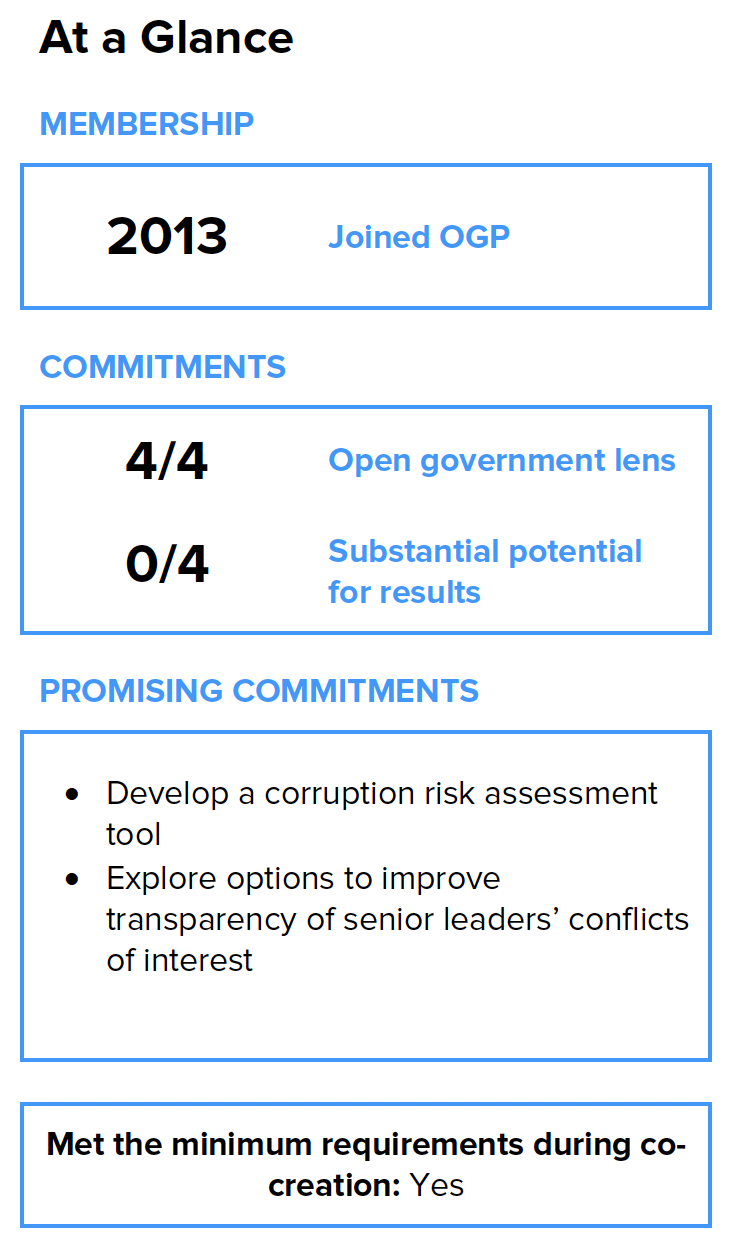
New Zealand’s fifth action plan includes four commitments, two of which envision promising reforms on government accountability. CommitmentOGP commitments are promises for reform co-created by governments and civil society and submitted as part of an action plan. Commitments typically include a description of the problem, concrete action... 2 plans to develop a systemic tool to help government departments identify insider fraud and corruption risks. Commitment 4 intends to improve transparencyAccording to OGP’s Articles of Governance, transparency occurs when “government-held information (including on activities and decisions) is open, comprehensive, timely, freely available to the public,... More of senior government leaders’ conflicts of interestA key part of anti-corruption involves preventing or revealing conflicts of interest — when a public official is in a position to use public office for personal or private gain. Technical specificatio....
The other two commitments plan reviews of important anti-corruption areas – Commitment 1 on whistleblower protection and Commitment 3 on government-private sector career transitions. However, they do not outline steps to translate the reviews into concrete reforms. Overall, there are fewer ambitious commitments in this action plan than in the previous one.
The action plan’s development process was overseen by the Public Service Commission (PSC). It was co-created in the last quarter of 2025 within the parameters of a government-set brief aligned to the Action Plan to Strengthen Integrity 2025-2028.[1] The Minister for the Public Service approved commitment areas for the plan,[2] which were announced to civil society and the public in an August email newsletter about the launch of the co-creation process. PSC also published timely information on its refreshed OGP website throughout the co-creation process. In September and November, following an online information session, PSC held three online workshops for government and civil society stakeholders to develop commitments within the areas approved by the Minister. PSC finalised the action plan in December. Its approach to co-creation drew on lessons learned from previous plans and met the minimum requirements of the OGP Participation and Co-Creation Standards. Civil society participants expressed their concern that the level of engagement opportunities for OGP action plan development had declined. They highlighted constraints to the scope of commitments, limited input in final commitments, and the desire for a multi-stakeholder forum.[3] In some cases this deterred participation by organisations that had formerly been active in OGP.[4]
Implementation could benefit from focused efforts on collaboration. Continuing the approach to co-creation, PSC intends for two meetings a year to report back on progress to civil society, and it is continuing email newsletters. Further involving civil society in the implementation of commitments through working groups and a renewed space for multistakeholder dialogue and oversight may help to secure engagement for the current and future action plan processes. This could help maintain action plan priorities following the national government election in November 2026 and respond to civil society requests for involvement in commitments’ implementation and governance oversight.[5]
Table 1. Promising Commitments
| Commitment 2: This commitment plans to deploy a tool to help government departments identify insider fraud and corruption risks. |
| Commitment 4: This commitment aims to improve the transparency of senior government leaders’ conflicts of interest. |
[1] “Action plan to strengthen integrity, 2025-2028,” Public Service Commission, accessed 17 April 2026, https://www.publicservice.govt.nz/role-and-purpose/integrity-and-conduct/work-we-are-doing-to-strengthen-integrity-and-conduct.
[2] “Cabinet paper for lodging and talking points – “Open Government Partnership National Action Plan 5,”” Public Service Commission, 28 July 2025, https://www.publicservice.govt.nz/assets/DirectoryFile/MoSR-2025-0626-REPORT-Cabinet-paper-for-lodging-Open-Government-Partnership-National-Action-Plan-5.pdf.
[3] “OGP NAP 5 Workshop 1 record of discussion,” Public Service Commission, 11 September 2025, https://www.publicservice.govt.nz/assets/OGP-NAP5-Workshop-1-record-of-discussion.pdf; “OGP NAP 5 Workshop 2 record of discussion,” Public Service Commission, 23 September 2025, https://www.publicservice.govt.nz/assets/OGP-NAP5-Workshop-2-record-of-discussion.pdf; “Comments on the draft 5th National Action Plan,” New Zealand Council for Civil Liberties, 8 December 2025, https://nzccl.org.nz/open-government-partnership-comments-on-draft-commitments-and-draft-5th-national-action-plan/#draft-plan; Steven Ensslen (New Zealand Council for Civil Liberties), correspondence with the IRM, 10 May 2025.
[4] “Ministerial letter re OGP NAP5,” Trust Democracy, 9 October 2025, https://trustdemocracy.nz/wp-content/uploads/2025/10/Ministerial-letter-re-OGP-NAP5.pdf; Max Rashbrooke (School of Government, Victoria University of Wellington), correspondence with the IRM, 6 February 2026; Ensslen, correspondence.
[5] “OGP NAP 5 Workshop 1,” Public Service Commission; “OGP NAP 5 Workshop 2,” Public Service Commission; “OGP NAP 5 Workshop 3 record of discussion,” Public Service Commission, 26 November 2025, https://www.publicservice.govt.nz/assets/OGP-NAP5-Workshop-3-record-of-discussion.pdf; “Comments on draft commitments,” New Zealand Council for Civil Liberties, 28 November 2025, https://nzccl.org.nz/open-government-partnership-comments-on-draft-commitments-and-draft-5th-national-action-plan/#draft-commitments.
Leave a Reply