Nigeria Action Plan Review 2026-2029
- Action Plan: Nigeria Action Plan 2025-2029
- Dates Under Review: 2026-2029
- Report Publication Year: 2026
Nigeria’s first four-year action planAction plans are at the core of a government’s participation in OGP. They are the product of a co-creation process in which government and civil society jointly develop commitments to open government ... aims to advance the Government of Nigeria’s eight-point agenda. Nearly all commitments have ambitious aims, but some stand out for having a coalition of reformers, funding, and a pathway for progress despite disruptions expected from the 2027 election period. Notable reforms include Nigeria’s open government approach to implementing digital public infrastructure and ongoing efforts in open contractingA transparent procurement process, known as open contracting, increases competition, improves public service delivery, and ensures governments better value for their money. Technical specifications: C... More and beneficial ownershipDisclosing beneficial owners — those who ultimately control or profit from a business — is essential for combating corruption, stemming illicit financial flows, and fighting tax evasion. Technical spe... More transparencyAccording to OGP’s Articles of Governance, transparency occurs when “government-held information (including on activities and decisions) is open, comprehensive, timely, freely available to the public,... More.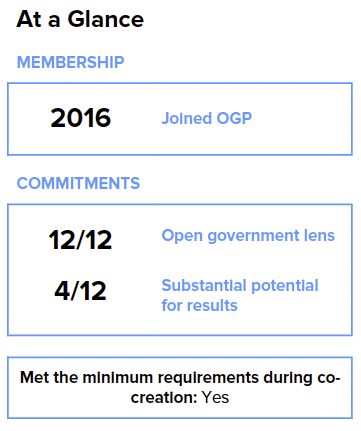
Nigeria’s fourth OGP action plan sets out a broad open government agenda across digital governanceAs evolving technologies present new opportunities for governments and citizens to advance openness and accountability, OGP participating governments are working to create policies that deal with the ... More, fiscal transparency, access to information, anti-corruption, justiceTo address barriers that prevent citizens from having their justice needs met, OGP participating governments are working to expand transparency, accountability, and inclusion into all systems of justi..., business and human rightsAn essential part of open government includes protecting the sacred freedoms and rights of all citizens, including the most vulnerable groups, and holding those who violate human rights accountable. T..., extractive transparency, climategovernance, and civic space. Commitments on access to justiceAccessible justice systems – both formal and informal – ensure that individuals and communities with legal needs know where to go for help, obtain the help they need, and move through a system that of... More and human rights in business represent new reform areas in Nigeria’s OGP action plans.
There is a strong potential for results for digital public infrastructure reforms advanced under Commitments 1 and 2. Taken together, they seek to establish both the technical and multi-stakeholder governance infrastructure for the Nigeria Data Exchange Platform (NGDX). Through CommitmentOGP commitments are promises for reform co-created by governments and civil society and submitted as part of an action plan. Commitments typically include a description of the problem, concrete action... 1, the platform promises to increase access to government services and information. Through Commitment 2, a multi-stakeholder governance approach seeks to ensure the NGDX adheres to data protection, human rights, and other key considerations.
Commitments 4 and 5, aligned with Nigeria’s government efficiency and anti-corruption agenda, also hold a substantial potential for results. Commitment 5 on beneficial ownership transparency builds on previous progress, aiming to strengthen the collection, sharing, verification, and use of beneficial ownership data. Commitment 4 on open contracting is supported by a coalition across government and non-government as well as dedicated funding to implement e-procurement reforms and upgrade the Nigeria Open Contracting Platform. Overall, this action plan is broader, more ambitious, and more aligned with government priorities compared to previous action plans.[1]
However, several commitments’ potential for results is moderated by possible implementation challenges. For instance, Commitment 11 on climate governance includes important objectives, but participation and ownership by the National Council on Climate Change Secretariat in this reform is unclear. Additionally, the 2027 electoral cycle presents a potential implementation risk for legislation-dependent commitments. With the presidential and National Assembly elections in January 2027 and state elections in February 2027, the legislative window for advancing bills and legislative attention is limited.[2] However, whether the electionsImproving transparency in elections and maintaining the independence of electoral commissions is vital for promoting trust in the electoral system, preventing electoral fraud, and upholding the democr... More will ultimately delay passage of specific bills will depend on legislative priorities and progress before the electoral period.
Nigeria’s fourth action plan was co-created through a participatory process led by the National Steering Committee and OGP Nigeria Secretariat. The committee gathered public input from digital tools and platforms, in-person meetings, youth engagement, and forums in the six geopolitical zones. Consultations included youth, women, persons with disabilities, civil society, subnational actors, and thematic working groups. New policy areas arose from stakeholder proposals, such as Commitment 8 on business and human rights, proposed by the Abuja Chamber of Commerce.[3]
The OGP Nigeria Secretariat coordinated across government to align the action plan with government priorities, funding, and engaged institutions. The plan is aligned with the government’s eight-point agenda and in coordination with the Presidential Special Adviser on Policy Coordination and the Central Results Delivery Coordination Unit. The Secretariat prompted government implementing institutions to pitch their commitments and demonstrate political support, funding opportunities, mandate fit, and links to ongoing work.[4]
As Nigeria’s first four-year plan, Nigeria’s OGP community will have the opportunity to review and revise the action plan at the midpoint. This enables reformers to consider any desired updates taking into consideration the January 2027 elections, lessons learned from the first two years of implementation, and recommendations from the IRM and partners.
[1] OGP Secretariat: Uchenna Arisukwu (CSO Advisor); Philip Mustapha Ahmed (Subnational Advisor); Mooreino Diftuffe (M&E Specialist), interview by the IRM, 21 August 2026.
[2] OGP Secretariat, interview.
[3] OGP Secretariat, interview.
[4] OGP Secretariat, interview.
Leave a Reply