Senegal Results Report 2023-2025
- Action Plan: Senegal Action Plan 2023-2025 (December)
- Dates Under Review: 2023-2025
- Report Publication Year: 2026
Senegal’s second OGP action planAction plans are at the core of a government’s participation in OGP. They are the product of a co-creation process in which government and civil society jointly develop commitments to open government ... saw the long-awaited passage of fundamental open government legislationCreating and passing legislation is one of the most effective ways of ensuring open government reforms have long-lasting effects on government practices. Technical specifications: Act of creating or r..., including the Access to Information Act, Whistleblower Protection Act, and decrees to strengthen the anticorruption authority and asset declarations. However, challenges around coordination, ownership, and funding inhibited other reforms. Notably, Senegal formalized its National Steering CommitteeThe Steering Committee is OGP’s executive decision-making body. Its role is to develop, promote and safeguard OGP’s values, principles and interests; establish OGP’s core ideas, policies, and rules; a... and Sectoral Technical Committees
Implementation 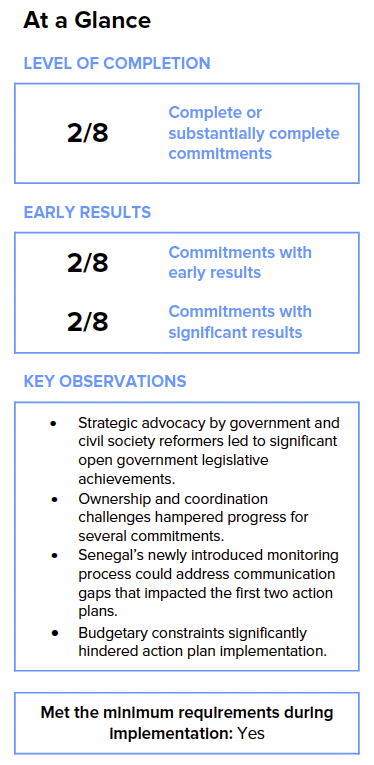
Senegal’s second action plan achieved notable progress on flagship anticorruption and access to information reforms. Commitments 1 and 3 were driven by longstanding civil society advocacy and alignment with the new administration’s agenda. Reformers also attributed the inclusionOGP participating governments are working to create governments that truly serve all people. Commitments in this area may address persons with disabilities, women and girls, lesbian, gay, bisexual, tr... More of CommitmentOGP commitments are promises for reform co-created by governments and civil society and submitted as part of an action plan. Commitments typically include a description of the problem, concrete action... 1 in the Open Gov Challenge with the successful passage of the Access to Information Law.
The remaining 6 commitments saw limited implementation, and no early results. These included reforms around open budgets, transparency in the fisheries sector, access to public services, citizen participation and local open government.[1] Commitments in this action plan were largely continued from the previous plan.
Under Commitment 1, Senegal passed the Access to Information Act and established the National Commission for Access to Information (CONAI) to promote and protect the right to informationThe legal right to request information from the government allows the public to follow government decision-making, participate in ensuring better decisions, and hold the government accountable. Techni.... Senegal now has a dedicated legal framework that defines the scope and processes around the right to information, as well as sanctions for noncompliance. While a significant step, future considerations include implementing the law, ensuring CONAI’s independence, and reasonable use of exemptions to disclosure.
Under Commitment 3, the Government of Senegal revised and strengthened anticorruption laws and the National Agency for the Prevention of Corruption (OFNAC). OFNAC’s mandate is now focused on the prevention and prosecution of corruption, mandatory publication of annual reports, and a transparent selection process for appointing members. Senegal also amended the law on asset declarations to expand the categories of individuals required to submit declarations. Finally, Senegal passed a Whistleblower Protection Act, the first in Francophone Africa.
Although highlighted as promising in the Action Plan Review, Commitment 4 on fisheries transparencyAccording to OGP’s Articles of Governance, transparency occurs when “government-held information (including on activities and decisions) is open, comprehensive, timely, freely available to the public,... More fell short of expected results. Senegal’s membership process did not advance due to a lack of coordination and communication among government actors. However, reformers were optimistic that progress could resume under the next action plan. Cross-cutting challenges for commitments included unclear ownership over commitment activities, incoordination among implementing institutions, limited funding, and a lack of political prioritization.
Participation and Co-Creation
Senegal’s OGP process is overseen by the Directorate for the Promotion of Good Governance (DPBG) in the Ministry of Justice, with the National Steering Committee (NSC) as the multi-stakeholder body.[2] A June 2024 ministerial decree formalized its creation and composition.[3] However, due to a change of government in March 2024, government members of the National Steering Committee and implementing institutions saw significant turnover. This included changes in the Minister of Justice and the DPBG Director.[4] Senegal’s OGP civil society platform, P-OSC-PGO, also developed rules of procedure.[5]
Co-creation for the second action plan involved an inclusive four-stage process: facilitator training, consultations across 14 regions with around 400 participants, drafting, and action plan validation workshops.[6] This was a welcome improvement over the previous action plan, including new sectoral working groups with two administration and two civil society members. It also involved engaging traditional communicators to share OGP information at the local level. Despite some financial obstacles, co-creation of the second action plan provided greater participation opportunities than the previous one.[7] With the development of a Senegal OGP website,[8] Senegal met the OGP Participation and Co-Creation minimum requirementsAll OGP participating countries are expected to adhere to the Participation and Co-Creation Standards. Each Standard includes clear and measurable minimum requirements that all OGP participating count....
Implementation in Context
Implementation was positively driven by civil society’s perseverance and the new government’s political priorities. A change of government led to significant turnover in government officials, including implementers and National Steering Committee (NSC) members.[9] However, implementation of Commitments 1 and 3 were significantly aided by the new administration’s prioritization of anticorruption and access-to-information reforms.[10]
Some challenges arose from budgetary constraints as well as coordination, ownership, and communication difficulties across commitments that involved a large number of institutions (for example, Commitments 5 and 7).[11] International partners—including the PAGOF (Open Government Support Program in Francophone Africa) and USAID (pre-withdrawal)—provided financial support, notably for website creation and workshops.[12] The creation of Sectoral Technical Committees with equal representation from the administration and civil society has the potential to address coordination challenges during implementation of future action plans.
[1] See “Senegal Action Plan 2023-2025 (December)” (OGP, 8 Jan. 2024), https://www.opengovpartnership.org/documents/senegal-action-plan-2023-2025-december/.
[2] “Decree on the creation and organization of the Open Government PartnershipThe Open Government Partnership (OGP) is a multi-stakeholder initiative focused on improving government transparency, ensuring opportunities for citizen participation in public matters, and strengthen... More National Steering Committee.” Ministry of JusticeTo address barriers that prevent citizens from having their justice needs met, OGP participating governments are working to expand transparency, accountability, and inclusion into all systems of justi.... Republic of Senegal. 20 June 2024. Document shared with the IRM researcher.
[3] Id.
[4] Présidence de la République du Sénégal, “Liste complète des membres du nouveau gouvernement. [Full list of members of the new government.],” Présidence du Sénégal, 6 Sep. 2025, https://www.presidence.sn/fr/actualites/liste-complete-des-membres-du-nouveau-gouvernement; Le Quotidien, “Ousmane Diagne a pris fonction au ministère de la Justice [Ousmane Diagne has taken up his post at the Ministry of Justice],” Le Quotidien, 12 Apr. 2024, https://lequotidien.sn/ousmane-diagne-a-pris-fonction-au-ministere-de-la-justice/.
[5] Abdoulaye Ndiaye, (ARTICLE 19 civil society member, OGP MSF Co-Chair), interview by IRM researcher, 23 and 26 Dec. 2025.
[6] Open Government Partnership Senegal – OGP SEN, [Facebook Post], 5 Dec. 2023, https://web.facebook.com/share/p/1DSRwQ7mwP/.
[7] Abdoul Diao (Legal Officer, Head of the Institutional Governance Division at DPBG) interview by IRM researcher, 12 Dec. 2025; Ndiaye, interview.
[8] Open Government Senegal, “Partenariat pour un Gouvernement Ouvert (PGO) [Open Government Partnership (OGP)],” accessed 12 Mar. 2026, https://pgo.sn/. https://pgo.sn/https://pgo.sn/https://pgo.sn/
[9] Bocar Harouna Diallo, “Les multiples défis de l’élection présidentielle au Sénégal en 2024 [Senegal’s 2024 presidential election faced profound challenges that threatened its democratic stability],” Le Quotidien, 15 Jan. 2024, https://lequotidien.sn/les-multiples-defis-de-lelection-presidentielle-au-senegal-en-2024/.
[10] Cécile Sabina Bassene, “Lutte contre la corruption: le Président Diomaye annonce la mise sur pied de 4 projets de lois” [Fight against corruption: President Diomaye announces the introduction of four bills],” PressAfrik, 30 Sep. 2024. https://www.pressafrik.com/Lutte-contre-la-corruption-le-President-Diomaye-annonce-la-mise-sur-pied-de-4-projets-de-lois_a278963.html.
[11] Diao, interview.
[12] Ndiaye, interview.
Leave a Reply