France Results Report 2023-2025
- Action Plan: France Action Plan 2023-2025 (December)
- Dates Under Review: 2023-2025
- Report Publication Year: 2026
France’s fourth action planAction plans are at the core of a government’s participation in OGP. They are the product of a co-creation process in which government and civil society jointly develop commitments to open government ... successfully advanced public participationGiving citizens opportunities to provide input into government decision-making leads to more effective governance, improved public service delivery, and more equitable outcomes. Technical specificatio... across multiple commitments and created civic educationAccountability within the public education system is key to improving outcomes and attainment, and accountability is nearly impossible without transparent policies and opportunities for participation ... tools in collaboration with civil society. Most commitments were completed despite implementation being delayed by an unprecedented number of changes in government. The launch of a multi-stakeholder forumRegular dialogue between government and civil society is a core element of OGP participation. It builds trust, promotes joint problem-solving, and empowers civil society to influence the design, imple... is also a major step toward deepening government–civil society relations.
Implementation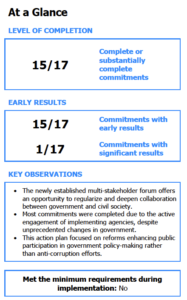
In France’s fourth action plan, 15 of 17 commitments were fully or substantially completed. Most progress was achieved by commitments related to mainstreaming public participation (Commitments 1, 2, 3, 5, and 14), open dataBy opening up data and making it sharable and reusable, governments can enable informed debate, better decision making, and the development of innovative new services. Technical specifications: Polici... (16 and 17), environmental policy planning (10), education (6 and 9), and health policy (8 and 11). The dedication of implementing teams within institutions, alongside clear and realistic commitmentOGP commitments are promises for reform co-created by governments and civil society and submitted as part of an action plan. Commitments typically include a description of the problem, concrete action... milestones, bolstered progress.
Two reforms stand out for advancing civic participation and open education. Commitment 2 led to the launch of the Transformation Campus, an online training platform for civil servants in participatory methods, which has already trained more than 4,600 public officials.
Commitment 6 led to a government–civil society partnership which developed civic education tools, reaching more than 40,000 students.
France’s Open Gov Challenge commitment (Commitment 5) aimed to establish a legal status for citizens participating in deliberative democracy mechanisms, which would provide protections and compensation, akin to jury duty. The government produced a report identifying barriers to civic participation and suggested a legislative framework for citizens participating in deliberative democracy mechanisms, such as citizens’ conventions or assemblies.[1] The commitment is part of a longer-term reform of the civic participation framework in France, which, if fully implemented, could significantly increase support for public engagement in policymaking. It would also position France as the first country to establish such a framework.
During this action plan, France expanded its support for open government reforms in five Francophone African countries. This support has led to the launch of a centralized National Public Data Registry and the consolidation of environmental datasets in Tunisia, the creation of a dedicated OGP website in Senegal, and support for open government practices at the local level and CSO engagement on budget transparency in Côte d’Ivoire.[2]
Some civil society organizations involved in the OGP process over several OGP cycles noted a weaker focus on anti-corruption commitments in this plan compared to the previous one.[3]
Participation and Co-Creation
The Interministerial Directorate for Public Transformation (DITP), a central government department that reports directly to the Prime Minister, oversees the OGP process. Within DITP, OGP coordination shifted from the cabinet of the Interministerial Delegate to the Interministerial Center for Citizen ParticipationAccording to OGP’s Articles of Governance, citizen participation occurs when “governments seek to mobilize citizens to engage in public debate, provide input, and make contributions that lead to more ... More (CIPC) in March 2025.
In April 2026, the Minister Delegate for Relations with Parliament launched the Open Forum. It is a multi-stakeholder forum co-chaired by the Minister responsible for OGP and the President of the Economic, Social and Environmental Council, a constitutional institution, laying the foundation for institutionalizing dialogue between government and civil society. During the action plan implementation period, however, without a functioning multistakeholder forum, civil society organizations interacted with government implementers through group and bilateral meetings.[4] Specifically, group meetings and workshops with several CSOs were organized in March and December 2024 to discuss options for Commitment 5 on the participant citizen status.[5] Bilateral meetings with CSOs were organized in March, April and December 2024; two further bilateral meetings were held in May 2025 on the Open Gov Challenge and in December 2025 on Commitment 1.[6] The implementers of Commitment 6 on the Fresque de la Démocratie liaised regularly with the CSOs involved in implementation.[7] Some CSOs involved in the development of the action plan expressed dissatisfaction with the information and opportunities available to actively monitor implementation.[8]
During implementation, France did not fulfill the minimum requirements for OGP’s Participation and Co-Creation Standards.[9]These requirements include maintaining a multi-stakeholder space for dialogue, an online repositoryAccess to relevant information is essential for enabling participation and ensuring accountability throughout the OGP process. An OGP repository is an online centralized website, webpage, platform or ... for OGP activities, regular implementation updates, and the opportunity for civil society stakeholders to comment on implementation. However, this does not affect France’s status in the partnership as this action plan falls under a grace period.
Implementation in Context
Implementation took place in a complex political, economic, and security context. France experienced an unprecedented number of changes in government, with six governments taking office during the implementation period, alongside the dissolution of the National Assembly and snap parliamentary elections in July 2024.[10]
These events slowed down policymaking and long-term strategic decision-making. They also fed into pre-existing sentiments of democratic fatigue among citizens, growing distrust of democratic institutions, and political polarization.[11]
Russia’s ongoing war against Ukraine triggered a renewed focus on defense and raising military spending, while high energy prices added further pressure on the state budget, contributing to economic stability becoming the main priority and reducing ministries’ margin for maneuver.[12]
Table 1. Commitments with Early ResultsEarly results refer to concrete changes in government practice related to transparency, citizen participation, and/or public accountability as a result of a commitment’s implementation. OGP’s Independ... More
| Commitment 2: Created a central online platform to train civil servants in participatory practices, with more than 4,600 civil servants trained. |
| Commitment 6: Led to a government–civil society partnership that developed civic education tools, reaching more than 40,000 students. |
[1] M. Marc Pichon de Vendeuil, Master of Requests at the Council of State, “Préfigurer un ‘statut du citoyen participant’,” May 2025, unpublished and confidential at the time of writing.
[2] “IRM Action Plan Review: Tunisia 2023–2025,” Open Government Partnership, 12 February 2025, https://www.opengovpartnership.org/documents/tunisia-action-plan-review-2023-2025; “IRM Results Report: Tunisia 2023–2025,” Open Government Partnership, 4 August 2026, https://www.opengovpartnership.org/documents/tunisia-results-report-2023-2025; “IRM Results Report: Senegal 2023–2025,” Open Government Partnership, 22 May 2026, https://www.opengovpartnership.org/documents/senegal-results-report-2023-2025; “IRM Action Plan Review: Côte d’Ivoire 2024–2026,” Open Government Partnership, 20 November 2025, https://www.opengovpartnership.org/documents/cote-divoire-action-plan-review-2024-2026.
[3] Civil society representatives, two interviews by IRM researcher, 4 February and 28 April 2026.
[4] In accordance with a list of government-civil society meeting provided by CIPC/DITP to the IRM researcher, 10 March 2026; Mayara Soares Faria, former DITP staff and former POC, interview by IRM researcher, 11 March 2026.
[5] In 2024, a group meeting with multiple CSOs was held in March, during the launch of the action plan. Another group meeting was held in December, a co-creation workshop with 10 CSOs to provide information about the progress and solicit ideas about Commitment 5 on the participant citizen status.
[6] In accordance with a list of government-civil society meeting provided by CIPC/DITP to the IRM researcher, 10 March 2026; Mayara Soares Farias, former DITP staff and former POC, interview by IRM researcher, 11 March 2026;
[7] Judith Klein (Ministry of Education and Parlons Démocratie), interview by IRM researcher, 3 April 2026.
[8] Civil society representatives, four interviews by IRM researcher, 4 and 17 February, 22 and 28 April 2026.
[9] “OGP Participation and Co-Creation Standards,” Open Government Partnership, 24 November 2021, https://www.opengovpartnership.org/wp-content/uploads/2021/12/OGP-Participation-and-Co-Creation-Standards_24November2021.pdf; “IRM Guidelines for the Assessment of Minimum Requirements,” Open Government Partnership, 31 May 2022, https://www.opengovpartnership.org/documents/irm-guidelines-for-the-assessment-of-minimum-requirements.
[10] Prime Minister Élisabeth Borne resigned on 8 January 2024, followed by subsequent governments led by Gabriel Attal (9 January–16 July 2024), Michel Barnier (5 September–13 December 2024), François Bayrou (23 December 2024–9 September 2025) and Sébastien Lecornu (named ‘Lecornu I’ whose government resigned the day after being appointed in October 2025, and ‘Lecornu II’ as of 12 October 2025).
[11] “Baromètre de la confiance politique,” [Public Confidence Barometer], Sciences Po – CEVIPOF, https://www.sciencespo.fr/cevipof/fr/etudes-enquetes/barometre-confiance-politique/#resultats; Mariama Darame, “French voters’ mistrust of politics aggravated since snap elections, gap with neighbors widens,” Le Monde, February 2025, https://www.lemonde.fr/en/politics/article/2025/02/12/french-voters-mistrust-of-politics-aggravated-since-snap-elections-gap-with-neighbors-widens_6738080_5.html; Julie Carrat, “Poll: French government crisis has deepened public distrust of political leaders,” Le Monde, 21 October 2025, https://www.lemonde.fr/en/politics/article/2025/10/21/poll-french-government-crisis-deepened-public-distrust-of-political-leaders_6746625_5.html.
[12] Eric Albert and Sophie Fay, “Political instability causes near stagnation in the French economy,” Le Monde, 7 October 2025, https://www.lemonde.fr/en/economy/article/2025/10/07/political-instability-causes-near-stagnation-in-the-french-economy_6746173_19.html; Blanche Leridon, “2025: Hope Beneath the Political Gridlock?” Institut Montaigne, 28 January 2025, https://www.institutmontaigne.org/en/expressions/decoding-france-2025-hope-beneath-political-gridlock; Cyprien Batut, “France’s Fiscal situation: Between Political Paralysis and European Discipline,” EMPN, 6 October 2025, https://empn.eu/publication/france-fiscal-situation; Julie Carriat, “By ‘dramatizing’ debt issue, French PM Bayrou risks exacerbating democratic fatigue,” Le Monde, 4 September 2025, https://www.lemonde.fr/en/politics/article/2025/09/04/by-dramatizing-debt-issue-french-pm-bayrou-risks-exacerbating-democratic-fatigue_6745048_5.htm; Doloresz Katanich, “Political instability in France: How does it impact the economy and investments?” Euronews, 4 September 2025, https://www.euronews.com/business/2025/09/04/political-instability-in-france-how-does-it-impact-the-economy-and-investments; “France’s democratic crisis is showing increasingly alarming symptoms,” Le Monde, 21 October 2025, https://www.lemonde.fr/en/opinion/article/2025/10/21/france-s-democratic-crisis-is-showing-increasingly-alarming-symptons_6746626_23.html.
Leave a Reply