
Tunisia Results Report 2023-2025
- Action Plan: Tunisia Action Plan 2023-2025
- Dates Under Review: 2023-2025
- Report Publication Year: 2026
Tunisia’s fifth national action planAction plans are at the core of a government’s participation in OGP. They are the product of a co-creation process in which government and civil society jointly develop commitments to open government ... advanced open dataBy opening up data and making it sharable and reusable, governments can enable informed debate, better decision making, and the development of innovative new services. Technical specifications: Polici... and budget transparencyAccording to OGP’s Articles of Governance, transparency occurs when “government-held information (including on activities and decisions) is open, comprehensive, timely, freely available to the public,... More. A challenging context, focus on internal technical activities, and lack of high-level government validation of key reform elements limited early resultsEarly results refer to concrete changes in government practice related to transparency, citizen participation, and/or public accountability as a result of a commitment’s implementation. OGP’s Independ... More despite the action plan’s high level of completionImplementers must follow through on their commitments for them to achieve impact. For each commitment, OGP’s Independent Reporting Mechanism (IRM) evaluates the degree to which the activities outlined... More. Although the OGP process was initially collaborative, communication between civil society and government decreased during implementation.
Implementation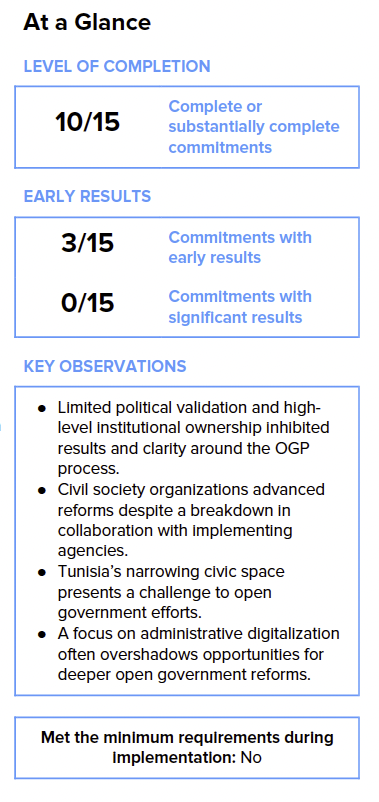
In Tunisia’s fifth national action plan, 10 of 15 commitments were fully or substantially completed.[1] The plan prioritized reforms related to open budget, open data, natural resource governance, and digitalization of administrative services. Despite a high level of completion, many activities were technical and internal to government. As such, the majority of commitments (12) fell short of notable results.
Reformers achieved moderate results in open data and budget transparency. Through Commitment 1, the Ministry of Finance launched a revitalized open budget portal, Mizaniatouna,[2] which provides granular, updated budget information. The Tunisian Civil Forum for OGP produced simplified budget materials to enhance access for persons with disabilities.
Under Commitments 6 and 7, the E-Government Unit advanced open data reforms by launching a national public data registry, enabling citizens to view and request inventoried data.[3] The Ministry of Environment also took steps toward greater publication of environmental data. Collaboration between government ministries, local civil society, and international partners facilitated public debate on environmental data across five governorates. However, for all three commitments, implementation was affected by decreased civil society-government collaboration.
The withdrawal or suspension of key implementing actors, coordination challenges, and a lack of open government relevanceAccording to the OGP Articles of Governance, OGP commitments should include a clear open government lens. Specifically, they should advance at least one of the OGP values: transparency, citizen partic... in commitmentOGP commitments are promises for reform co-created by governments and civil society and submitted as part of an action plan. Commitments typically include a description of the problem, concrete action... design hindered the remaining commitments’ early results. Commitment 4, identified as promising in the Action Plan Review, did not achieve expected results due to the withdrawal of the implementing civil society organization from the OGP process. Commitment 5 on access to information was impacted by the continued suspension of the Access to Information Authority. Commitment 10 on e-participation lost funding following the suspension of USAID support in the country. Commitments 8 and 9 on open government at the local level, also initially considered promising, were impeded by coordination challenges between implementing agencies and local and international partners.
Many commitments focused on internal administrative reforms. Consequently, these commitments did not directly contribute to making the government more open to Tunisians despite high levels of implementation. Reforms that lacked a clear connection to open government included Commitments 2 and 3 on water management, Commitments 11 and 12 on public integrity, and Commitment 14 on investor services. While Commitments 13 and 15 produced documents to support CSO governance and access to information for persons with disabilities, the IRM found limited evidence of their operationalization by the end of the implementation period. Partners such as the Program to Support Francophone Open Governments (PAGOF), Deutsche Gesellschaft für Internationale Zusammenarbeit (GIZ), and the World Bank provided key technical and financial support across commitments.
Participation and Co-Creation
The OGP process was overseen by the E-Government Unit within the Presidency of the Government alongside a Steering Committee or Comité de pilotage (Copil).[4] The action plan co-creation process included three regional workshops in Gafsa, Kairouan, and Kef to engage stakeholders outside the capital and the collection of over 320 proposals through the digital participation portal, workshops, email, and via public structures.[5] Throughout the implementation period, Tunisia continued to not have a high-level government point of contact for OGP. Consequently, reforms lack a high-level advocate to translate focused technical progress into institutionalized open government results. CSO participation and meeting frequency decreased toward the second half of the implementation period, creating uncertainty around the next action plan.[6]
Tunisia did not meet the minimum requirements under OGP Participation and Co-Creation Standards as Copil did not meet between May 2025 and the end of the implementation period in December 2025.[7] The IRM therefore recommends that Copil convenes to restart dialogue between government and civil society, particularly on the implementation progress of the fifth action plan and the co-creation timeline for future commitments.
Implementation in Context
Implementation of Tunisia’s fifth action plan was affected by an increasingly challenging governance and civic space environment.[8] In this context, collaboration between government and civil society on OGP reforms decreased during implementation. Civil society organizations, including through the Tunisian Civil Forum for OGP, continued their efforts with the support of international partners. While evidence available online indicates that some ministries continued to implement reforms, a lack of high-level validation limited several commitments’ potential results. For instance, the National Open Data Strategy awaits formal government endorsement. At the local level, three of the five Tunisian OGP Local members have active commitments as of March 2026.[9] As government OGP contacts did not respond to interview requests, this report was informed only by desk research and interviews with civil society stakeholders.
[1] Presidency of the Government, “Tunisia Action Plan 2023–2025,” Open Government Partnership, 9 January 2024, https://www.opengovpartnership.org/documents/tunisia-action-plan-2023-2025-december
[2] “Mizaniatouna,” Government of Tunisia, accessed June 2026, http://www.mizaniatouna.gov.tn.
[3] “National Open Data Registry,” Government of Tunisia, accessed June 2026, registre.data.gov.tn.
[4] Presidency of the Government, “Tunisia Action Plan 2023–2025,” Open Government PartnershipThe Open Government Partnership (OGP) is a multi-stakeholder initiative focused on improving government transparency, ensuring opportunities for citizen participation in public matters, and strengthen... More.
[5] Presidency of the Government, “Tunisia Action Plan 2023–2025,” Open Government Partnership, p. 10.
[6] Anonymous civil society stakeholder, interview by IRM Researcher, 6 February 2026; Anonymous civil society stakeholder, interview by IRM Researcher, 23 February 2026.
[7] “COPIL meeting minutes,” OGP Tunisia, http://www.ogptunisie.gov.tn/en/?cat=51. The IRM further confirmed the absence of any meetings from 22 May 2025 to December 2025 through interviews with civil society stakeholders.
[8] “Civic Space Monitor: Tunisia,” Civicus, accessed June 2026, https://monitor.civicus.org/country/tunisia; “Freedom in the World 2025: Tunisia,” Freedom House, accessed June 2026, https://freedomhouse.org/country/tunisia/freedom-world/2025; “Civic Freedom Monitor: Tunisia,” International Center for Not-for-Profit Law, updated 15 May 2026, http://www.icnl.org/resources/civic-freedom-monitor/tunisia.
[9] Among the five Tunisian OGP Local members, only Zriba, El Kef, and Dar Chaabane El Fehri have active commitments, whereas Carthage and Regueb did not have any. See: “OGP Local,” Open Government Partnership, 27 March 2026, https://www.opengovpartnership.org/ogp-local.
Leave a Reply