Ecuador Results Report 2022-2024
- Action Plan: Ecuador Action Plan 2022-2024
- Dates Under Review: 2022 - 2024
- Report Publication Year: 2025
Under the leadership of the Open Government Steering CommitteeThe Steering Committee is OGP’s executive decision-making body. Its role is to develop, promote and safeguard OGP’s values, principles and interests; establish OGP’s core ideas, policies, and rules; a... (Grupo Núcleo de Gobierno Abierto), Ecuador’s second action planAction plans are at the core of a government’s participation in OGP. They are the product of a co-creation process in which government and civil society jointly develop commitments to open government ... achieved an expansion in participation and made initial progress toward an Open State model. Despite contextual challenges, the plan was implemented effectively, resulting in a high level of completionImplementers must follow through on their commitments for them to achieve impact. For each commitment, OGP’s Independent Reporting Mechanism (IRM) evaluates the degree to which the activities outlined... More. It also improved transparencyAccording to OGP’s Articles of Governance, transparency occurs when “government-held information (including on activities and decisions) is open, comprehensive, timely, freely available to the public,... More in certain areas and fostered participatory co-creation at the municipal level.
Implementation
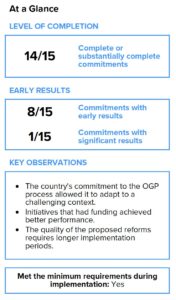
This is Ecuador’s second action plan. The IRM assesment determined that 14 of the 15 commitments were completed or substantially completed. Seven of these commitments achieved moderate early resultsEarly results refer to concrete changes in government practice related to transparency, citizen participation, and/or public accountability as a result of a commitment’s implementation. OGP’s Independ... More, and one achieved significant early results. The public policy areas that made the most progress were fiscal transparency (in the fishing and legislative sectors) and public procurementTransparency in the procurement process can help combat corruption and waste that plagues a significant portion of public procurement budgets globally. Technical specifications: Commitments that aim t... More.
The implementation of these commitments has improved the availability and quality of data, which can now support public policy decisions, citizen participationAccording to OGP’s Articles of Governance, citizen participation occurs when “governments seek to mobilize citizens to engage in public debate, provide input, and make contributions that lead to more ... More, and oversight. For example, CommitmentOGP commitments are promises for reform co-created by governments and civil society and submitted as part of an action plan. Commitments typically include a description of the problem, concrete action... 10, implementing the Fisheries Transparency Initiative (FiTI), launched participation processes for industry organizations at both national and local levels. Additionally, for public procurement (Commitment 11), the country approved a strategy to promote integrity, with a focus on genderOGP participating governments are bringing gender perspectives to popular policy areas, ensuring diversity in participatory processes, and specifically targeting gender gaps in policies to address gov... More and environmental sustainability. This new strategy is scheduled for implementation in 2025.
Commitment 5 achieved significant early results by promoting open innovation at the municipal level. It did this by piloting a mentoring process to co-create solutions for local issues. The chosen proposals resulted in a prototyped mobile application for public infrastructure reporting and an action plan to boost citizen participation in rights protection committees.
As the IRM has noted in previous reports, civil society organizations, academia, and the private sectorGovernments are working to open private sector practices as well — including through beneficial ownership transparency, open contracting, and regulating environmental standards. Technical specificatio... More in Ecuador play a crucial counterpart role in the implementation process. This role has often been fundamental to achieving early results, as these organizations contribute both their technical expertise and by managing funds from international cooperation.
The implementation context clearly influenced the progress of several commitments, as detailed later. For example, Commitment 2, a promising initiative identified by the IRM, was designed to promote political transparency. However, its implementation was impacted because the National Electoral Council had to organize two presidential electionsImproving transparency in elections and maintaining the independence of electoral commissions is vital for promoting trust in the electoral system, preventing electoral fraud, and upholding the democr... More, one legislative election, a referendum, and a popular consultation.
Participation and Co-Creation
The Directorate of Open Government, which falls under the General Undersecretariat of Public Administration and Cabinet of the Presidency of the Republic, oversees the process in the country. The OGP point of contact and the technical team remained in their positions throughout the co-creation and implementation phases.[1]
Since co-creating its first action plan, Ecuador has been known for complying with OGP standards and for introducing innovative initiatives to advance its commitments. A key example is the signing of commitment agreements, which identify the responsible government entity and its counterparts from civil society, academia, and the private sector.
The co-creation processCollaboration between government, civil society and other stakeholders (e.g., citizens, academics, private sector) is at the heart of the OGP process. Participating governments must ensure that a dive... for this action plan expanded participation opportunities for civil society organizations, academia, the private sector, and the general public. This was done through virtual and in-person workshops in major cities and by using a digital tool to collect proposals. For feedback, all received proposals were categorized to be either included in the plan, saved in a proposal bank for future plans, or sent to relevant government entities for follow-up.
To keep the public informed on the country’s open government progress, the government maintains an updated, specialized website and a platform for tracking commitments.[2] The government also uses social media and an electronic newsletter to complement its communication strategy.
Implementation in Context
In April 2023, the General Secretariat of Public Administration and Cabinet of the Presidency of the Republic declared the “Open State” management model a public policy via agreement SGAPG-2023-0001.[3] This policy will be implemented through OGP action plans. The agreement also reformed the Steering Committee to expand its membership to include: a representative from the Secretariat, representatives from the five state branches and from autonomous and decentralized governments at the parish, municipal, and provincial levels, as well as nine representatives from civil society, higher educationAccountability within the public education system is key to improving outcomes and attainment, and accountability is nearly impossible without transparent policies and opportunities for participation ..., and the private sector.
On May 17, 2023, then-President Guillermo Lasso, facing impeachment, activated the “cross death” clause. This provision of the 2008 Constitution allows the president to dissolve the National Assembly, provided that the president’s term is also put to a vote.[4] As a result, Daniel Noboa took office on November 23 of the same year, serving for one year and six months to complete the previous president’s term.[5] This change in government, along with the new National Assembly, led to a turnover of decision-makers and technical staff in the agencies involved in the action plan.
During the final year of the action plan’s implementation, the country was challenged by rising insecurity and an energy crisis. In response to a spike in organized crime, the government declared a state of emergency in October 2024 across six provinces and the capital, Quito. Under this order, rights such as freedom of assembly and the inviolability of the home were suspended.[6] Furthermore, the country’s energy crisis led to scheduled power outages at various times throughout the year.[7]
[1] During the public comment period, the Open Government Directorate noted that one of the main challenges during implementation was the changes in ministerial authorities. These changes required strengthening coordination strategies between the technical point of contact, represented by the Director of Open Government, and the technical and communications teams.
[2] Platform for Tracking the Commitments of the Open Government Action Plan Ecuador:
https://paga.presidencia.gob.ec/compromisos/panelsn
[3] SGAPG-2023-001 “Open State” Management Model Declared a Public Policy, with the goal of strengthening its pillars, General Secretariat of Public Administration and Cabinet, Tuesday, April 25, 2023, https://www.gobiernoabierto.ec/wp-content/uploads/2019/10/primer_suplemento_no._297.pdf
[4] BBC Mundo, “What is the ‘cross death’ invoked by President Lasso in Ecuador and what happens now,” https://www.bbc.com/mundo/noticias-america-latina-65624119
[5] Ana María Roura, “Daniel Noboa assumes the presidency in Ecuador for one and a half years: what is the purpose of such a short government,” BBC Mundo, November 23, 2023 https://www.bbc.com/mundo/articles/c7291r4xxneo
[6] DW, October 3, 2024, “Ecuador declares a state of emergency in six provinces,”https://www.dw.com/es/ecuador-declara-estado-de-excepci%C3%B3n-en-seis-provincias-por-grave-conmoci%C3%B3n-interna/a-70397076
[7] Blanca Morales Pesantes, BBC Mundo, November 15, 2024, “‘It’s like going back to the 18th century’: the blackouts that have Ecuador without light for 12 hours a day,” https://www.bbc.com/mundo/articles/c05z0vr0rneo
Leave a Reply