Republic of Moldova Results Report 2023-2025
- Action Plan: Moldova Action Plan 2023-2025
- Dates Under Review: 2023-2025
- Report Publication Year: 2026
The Republic of Moldova’s 2023–2025 OGP action planAction plans are at the core of a government’s participation in OGP. They are the product of a co-creation process in which government and civil society jointly develop commitments to open government ... saw high levels of implementation and strong government-civil society collaboration. Early resultsEarly results refer to concrete changes in government practice related to transparency, citizen participation, and/or public accountability as a result of a commitment’s implementation. OGP’s Independ... More are visible in participatory lawmaking reforms and improved access-to-information tools, supporting the country’s alignment with European Union accession requirements. Changes in its multi-stakeholder forumRegular dialogue between government and civil society is a core element of OGP participation. It builds trust, promotes joint problem-solving, and empowers civil society to influence the design, imple..., such as involving additional civil society organizations beyond its core membership, expanded awareness of and participation in the OGP process.
Implementation
The Republic of Moldova’s fifth action plan for 2023–2025 initially comprised six commitments. It was amended in December 2024 to add a commitment concerning data publication and reuse. Most commitments expanded on policy areas covered in previous action plans, such as access to information, public participation, anti-corruption, and public procurement, and involved capacity buildingEnhancing the skills, abilities, and processes of public servants, civil society, and citizens is essential to achieving long-lasting results in opening government. Technical specifications: Set of ac... and skills development for public officials. Several commitments entailed the adoption of new legislationCreating and passing legislation is one of the most effective ways of ensuring open government reforms have long-lasting effects on government practices. Technical specifications: Act of creating or r... and regulations, or the implementation of legislation adopted shortly before the action plan cycle, such as the Law on Access to Information.
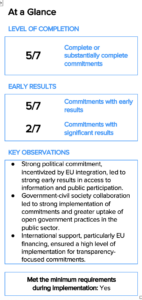
The commitments had a high level of completion, with five out of seven substantially or fully completed.[1] Policy areas assessed as promising in the IRM Action Plan Review—on access to information (Commitment 1) and public participation in decision-making (Commitment 2)—generated the most notable early results.[2] These commitments helped operationalize
open government principles that civil society has advocated for many years. They also constitute milestones in the Republic of Moldova’s European Union (EU) accession process under Cluster 1: Fundamentals of the accession process.[3]
As a result of CommitmentOGP commitments are promises for reform co-created by governments and civil society and submitted as part of an action plan. Commitments typically include a description of the problem, concrete action... 1, the State Chancellery and civil society organizations (CSOs) implemented a wide range of activities to support the effective implementation of Law No. 148 of 2023 on Access to Information. Consequently, public authorities now have a more consistent way to provide public information, while citizens have better access to data on access to information requests.
Under Commitment 2, the State Chancellery engaged civil society to design a new law on public participationGiving citizens opportunities to provide input into government decision-making leads to more effective governance, improved public service delivery, and more equitable outcomes. Technical specificatio... in decision-making. While the law is expected to come into force in January 2027, some of its reforms have already been introdu
ced to public officials through training and guidance. The State Chancellery has also submitted Commitments 1 and 2 as Open Government Challenges. Commitment 7, added as an amendment, resulted in the adoption of a regulatory framework on open dataBy opening up data and making it sharable and reusable, governments can enable informed debate, better decision making, and the development of innovative new services. Technical specifications: Polici... and the reuse of public sector information, transposing the EU Directive 2019/1024 on Open Data and the Reuse of Public Sector Information.
Commitments 1, 2, 5, 6 and 7 set a strong foundation for expanding transparencyAccording to OGP’s Articles of Governance, transparency occurs when “government-held information (including on activities and decisions) is open, comprehensive, timely, freely available to the public,... More, participation, and accountability. Moving forward, more efforts will be needed to translate these policy changes into practical impact. The commitments also contributed to strategic documents that the Moldovan Government has published on EU accession, civil society development and collaboration, anti-corruption, and digital transformationGovernments are working to increase access to and quality of government services, improve transparency, and create opportunities for participation by using information and communications technologies.... More. CSOs were involved in implementing or supporting certain milestones, including through training sessions, with Commitment 5 being fully implemented by several CSOs.
The high level of government dedication and collaboration with civil society were key to the strong completionImplementers must follow through on their commitments for them to achieve impact. For each commitment, OGP’s Independent Reporting Mechanism (IRM) evaluates the degree to which the activities outlined... More level of the action plan. In addition, the EU accession process and related funding enabled actors to sustain focus on OGP implementation.
Participation and Co-Creation
The State Chancellery remained the OGP secretariat and point of contact in the Republic of Moldova. The country’s multi-stakeholder forum is the Coordination Committee, composed of ten members—five each from civil society and government. The co-creation process for the action plan followed past IRM recommendations by establishing a timeline, revisiting the multi-stakeholder committee, gathering priorities through an open questionnaire and public consultations, and offering reasoned responses. Despite tight deadlines, limited resources, and a difficult political context, stakeholders praised the State Chancellery’s efforts to organize the process and engage both national and local actors.[4]
The committee met quarterly during the implementation period. The participation of state secretaries—equivalent to deputy ministers—in committee meetings ensured high-level political buy-in for the action plan.[5] Because of the selection procedure, civil society members represent broader coalitions of CSOs. In addition, the involvement of the Congress of Local Authorities[6] in the committee created opportunities for broader dissemination and coordination for commitments requiring action from local governments.
Early in the implementation process, the committee opened its meetings to a larger group of stakeholders to ensure broader participation from CSOs and other interested parties. This innovation increased awareness of and participation in the OGP process, generated additional comments, inputs and ideas, and strengthened oversight of the plan’s implementation.[7] Civil society stakeholders noted the high level of engagement from the State Chancellery and its focus on maintaining the pace of implementation despite political and institutional constraints.[8]
Implementation in Context
The European Council granted EU candidate status to the Republic of Moldova in June 2022 and opened accession negotiations with the country in December 2023. EU candidate status contributed to the revival of the country’s OGP process after a three-year gap following the previous plan’s conclusion in 2020 and shaped the priorities of the 2023–2025 action plan. Another relevant important development before the action plan was the adoption of the Law No 148 of 2023 on Access to Information of Public Interest in June 2023. The State Chancellery included Commitment 1 to ensure the law’s effective implementation.
During implementation, the Republic of Moldova operated in a challenging political and security environment. Russia’s ongoing war against Ukraine has deep political and economic repercussions.[9] At the same time, the Republic of Moldova held presidential elections and an EU integration referendum in 2024, followed by parliamentary elections in 2025, further straining administrative capacity and demanding the attention of decision-makers. Destabilization attempts by Russian actors and proxies—including disinformation, vote buying, illicit financing, and other hybrid attacks—placed sustained pressure on state institutions and weakened societal trust.[10]
Economic conditions also remained fragile. Ukraine’s decision in January 2025 not to renew the contract for transiting Russian natural gas transit to Europe and the broader effects of the war led to energy price shocks, higher fiscal costs, and continued vulnerability, despite the Republic of Moldova securing energy supplies through EU imports.[11] The war also led to the presence of a high number of Ukrainian refugees in the Republic of Moldova, straining the country’s resources.
Amid pressures linked to Russia’s military invasion of Ukraine, the government maintained a strong focus on EU integration, with many OGP commitments aligned with accession-related reforms and associated funding frameworks.[12] However, reductions in United States Agency for International Development (USAID) and other US government funding in early 2025 directly affected many development and governance programs and organizations.[13] Certain commitments included in the action plan—such as Commitment 3 to digitalize correctional services—were temporarily affected, although the government found a different source of funding to cover the gaps. Although the action plan was implemented amid heightened geopolitical, economic, and electoral pressures, the Coordination Committee specifically and the OGP process generally provided an expression of vibrant civic space.[14]
[1] “Self-evaluation report,” State Chancellery, 10 February 2026, https://gov.md/sites/default/files/users-media/media-15/Raport%20de%20autoevaluare%20a%20implementarii%20PAGD%202023-2025.pdf.
[2] “IRM Action Plan Review: Republic of Moldova 2023–2025,” Open Government Partnership, May 2024, https://www.opengovpartnership.org/wp-content/uploads/2024/05/Moldova_Action-Plan-Review_2023-2025_EN.pdf.
[3] “Republic of Moldova 2025 Report,” European Commission, 4 November 2025, https://enlargement.ec.europa.eu/document/download/23fa6af0-89b3-4532-a3d9-d1638727d14c_en?filename=moldova-report-2025.pdf; “Shadow Report No 2: Assessment of the progress of the Republic of Moldova in implementing the European Commission’s recommendations on the Fundamentals Cluster in the context of EU accession,” Expert-Grup, 29 July 2025, https://www.euromonitor.md/en/raportul-de-monitorizare-independenta-nr-2-evaluarea-progresului-republicii-moldova-in-implementarea-recomandarilor-comisiei-europene-privind-clusterul-elementele-fundamentale-in-contextul-aderarii-l.
[4] “IRM Action Plan Review: Republic of Moldova 2023–2025,” Open Government PartnershipThe Open Government Partnership (OGP) is a multi-stakeholder initiative focused on improving government transparency, ensuring opportunities for citizen participation in public matters, and strengthen... More.
[5] “Composition of the 2023–2025 Coordination Committee is available at: https://gov.md/sites/default/files/Filepdf/Componenta%20actuala_27.05.2025.pdf.
[6] See: https://www.calm.md.
[7] Natalia Postica (OGP Point of Contact at the State Chancellery), interview by IRM researcher, 26 January 2026.
[8] Viorel Rusu (Congress of Local Authorities), Diana Enache (IDIS Viitorul), Nicolae Panfil (PromoLex), interviews by IRM researcher, 30 January–6 February 2026.
[9] “Socio-economic impact on the Moldovan economy since the war in Ukraine,” Norwegian Refugee Council, 24 November 2023, https://www.nrc.no/resources/reports/socio-economic-impact-on-the-moldovan-economy-since-the-war-in-ukraine.
[10] Laura Thornton, “Analysis: Pre-Election Mission to the Republic of Moldova,” McCain Institute, 18 September 2025, https://www.mccaininstitute.org/resources/reports/analysis-pre-election-mission-to-moldova; Ancuta Hanssen, “How Russia tried to manipulate Moldova’s election—and what it reveals,” The Lowy Institute, 27 November 2025, https://www.lowyinstitute.org/the-interpreter/how-russia-tried-manipulate-moldova-s-election-what-it-reveals.
[11] “The EU offers emergency support to tackle the energy crisis in Moldova,” European Commission, 27 January 2025, https://enlargement.ec.europa.eu/news/eu-offers-emergency-support-tackle-energy-crisis-moldova-2025-01-27_en.
[12] See: https://enlargement.ec.europa.eu/moldova-report-2025_en.
[13] Simion Ciochina, “Moldova: Development Set to Suffer after USAID Cutbacks,” Deutsche Welle, 1 April 2025, https://www.dw.com/en/moldova-development-set-to-suffer-after-usaid-cutbacks/video-72110440.
[14] Panfil, interview.
Leave a Reply