Sweden Results Report 2023-2025
- Action Plan: Sweden Action Plan 2023-2025 (June)
- Dates Under Review: 2023-2025
- Report Publication Year: 2026
Sweden’s fifth OGP action planAction plans are at the core of a government’s participation in OGP. They are the product of a co-creation process in which government and civil society jointly develop commitments to open government ... achieved positive and sustained early resultsEarly results refer to concrete changes in government practice related to transparency, citizen participation, and/or public accountability as a result of a commitment’s implementation. OGP’s Independ... More in adopting and implementing the principles of the Open DataBy opening up data and making it sharable and reusable, governments can enable informed debate, better decision making, and the development of innovative new services. Technical specifications: Polici... Charter as well as in developing the country’s second anti-corruption plan. There were notable improvements to the process for developing commitments, with government and civil society having different expectations about how engagement could be further strengthened.
Implementation
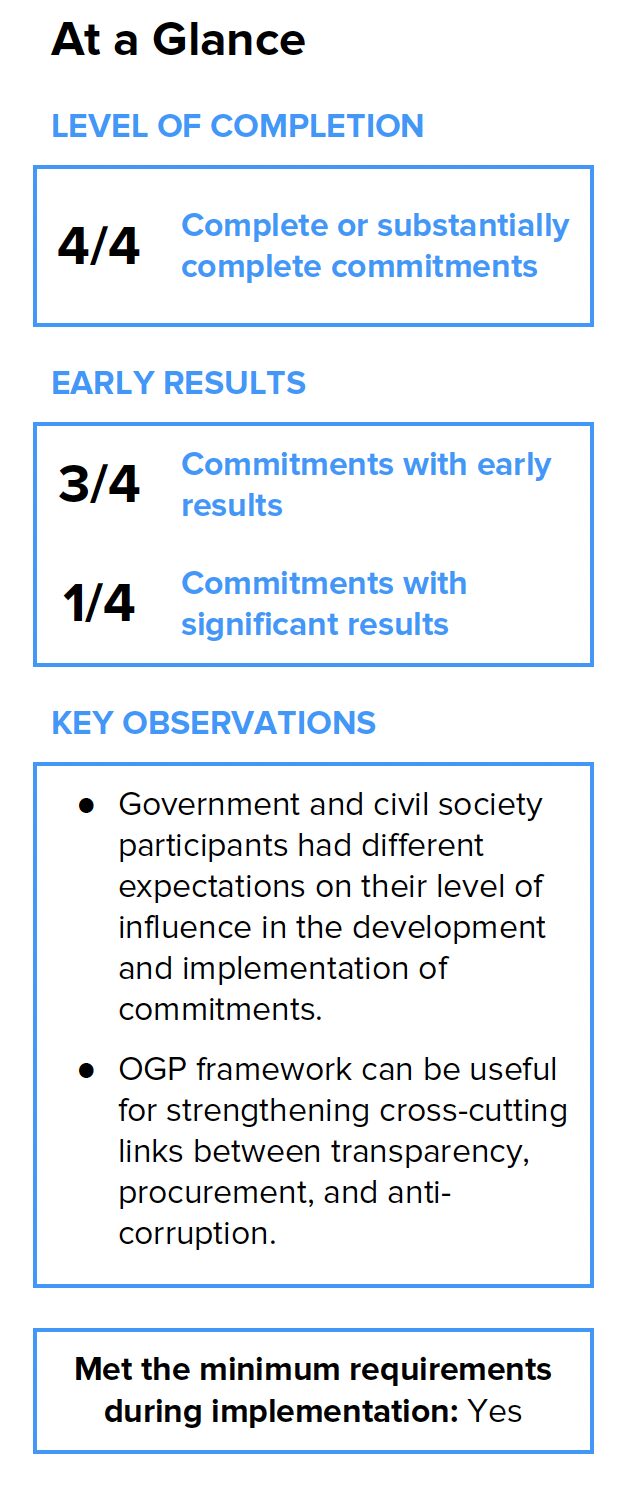
Sweden’s fifth OGP action plan comprised four commitments, three of which were fully completed and led to early results. Sweden adopted the Open Data Charter, and the Agency for Digital Government (Digg) made progress on implementing the Charter’s principles by providing new resources and capacity buildingEnhancing the skills, abilities, and processes of public servants, civil society, and citizens is essential to achieving long-lasting results in opening government. Technical specifications: Set of ac... on open data for government organizations (Commitments 1 and 2). The government’s second anti-corruption plan was another main outcome, which the Ministries of Finance and JusticeTo address barriers that prevent citizens from having their justice needs met, OGP participating governments are working to expand transparency, accountability, and inclusion into all systems of justi... produced in consultation with civil society (CommitmentOGP commitments are promises for reform co-created by governments and civil society and submitted as part of an action plan. Commitments typically include a description of the problem, concrete action... 4). More significant progress on opening public procurementTransparency in the procurement process can help combat corruption and waste that plagues a significant portion of public procurement budgets globally. Technical specifications: Commitments that aim t... More data has continued beyond the implementation period into 2026 (Commitment 3).
Participation and Co-Creation
The Ministry of Finance ensured that Sweden met the minimum requirementsAll OGP participating countries are expected to adhere to the Participation and Co-Creation Standards. Each Standard includes clear and measurable minimum requirements that all OGP participating count... for OGP’s Participation and Co-Creation StandardsCollaboration between government, civil society and other stakeholders is at the heart of the OGP process. The Participation and Co-Creation Standards are intended to support this collaboration throug....
Improving upon previous cycles, the government ensured the availability of reasoned responseOngoing dialogue between stakeholders during the development of an OGP action plan is critical to the plan’s success. Specifically, communicating back to stakeholders the ideas received and decisions ... during co-creation, the launch of an OGP webpage, and regular meetings with civil society throughout the implementation period.
There were differing expectations between government and civil society stakeholders on engagement during the development and implementation of commitments. While a Ministry of Finance representative stated that the Ministry valued the input received, some civil society organization (CSO) representatives indicated that it was unclear to what extent their comments were taken on board. Ultimately, this perception led some CSOs to reduce their engagement during the implementation period. This perception about influence on policy-making is also mirrored in other Swedish citizen consultation processes.[1]
Implementation in Context
Sweden’s commitments in its OGP action plan represented a subset of the country’s wider open government efforts. The country participates in OGP with a high baseline of openness, low levels of corruption, and a strong culture of public participation. Sweden remained among the top 10 countries in relevant global rankings, such as the 2024 World Justice Project’s Rule of Law Index and the 2025 Transparency International Corruption Perceptions Index.[2]
Internationally, Sweden has provided funding for democracy, governance, and open government initiatives through the Ministry of Foreign Affairs, the Swedish International Development Cooperation Agency (Sida), and the Swedish Association of Local Authorities and Regions.
[1] About one-third of Swedes (29 percent) find it likely that government would use inputs from citizens’ consultation, lower than the OECD average (32 percent). See Organisation for Economic Co-operation and Development (OECD), OECD Survey on Drivers of Trust in Public Institutions 2024 Results – Country Notes Sweden: Perceptions of decision making on complex policy issues, 10 July 2024, https://www.oecd.org/en/publications/oecd-survey-on-drivers-of-trust-in-public-institutions-2024-results-country-notes_a8004759-en/sweden_11ca1946-en.html#section-d1e185.
[2] World Justice Project, Rule of Law Index 2024: Sweden, 2024, https://worldjusticeproject.org/rule-of-law-index/country/2024/Sweden/Open%20Government; Transparency International, Corruption Perceptions Index 2025: Sweden, 2025, https://www.transparency.org/en/cpi/2025/index/swe.
Downloads
- Sweden_Results-Report_2023–2025_EN
- Sweden_Results-Report_2023–2025_SV
- Sweden_Results-Report_2023-2025_Comments-Received
Leave a Reply