In Côte d’Ivoire, A United Front Against Corruption
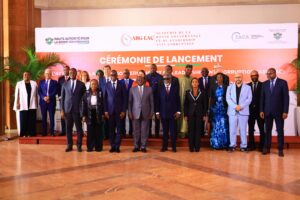
Credit: Haute Autorité pour la Bonne Gouvernance
For some years now, the fight against corruption in Côte d’Ivoire has no longer been waged behind closed doors. In the corridors of the Haute Autorité pour la Bonne Gouvernance (High Authority for Good Governance) and in meetings between NGOs, one method has become the norm: putting up a united front. A national strategy was born, co-constructed by the State and civil society, with a shared concern for efficiency and transparencyAccording to OGP’s Articles of Governance, transparency occurs when “government-held information (including on activities and decisions) is open, comprehensive, timely, freely available to the public,... More. Digitization of procedures, training of players, citizen budgeting, whistleblower protection: the task is vast, the resistance real, but the lines are moving. Here’s the story of a fragile but unprecedented dialogue between government and citizens.
In an Abidjan office, a pile of anonymous reports is waiting to be processed. Each in its own way, they denounce a suspicion of corruption. Since 2015, they have arrived by the hundreds at the High Authority for Good Governance (HABG), an institution born in 2013 and placed under the supervision of the presidency. The team investigates, passes on its findings to the public prosecutor’s office and then keeps quiet.
“The HABG is not a court. Its mission is to prevent and punish corruption and related offences. In terms of repression, it is upstream in the chain. Its role is to receive complaints and denunciations, process them, conduct investigations and pass on the findings to the Pôle Pénal Économique et Financier. The public prosecutor has the final say on whether or not to prosecute,” explains Esther Coulibaly, Director of Cooperation at the HABG.
Today, the HABG is one of the most visible faces in the fight against corruption in Côte d’Ivoire. But it is no longer alone. The country’s accession to the Open Government Partnership (OGP) in 2015 has helped to structure a broader space for dialogue, in which new voices have asserted themselves: those of NGOs, journalists, citizen collectives. Among them, that of Kouamé Dongo Kouman, national coordinator of Publish What You Pay – Côte d’Ivoire “In 2015, we understood that we had to speak with one voice (as civil society) to be heard,” he says. Kouman now sits on the OGP’s technical committee on behalf of the NGO Transparency JusticeTo address barriers that prevent citizens from having their justice needs met, OGP participating governments are working to expand transparency, accountability, and inclusion into all systems of justi... alongside government representatives.
Dialogue hasn’t always been easy. In the early days, it even bordered on incomprehension.
“Civil society expected immediate criminal sanctions. We had to explain our mandate, open our doors and reach out to the public. This pedagogy enabled us to truly co-create our commitments”, says Esther Coulibaly.
The first results are tangible. A synthetic citizen’s budget has been created to popularize public finance. A National Anti-Corruption Strategy (SNLC), covering the period 2024-2028, was adopted last June. It sets out fifty-four concrete actions in five priority areas: reforming the legal framework, strengthening controls, improving administration, consolidating anti-corruption bodies, and involving citizens.
Stronger commitments have emerged, focusing on the integrity of public services, through concrete actions such as the digitization of the administration or the generalization of asset declarations, mandatory at the beginning and end of the term of office for public servants.
“The declaration of assets is an essential tool. It must be made on entering and leaving office. Today, we are working on digitizing the entire process to better detect cases of illicit enrichment”, explains the Director of Cooperation.
Audits have been carried out in several government entities, leading to the dismissal of managers in key structures (Agence de Gestion et de Développement Informatique, Fonds d’Entretien Routier, Office National de la Statistique, Autorité de Régulation des Télécommunications/TIC de Côte d’Ivoire). In fact, several governance indicators used by the Millennium Challenge Corporation (MCC) went from red to green between 2011 and 2019, notably in terms of corruption control, government efficiency and civil liberties, which enabled Côte d’Ivoire to become eligible for a Compact program worth over $500 million signed in 2017.
Chantal Angoua, Technical Advisor to the Minister of Trade and Industry and Chair of the OGP’s Technical Committee, insists on another lever: technology. “Digital tools enable complaints to be processed more quickly, and verifications to be automated,” she explains. An integrated IT platform has been set up to manage asset declaration data. The Observatoire du Service Public (OSEP), a tripartite body bringing together the administration, the private sectorGovernments are working to open private sector practices as well — including through beneficial ownership transparency, open contracting, and regulating environmental standards. Technical specificatio... More and civil society, collects user complaints and monitors their processing. The Maison du Service Public, meanwhile, offers a single physical and digital gateway to a wide range of administrative services. “Digital isn’t just about modernization; it’s a way of reducing the scope for arbitrariness,” she stresses.
Citizens, now better equipped, can anonymously report acts of corruption through a number of digital or telephone channels. Mobile applications, toll-free numbers, online forms: these are all discreet and accessible means that reinforce their role in monitoring public action.
Côte d’Ivoire’s approach has attracted interest beyond its borders. The HABG has forged partnerships with its counterparts in Senegal, Chad and Burkina Faso. In 2024, it launched an Academy of Good Governance with the support of the International Academy of Vienna. Two hundred auditors from the public and private sectors have already been trained.
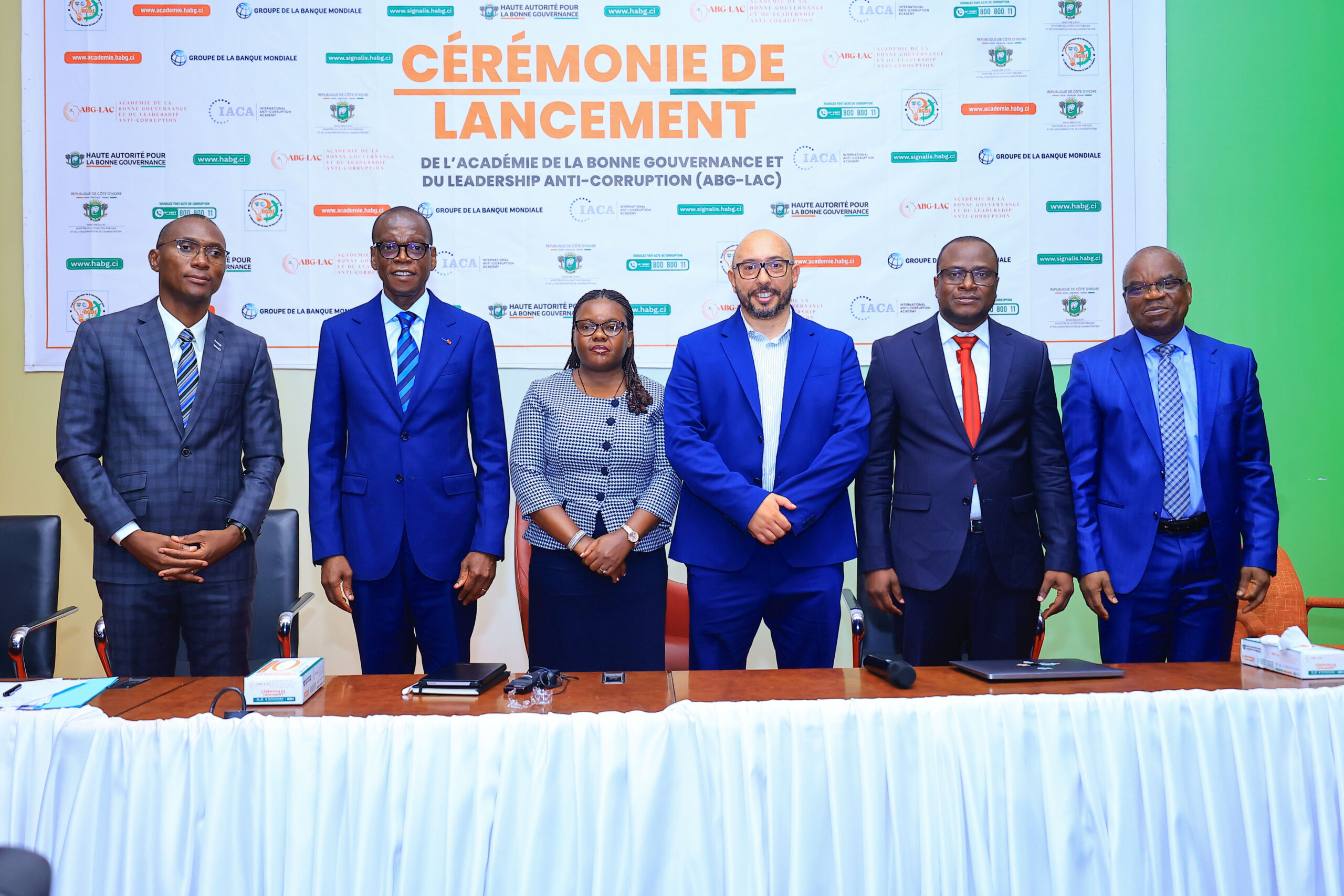
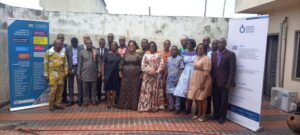
Launch of the Academy for Good Governance and Anti-Corruption Leadership (ABG-LAC)PHOTO: Credit: Haute Autorité pour la Bonne Gouvernance
Civil society, for its part, is pursuing its advocacy efforts. The creation of a national governance index is underway, as is a draft bill to protect whistle-blowers. On the ground, expectations remain high. “We’ve laid the foundations, now we need to follow up line by line,” says Kouman.
In a country still marked by political tensions and the memory of conflict, transparency is progressing by small steps. While there is still room for improvement, the gradual consolidation of dialogue between public institutions and civil society represents a structuring lever for more responsible and inclusive governance.
This blog is supported by the French Development Agency (AFD). The ideas and opinions expressed are those of the authors and do not necessarily reflect the views of the French Development Agency.
No comments yet
Related Content

Behind the Scenes of African Parliaments: Transparency in the Making
Au Maroc, en Côte d’Ivoire et au Ghana, des efforts soutenus sont à l’œuvre pour retisser le lien entre institutions parlementaires et citoyenneté. Lire la suite pour en savoir plus.
 Case Studies
 Co-Creation in Action: How Benin is Making Budgets Work for People
Learn how citizen action in Benin is turning open budgets into real change—from fixing textbook gaps to funding rural healthcare.
 Insights
 Francophone Africa: Civil Society Weaves a Network for Transparency
Across WhatsApp chats and Zoom screens, from Dakar to Rabat, a quiet movement is threading its way through Francophone Africa. It’s not loud, but it’s determined: a growing network of…
Leave a Reply