
Keeping the Courts Open and Honest in Colombia
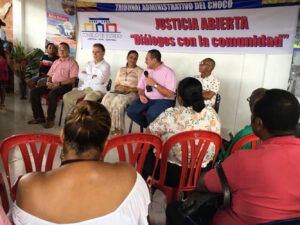
Citizens gather for a community dialogue on justice in Quibdó, Colombia | Credit: Consejo Estado – Rama Judicial (Colombia)
Summary
In Colombia, a collaboration between the Council of State and its citizens has led to a more transparent judicial system that is accountable to the people.
Submitted by: Open Government PartnershipThe Open Government Partnership (OGP) is a multi-stakeholder initiative focused on improving government transparency, ensuring opportunities for citizen participation in public matters, and strengthen... More
A New Era of Collaboration Begins
A Culture of Mistrust
For a democracy to be functional well, the courts serve a number of important roles, including a check on the government’s power. This means at times serving as a buffer between the government and the public, to ensure that equality under the law is maintained. When it fails at this and aligns with the government, it becomes more of a partisan political force than a neutral legal one. Colombians have historically had little faith in their judiciaryWhile a majority of open government reforms occur within the executive branch, OGP members are increasingly taking on commitments to increase the openness of the judicial branch. Technical specificati..., including the Council of State, the country’s highest administrative court. Despite various attempts at legal reform, the sense among the Colombian public was that the courts were corrupt, wielding their power for political reasons.
A turning point came in 2015, when a prominent businessman accused of murder was allowed to go free. The prosecutor’s office arrested 11 members of the judiciary responsible for this miscarriage of justiceTo address barriers that prevent citizens from having their justice needs met, OGP participating governments are working to expand transparency, accountability, and inclusion into all systems of justi....
Judicial Accountability, Transparency, and Commitments to Honesty
The Colombian government, working with civil society organizations, resolved to tackle corruption in the judiciary. A commitmentOGP commitments are promises for reform co-created by governments and civil society and submitted as part of an action plan. Commitments typically include a description of the problem, concrete action... in Colombia’s 2015-2017 action planAction plans are at the core of a government’s participation in OGP. They are the product of a co-creation process in which government and civil society jointly develop commitments to open government ... sought to bring transparencyAccording to OGP’s Articles of Governance, transparency occurs when “government-held information (including on activities and decisions) is open, comprehensive, timely, freely available to the public,... More and accountability to the Council of the State. This move to keep the courts honest is an important change in judicial transparency.
This commitment signifies an exceptional change in judicial sector transparency. Colombia continues to implement different elements of this commitment and open the Council of State in other ways. For example, Colombia aims to create mechanisms for judicial accountability and publish information on potential conflicts of interestA key part of anti-corruption involves preventing or revealing conflicts of interest — when a public official is in a position to use public office for personal or private gain. Technical specificatio... of judges and court personnel. In the long term, these changes can reduce corruption in the institutions of justice and allow them to regain the public trust.
A New Era of Openness; Agendas, Procedures, and Resumes
By publishing its agendas and past rulings online, the court made it possible for the public and civil society organizations to scrutinize the court’s actions in search of corruption or conflicts of interest. Additionally, now available are the resumes of lawyers aspiring to become counselors, so that the records of the people occupying the courts can be studied for potential concerning actions or associations.
Further information has been published, some of it to help equip the public to scrutinize these newly opened records. These include explanations of legal proceedings and precedents, and how to interpret the law. It also published a series of guides on proper legal procedures to be followed by the courts. Together these allow the public to both understand legal processes and recognize when a court has deviated from the legal best practice. For the first time, the court is publishing information on its agendas, past decisions and procedures online. This allows citizens and civil society organizations to better understand complex court functions and watch the court’s action for potential corruption.
The reform marks a new era of openness, bringing the citizens and courts closer. With the ability to see the agenda and decisions of the judges, and to identify where conflicts of interest may arise, the public is able to scrutinize the courts and use new mechanisms to hold it accountable. A monitoring committee, composed of government, civil society, and citizen figures, is able to use the new guidelines on legal propriety to watch out for and report any potential instances of corruption.
This commitment was continued into Colombia’s 3rd and 4th action plans, building on the foundational reforms, and strengthening the mechanisms to hold the courts accountable, building trust between the courts and the public.
Leave a Reply