
Albania Results Report 2023-2025
- Action Plan: Albania Action Plan 2023-2025
- Dates Under Review: 2023-2025
- Report Publication Year: 2026
Albania’s sixth action planAction plans are at the core of a government’s participation in OGP. They are the product of a co-creation process in which government and civil society jointly develop commitments to open government ... delivered moderate early resultsEarly results refer to concrete changes in government practice related to transparency, citizen participation, and/or public accountability as a result of a commitment’s implementation. OGP’s Independ... More in public procurementTransparency in the procurement process can help combat corruption and waste that plagues a significant portion of public procurement budgets globally. Technical specifications: Commitments that aim t... More transparencyAccording to OGP’s Articles of Governance, transparency occurs when “government-held information (including on activities and decisions) is open, comprehensive, timely, freely available to the public,... More and public consultation, driven by strong political backing and oversight. Implementation was weaker across the rest of the plan. Although the action plan was co-created with a formal multi-stakeholder forumRegular dialogue between government and civil society is a core element of OGP participation. It builds trust, promotes joint problem-solving, and empowers civil society to influence the design, imple..., there was limited government outreach to civil society during implementation. For future action plans, the government could extend capacity and engagement beyond the Office of the Prime Minister and reach out to a wider range of civil society and private sectorGovernments are working to open private sector practices as well — including through beneficial ownership transparency, open contracting, and regulating environmental standards. Technical specificatio... More groups.
Implementation
Albania’s 2023–2025 action plan had 24 commitments covering areas such as monitoring integrity plans, beneficial ownershipDisclosing beneficial owners — those who ultimately control or profit from a business — is essential for combating corruption, stemming illicit financial flows, and fighting tax evasion. Technical spe... More transparency, access to justiceAccessible justice systems – both formal and informal – ensure that individuals and communities with legal needs know where to go for help, obtain the help they need, and move through a system that of... More, open dataBy opening up data and making it sharable and reusable, governments can enable informed debate, better decision making, and the development of innovative new services. Technical specifications: Polici..., public service deliveryTo ensure that citizens of all groups are better supported by the government, OGP participating governments are working to improve the quality of and access to public services. Commitments in this are... More, open contractingA transparent procurement process, known as open contracting, increases competition, improves public service delivery, and ensures governments better value for their money. Technical specifications: C... More and fiscal transparency, innovation in the defense sector, inclusivity in public services, public consultations and regulatory impact assessments, and open parliamentEnsuring access to legislative information and creating mechanisms for public participation are critical to building an open, trusting relationship with citizens. Technical specifications: Commitments... More.
The action plan achieved moderate early results in two commitments: transparency of public procurement (CommitmentOGP commitments are promises for reform co-created by governments and civil society and submitted as part of an action plan. Commitments typically include a description of the problem, concrete action... 15) and public consultation and regulatory impact assessments (Commitment 23). For Commitment 15, the Public Procurement Agency upgraded the e-procurement systems and strengthened monitoring of procurement, while the Public Procurement Commission fully digitalized the complaints process, giving the public easier access to contract data and appeals. For Commitment 23, the Office of the Prime Minister published regular performance reports and ensured that nearly all primary draft acts were subject to consultation on the e-consultation portal. Both commitments closely aligned with Albania’s ambitionAccording to OGP’s Articles of Governance, OGP commitments should “stretch government practice beyond its current baseline with respect to key areas of open government.” Ambition captures the potentia... for accession to the European Union (EU) by 2030, namely EU Chapter 5 obligations to reinforce wider public administration modernization. However, transparency and accountability gaps remain. Public private partnership and concession contracts are not continuously published, while drafting specifications and evaluation of tenders remain outside the scope of current reforms.
Additionally, public consultations remain overly formal with limited outreach and input from citizens and stakeholder groups.
Other commitments showed weaker levels of implementation or had unclear potential for results. This includes Commitment 12 on awareness and educationAccountability within the public education system is key to improving outcomes and attainment, and accountability is nearly impossible without transparent policies and opportunities for participation ... of the public on budget transparency, the sole commitment identified as promising in the IRM Action Plan Review, which had a limited level of implementation.
Participation and Co-Creation
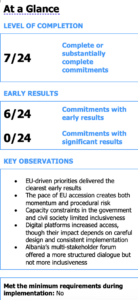
Albania’s sixth action plan was the country’s first to be co-created and implemented with a formal multi-stakeholder forum, the Multi-Stakeholder Committee (MSC). During implementation, however, political leadership of the MSC shifted due to government restructuring, meetings were less frequent, and outreach was limited. Civil society engagement with the MSC was largely formal. Participation in implementation of specific commitments concentrated around well-established and capital-based CSOs and focused on central institutions that were more receptive to civil society contributions. Compared to earlier cycles, the process showed stronger structural organization through the establishment of the MSC, but this institutional improvement did not lead to broader inclusiveness in practice. Unlike the co-creation phase, during implementation Albania did not fully meet the OGP Participation and Co-Creation Standards’ minimum requirementsAll OGP participating countries are expected to adhere to the Participation and Co-Creation Standards. Each Standard includes clear and measurable minimum requirements that all OGP participating count..., due to the absence of MSC meetings in the second half of 2023 and the first half of 2025, as well as the lack of updates on the country’s online repositoryAccess to relevant information is essential for enabling participation and ensuring accountability throughout the OGP process. An OGP repository is an online centralized website, webpage, platform or ... (see Section III).
Implementation in Context
EU accession remains the strongest driver of reforms in Albania, shaping both the pace and content of OGP commitments. The government’s ambition to join the EU by 2030 has created momentum for technical upgrades, improved monitoring, and performance reporting. However, it also creates risks that fast-tracked reforms may bypass meaningful consultation. Progress in Albania’s sixth OGP action plan was more visible where strong political backing and central institutions with clear mandates and external support were present. This central positioning and political attention proved decisive in driving early results, even as broader implementation challenges persisted. Institutional changes due to government restructuring prevented the MSC from meeting regularly, though technical coordination continued uninterrupted. Donor-funded CSO tools like Open Procurement Albania continued to play a critical role in the transparency of public procurement, but face sustainability risks as international funding shifts. Overall, Albania’s open government journey is becoming more institutionalized, led by central bodies, and complementary to ongoing EU accession reforms, but its impact depends on extending resources and inclusiveness across all institutions and stakeholders.
Leave a Reply