Argentina Results Report 2022-2024
- Action Plan: Argentina Action Plan 2022-2024
- Dates Under Review: 2022-2024
- Report Publication Year: 2025
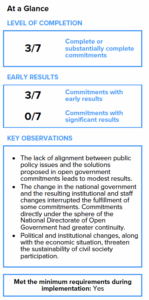
Argentina’s fifth open government plan (2022-2024) was partially fulfilled. The change in the national government in December 2023 affected the institutional and technical capacity to complete the previous administration’s commitments. While federal participation spaces were expanded and civil society consultations were maintained, institutional and economic challenges threaten to reverse the progress made.
Implementation
Argentina’s fifth Open Government National Action Plan lists seven commitments related to the following areas of public policy: the environment, public works, health, and gender, which were addressed in previous action plans. Additionally, the plan introduces two new areas for open government advancements: mental health and care policies. A seventh commitment, focused on an Open State, was added after the plan was reviewed to ensure continuity with actions initiated in the fourth plan.[1]
The areas that showed the most progress were the environment (CommitmentOGP commitments are promises for reform co-created by governments and civil society and submitted as part of an action plan. Commitments typically include a description of the problem, concrete action... 1) and the Open State (Commitment 7). In both cases, meetings and training sessions were held across the country, and new outreach and transparencyAccording to OGP’s Articles of Governance, transparency occurs when “government-held information (including on activities and decisions) is open, comprehensive, timely, freely available to the public,... More materials were developed. Initial steps were also taken to establish consultation and exchange forums with civil society in various cities and provinces.
Despite the substantial completionImplementers must follow through on their commitments for them to achieve impact. For each commitment, OGP’s Independent Reporting Mechanism (IRM) evaluates the degree to which the activities outlined... More of these two commitments, the outcomes were moderate. While some new tools were introduced and new coordination bodies were established, their long-term institutionalization and sustainability remain unclear.
As for the other commitments, the fifth plan was partially completed. The change in national government in December 2023 caused a restructuring of the executive branch that hindered the implementation of several commitments and milestones.[2]
Participation and Co-Creation
Four civil society organizations are part of the National Roundtable of Open Government. For the 2022-2024 period, these were: Democracia en Red, Directorio Legislativo, Red Ciudadana Nuestra Córdoba, and Escuela de Fiscales.[3] The latter joined the National Board as a substitute after Somos Pares—an organization focused on gender equality—withdrew due to an internal restructuring and following the elimination of the Ministry of Women from the state’s organizational chart.[4]
Following the change of government in December 2023, there was a multi-month hiatus in the National Roundtable of Open Government’s operations, along with various communication issues between civil society and the government. The roundtable met four times in 2024. Despite reported changes in the dynamic and frequency of collaboration, civil society highlighted the new administration’s continued compliance with meetings and reporting.[5] The minimum requirementsAll OGP participating countries are expected to adhere to the Participation and Co-Creation Standards. Each Standard includes clear and measurable minimum requirements that all OGP participating count... of the OGP participation and co-creation standardsCollaboration between government, civil society and other stakeholders is at the heart of the OGP process. The Participation and Co-Creation Standards are intended to support this collaboration throug... were met throughout the entire cycle.
Implementation in Context
The change in government in December 2023 caused staff turnovers, a lack of designated representatives, and communication issues with civil society, which in turn affected the commitments’ implementation. The elimination or restructuring of ministries and secretariats meant some commitments were left without identified contacts or the teams responsible for continuing their work.[6] Furthermore, programmatic differences between the new and former administrations led to the explicit or implicit abandonment of some commitments that were partially initiated or fulfilled in 2023.[7]
The economic and social situation in Argentina, coupled with changes in civil society funding in early 2025[8], also presents new challenges to civil society’s involvement in the open government agenda.
[1] Action Plan Review: Argentina 2022-2024, IRM, p. 5. https://www.opengovpartnership.org/es/documents/argentina-action-plan-review-2022-2024/
[2] Highlighted by all interviewed civil society representatives.
[3] National Roundtable of Open Government, consulted on May 14, 2025, https://ogp-sociedadcivilargentina.org/
[4] Emilse Carrizo (Open Government Agenda Representative, Red Ciudadana Nuestra Córdoba), interview by IRM researcher, April 1, 2025; Morena Bao (Head of Citizenship and Government Institutions Projects, Directorio Legislativo), interview by IRM researcher, March 29, 2025.
[5] Emilse Carrizo (Open Government Agenda Representative, Red Ciudadana Nuestra Córdoba), April 1, 2025; Cecilia Ibarra (Former Project Lead, Democracia en Red), interview by IRM researcher, March 31, 2025.
[6] Betiana Cáceres (Director of General Services Division, Fundación Huésped), interview by IRM researcher, March 25, 2025; Carmen Ryan (Director of Institutional Development, Fundación Huésped), interview by IRM researcher, March 25, 2025; Cecilia Ibarra (Former Project Lead, Democracia en Red), interview by IRM researcher, March 31, 2025; Emilse Carrizo (Open Government Agenda Representative, Red Ciudadana Nuestra Córdoba), April 1, 2025.
[7] Morena Bao (Head of Citizenship and Government Institutions Projects, Directorio Legislativo), March 29, 2025; Cecilia Ibarra (Former Project Lead, Democracia en Red), March 31, 2025; Emilse Carrizo (Open Government Agenda Representative, Red Ciudadana Nuestra Córdoba), April 1, 2025.
[8] See for example, “The suspension of USAID funds, the latest major blow to the independent Latin American press,” El País, February 16, 2025, https://elpais.com/us/2025-02-16/la-suspension-de-fondos-de-usaid-el-ultimo-gran-golpe-a-la-prensa-independiente-latinoamericana.html, “What is USAID, who does it fund, and how could its closure affect them?” CNN en Español, February 3, 2025, https://cnnespanol.cnn.com/2025/02/03/mundo/que-es-usaid-paises-financia-orix , “Does U.S. Democracy AidMore and better information about aid helps partner countries and donor institutions plan and manage aid resources more effectively, parliaments and civil society to hold governments accountable for t... Have a Future?” Carnegie Endowment for International Peace, March 3, 2025.
Leave a Reply