
Dominican Republic: Action Plan Review 2024-2028
- Action Plan: Dominican Republic Action Plan 2024-2028
- Dates Under Review: 2024-2028
- Report Publication Year: 2025
The Dominican Republic’s sixth Action PlanAction plans are at the core of a government’s participation in OGP. They are the product of a co-creation process in which government and civil society jointly develop commitments to open government ... is notably tech-focused: nine of its ten commitments involve the integration or development of digital platforms, and three specifically mention using artificial intelligence. While all commitments include innovative components, four are particularly promising. However, some primarily address internal public administration functions and lack a clear connection to open government principles. These could be strengthened in the plan’s next update by more directly aligning the proposed solutions with open government principles.
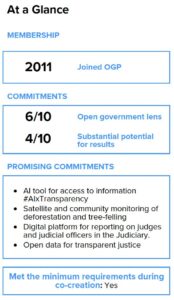
The Dominican Republic’s sixth action plan features 10 commitments covering a wide array of themes, including bureaucratic procedures, citizen complaints, health, and justice. The plan marks the introduction of open budgets to the country’s open government agenda and builds upon previous initiatives related to the environment, employability, public services, and open data. The plan did not contain any commitments from the municipal sector.[1]
For the first time, the action plan will have a four-year implementation period (2024–2028). It includes four commitments considered “promising” for their relevanceAccording to the OGP Articles of Governance, OGP commitments should include a clear open government lens. Specifically, they should advance at least one of the OGP values: transparency, citizen partic..., innovative nature, and potential to achieve significant results.
The first promising commitmentThrough the Action Plan Review, OGP’s Independent Reporting Mechanism (IRM) recognizes promising commitments that address a policy area that is important to stakeholders or the national context. Promi... (CommitmentOGP commitments are promises for reform co-created by governments and civil society and submitted as part of an action plan. Commitments typically include a description of the problem, concrete action... 1: AI tool for access to information) leverages generative artificial intelligence, like “Chat GPT,” to improve public access to information. The second (Commitment 5: Satellite and Community Monitoring of Deforestation and Tree-Felling) aims to provide citizens with deforestation data from the Reforestation Initiatives Information and Management System (SIGIR), encouraging public oversight of illegal logging. The third (Commitment 9: Digital platform for reporting on judges and judicial officers of the JudiciaryWhile a majority of open government reforms occur within the executive branch, OGP members are increasingly taking on commitments to increase the openness of the judicial branch. Technical specificati...) will create a secure platform for filing complaints about ethical violations, conflicts of interestA key part of anti-corruption involves preventing or revealing conflicts of interest — when a public official is in a position to use public office for personal or private gain. Technical specificatio..., and misconduct by judicial officials. Finally, the fourth (Commitment 10: Open DataBy opening up data and making it sharable and reusable, governments can enable informed debate, better decision making, and the development of innovative new services. Technical specifications: Polici... for Transparent JusticeTo address barriers that prevent citizens from having their justice needs met, OGP participating governments are working to expand transparency, accountability, and inclusion into all systems of justi...) will see the Judiciary create an Open Data Policy and start regularly publishing data in an open format.
A significant milestone of this action plan is the inclusion of commitments to be implemented by branches of government other than the executive. The Judiciary will be responsible for implementing the final three commitments: “Data Interconnection in the Justice and Security System,” “Digital Platform for Reporting on Judges and Judicial Officers of the Judiciary,” and “Open Data for Transparent Justice.” This marks a major step toward the country’s goal of an Open State, aligning with a key recommendation from the IRM’s 2022–2024 Action Plan Review report.[2]
The Dominican Republic continues to improve how it drafts most of its commitments, particularly by enhancing their specificity, defining success, and developing quantifiable indicators to measure progress and completionImplementers must follow through on their commitments for them to achieve impact. For each commitment, OGP’s Independent Reporting Mechanism (IRM) evaluates the degree to which the activities outlined... More. However, there is still an opportunity to identify how to address co-creation issues with actions that are more directly relevant to open government.
Based on the IRM’s assessment, four of the ten commitments lack a clear open government lens. This is because their implementation focuses on internal administrative functions—like developing digital platforms or managing technological systems—rather than on public-facing activities. As a result, they don’t have a direct, immediate impact on citizens in terms of transparencyAccording to OGP’s Articles of Governance, transparency occurs when “government-held information (including on activities and decisions) is open, comprehensive, timely, freely available to the public,... More, public disclosure, participation, or accountability. While these actions may be necessary preliminary steps for future initiatives, achieving open government results will require adding more public-facing measures to the commitments, particularly in their milestones. This is especially true for Commitment 3 (“SoyYoRD – My Citizen Folder”), Commitment 6 (“Single Health Record”), Commitment 7 (“#PasantíasPúblicasRD” for the national public internship system), and Commitment 8 (“Data Interconnection in the Justice and Security System”). Adding specific open government elements that directly impact citizens could significantly improve the potential of these commitments. This would be reflected in the action plan’s midterm assessment.
The country’s open government agenda is coordinated by a multi-stakeholder forum led by the General Directorate of Ethics and Government Integrity (DIGEIG). The forum includes six members from the Executive Branch, three from civil society, one from the business sector, and two from academia. Members for the 2024–2028 action plan were selected through an open process where each civil society sector nominated its candidates. A committee of experts—comprising former forum members, civil society organizations, and academics—then evaluated the nominations and chose the new members.[3] The forum’s scope, responsibilities, and characteristics were legally established by decrees 713-2021[4] and 9-22[5] dated November 4, 2021, and January 17, 2022, respectively.
According to civil society members who took part in the action plan’s co-creation process[6], the effort featured adequate outreach and provided participants with the necessary background information. They also noted that progress was well-communicated[7], and that participants received feedback on how their proposals were used or why they were not considered.[8] All of this information was published on a dedicated website that served as an open government repository throughout the entire co-creation process.[9]
[1] Subsequent to the drafting of this report, the country incorporated an additional commitment proposed by the municipal sector. Berenice Barinas Ubiñas, Executive Director, General Directorate of Ethics and Government Integrity (DIGEIG). Correspondence from July 22, 2025
[2] Independent Reporting Mechanism, “Action Plan Review: Dominican Republic 2022-2024,” August 8, 2024: https://www.opengovpartnership.org/es/documents/dominican-republic-action-plan-review-2022-2024/
[3] General Directorate of Ethics and Government Integrity Presidency of the Republic, Dominican Republic, VI Action Plan of the Dominican Republic to the Open Government Partnership 2024-2028, https://www.opengovpartnership.org/wp-content/uploads/2025/01/Dominican-Republic_Action-Plan_2024-2028_ES.pdf
[4] Presidency of the Republic, Dominican Republic, Decree NUMBER: 713-21: https://gobiernoabierto.gob.do/wp-content/uploads/2022/01/713-21-Fomento-y-la-Creacion-de-un-Foro-Multiactor-para-un-GA.pdf
[5] Presidency of the Republic, Dominican Republic, Decree NUMBER: 9-22:https://gobiernoabierto.gob.do/wp-content/uploads/2022/08/Decreto-9-22-Modifica-el-articulo-6-decreto-713-21.pdf
[6] Eduardo Hernández (Executive Director and Founder of Fundación Verdad and the i-Bids platform, member of the multi-stakeholder forumRegular dialogue between government and civil society is a core element of OGP participation. It builds trust, promotes joint problem-solving, and empowers civil society to influence the design, imple... of the Dominican Republic). Interview conducted on March 10, 2025.
[7i] Co-creation timeline, VI Action Plan of the Dominican Republic to the Open Government Partnership 2024-2028:https://gobiernoabierto.gob.do/cronograma-co-creacion-del-vi-plan-de-accion-de-la-republica-dominicana-ante-la-alianza-para-el-gobierno-abierto-2024-2028/
[8] Government of the Dominican Republic, “Reasoned responses from the co-creation process of the VI Action Plan of the Dominican Republic, to the Open Government Partnership 2024-2028,”, https://gobiernoabierto.gob.do/wp-content/uploads/2024/12/Respuestas-Razonadas-del-proceso-de-cocreacion-del-VI-Plan-de-Accion-de-la-Republica-Dominicana-ante-la-Alianza-para-el-Gobierno-Abierto-2024-2028.pdf
Leave a Reply