Kosovo Results Report 2023-2025
- Action Plan: Kosovo Action Plan 2023-2025 (December)
- Dates Under Review: 2023-2025
- Report Publication Year: 2026
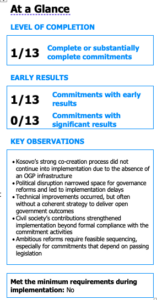
Kosovo’s first OGP action planAction plans are at the core of a government’s participation in OGP. They are the product of a co-creation process in which government and civil society jointly develop commitments to open government ... (2023–2025) improved the transparencyAccording to OGP’s Articles of Governance, transparency occurs when “government-held information (including on activities and decisions) is open, comprehensive, timely, freely available to the public,... More of recruitment of high-level officials. However, most of the other commitments saw limited completionImplementers must follow through on their commitments for them to achieve impact. For each commitment, OGP’s Independent Reporting Mechanism (IRM) evaluates the degree to which the activities outlined... More. The action plan was co-created through an open and inclusive process, but implementation lacked central coordination and stakeholder engagement. Future action plans could benefit from a more systematic OGP infrastructure and structured partnerships with civil society in co-creating and co-implementing commitments.
Implementation
Kosovo’s 2023–2025 action plan included 13 commitments spanning digital governanceAs evolving technologies present new opportunities for governments and citizens to advance openness and accountability, OGP participating governments are working to create policies that deal with the ... More, open dataBy opening up data and making it sharable and reusable, governments can enable informed debate, better decision making, and the development of innovative new services. Technical specifications: Polici..., citizen pa
rticipation in decision-making, civic space, public procurementTransparency in the procurement process can help combat corruption and waste that plagues a significant portion of public procurement budgets globally. Technical specifications: Commitments that aim t... More, and political financeProviding for transparency in the funding of campaigns, political parties, and democratic politics is an essential accountability mechanism for democratic government and is a growing focus area in OGP... More transparency. CommitmentOGP commitments are promises for reform co-created by governments and civil society and submitted as part of an action plan. Commitments typically include a description of the problem, concrete action... 4.2 (transparent recruitment of high-level officials) achieved substantial completion. This commitment led to a new legal framework and a central human resources management platform contributed to a more standardized recruitment process, with public vacancy announcements and online applications. However, transparency gaps remained (e.g., lack of panel-level scoring disclosure and inconsistent justification practices), integrity safeguards were not institutionalized as foreseen, and the reliance on acting appointments limited the contribution of reforms to public trust and accountability.
Other commitments progressed unevenly or were stalled. Many commitments that involved digital platforms such as the national open data portal (Commitments 2.1-2.4) and the e-municipality (“e-Komunat”) portal (Commitment 1.2) were impacted by uneven technical and human capacities in government, as well as platform functionality issues. The two commitments identified as the most ambitious in the IRM Action Plan Review (Commitment 4.1 on public procurement transparency and Commitment 4.3 on political finance transparency) depended on the passage of legislationCreating and passing legislation is one of the most effective ways of ensuring open government reforms have long-lasting effects on government practices. Technical specifications: Act of creating or r... and did not move forward due to the absence of a functioning Parliament for most of the implementation period. Moreover, a prolonged gap in central coordination of the action plan limited implementation.
Participation and Co-Creation
Kosovo co-created its first action plan through an inclusive process, with a multi-stakeholder forumRegular dialogue between government and civil society is a core element of OGP participation. It builds trust, promotes joint problem-solving, and empowers civil society to influence the design, imple... (the National Coordinating Committee – NCC), multiple thematic workshops, public discussions, and an extended online consultation. Civil society widely reported that their inputs were reflected in the final plan, supported by an engaged Point of Contact during co-creation. In contrast, participation stalled during implementation. Kosovo operated for an extended period without an active point of contact at the Ministry of Local Government Administration (MLGA) after the plan’s adoption, the NCC did not meet during implementation, and there was no systematic outreach or reporting to civil society. The dedicated OGP website, initially maintained by civil society, was not updated during implementation and remained non-functional even after technical transfer to the government, leaving no accessible repositoryAccess to relevant information is essential for enabling participation and ensuring accountability throughout the OGP process. An OGP repository is an online centralized website, webpage, platform or ... of evidence or progress tracking. As a result, Kosovo did not meet the minimum requirementsAll OGP participating countries are expected to adhere to the Participation and Co-Creation Standards. Each Standard includes clear and measurable minimum requirements that all OGP participating count... for implementation under the OGP Participation and Co-Creation StandardsCollaboration between government, civil society and other stakeholders is at the heart of the OGP process. The Participation and Co-Creation Standards are intended to support this collaboration throug.... In June 2025, the MLGA established a division dedicated to OGP, which led the process of designing the new Action Plan 2026-2028 and is expected to strengthen continuity of coordination, support more regular stakeholder dialogue, and improve public tracking and reporting of implementation.
Implementation in Context
Implementation took place amid a complex and volatile political environment in Kosovo. The 2024 context was shaped by heightened Kosovo-Serbia tensions, stalled international and EU-integration processes, and security-dominated public debate, which narrowed political attention for governance reforms. In 2025, recurrent electionsImproving transparency in elections and maintaining the independence of electoral commissions is vital for promoting trust in the electoral system, preventing electoral fraud, and upholding the democr... More and institutional paralysis further constrained reform delivery: prolonged delays in constituting the Parliament, a caretaker government with limited powers, and repeated election cycles reduced the space for inter-institutional coordination and sustained policy follow-through. These dynamics contributed to fragmented delivery of commitments across institutions and limiting opportunities for structured stakeholder monitoring and accountability.
Downloads
- Kosovo_2023-2025_Results-Report_EN
- Kosovo_2023-2025_Results-Report_SQ
- Kosovo Results Report 2023-2025 – Comments Received
Leave a Reply