Côte d’Ivoire Results Report 2022-2024
- Action Plan: Cote d’Ivoire Action Plan 2022-2024
- Dates Under Review: 2022-2024
- Report Publication Year: 2025
Côte d’Ivoire’s fourth action planAction plans are at the core of a government’s participation in OGP. They are the product of a co-creation process in which government and civil society jointly develop commitments to open government ... notably enhanced civic participation in assessing public services, anti-corruption efforts, and advancing environmental governance. Collaboration between the government and civil society on OGP continued to strengthen, with jointly implemented commitments showing the most progress. However, other commitments saw limited advancement due to weak connections to open government values.
Implementation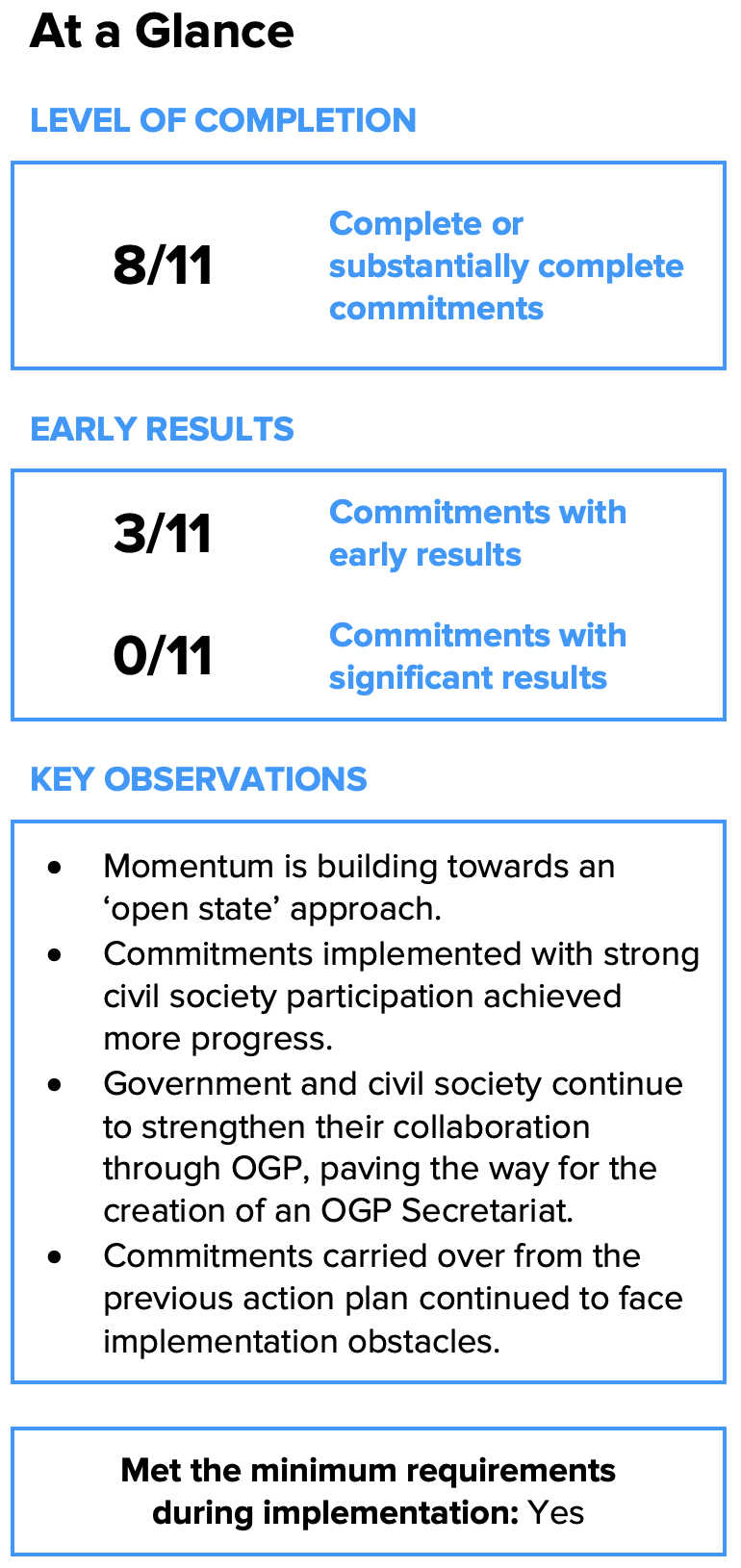
Côte d’Ivoire’s fourth action plan achieved high levels of completionImplementers must follow through on their commitments for them to achieve impact. For each commitment, OGP’s Independent Reporting Mechanism (IRM) evaluates the degree to which the activities outlined... More but limited early resultsEarly results refer to concrete changes in government practice related to transparency, citizen participation, and/or public accountability as a result of a commitment’s implementation. OGP’s Independ... More. Some commitments had limited connection to open governance, while others encountered obstacles in implementation. Three of eleven commitments achieved early results by the end of the implementation period.
This report provides detailed analyses of Commitments 4, 6 and 9, which made notable progress strengthening civil society participation in government decision-making.
Through CommitmentOGP commitments are promises for reform co-created by governments and civil society and submitted as part of an action plan. Commitments typically include a description of the problem, concrete action... 4, the government launched Côte d’Ivoire’s first National Anti-Corruption Strategy, to be implemented in partnership with civil society, the private sectorGovernments are working to open private sector practices as well — including through beneficial ownership transparency, open contracting, and regulating environmental standards. Technical specificatio... More, and the public.
Under Commitment 6, civil society members conducted satisfaction surveys and provided feedback to government departments on public services. Government entities in educationAccountability within the public education system is key to improving outcomes and attainment, and accountability is nearly impossible without transparent policies and opportunities for participation ... and finance used these findings to improve services.
Under Commitment 9, Côte d’Ivoire adopted a new Environmental Code that enshrines the right to informationThe legal right to request information from the government allows the public to follow government decision-making, participate in ensuring better decisions, and hold the government accountable. Techni..., participation, and accountability in environmental governance. It particularly underscores the right of associations, young people, women, and persons with disabilities to take part in the decision-making, planning, and assessment of environmental policies. At the time of writing, implementing decrees were still being drafted to enact the code.
More than half of the commitments in the action plan were substantially or fully completed, similar to the previous action plan. However, strong levels of completion did not translate to notable early results. Commitments 3, 2, 5, 8 and 10 continued positive, but pre-existing, government practices. The IRM did not find evidence that these commitments expanded the ambitionAccording to OGP’s Articles of Governance, OGP commitments should “stretch government practice beyond its current baseline with respect to key areas of open government.” Ambition captures the potentia... or scope of these reforms on policing, budget transparencyAccording to OGP’s Articles of Governance, transparency occurs when “government-held information (including on activities and decisions) is open, comprehensive, timely, freely available to the public,... More, asset disclosureAsset declaration laws are an essential safeguard against corruption that require public servants to disclose information on their wealth, possessions, and other interests. Technical specifications: A... and citizen’s engagement in fight against inflation and in reporting violations on construction, housing and urban planning. Commitments 1 and 2 were highlighted as promising in the Action Plan Review, but achieved a limited level of implementation towards participatory budgeting in local authorities and consumer protection. Insufficient evidence for commitment 11 impacted the IRM’s ability to assess early results.
Participation and Co-Creation
A high-level interministerial committee and a working-level technical committee continued to steer Côte d’Ivoire’s OGP process. The technical committee experienced a high level of membership turnover, including its president, during the implementation period due to elections and subsequent administrative reorganization.[1] The technical committee has sought to reduce future turnover by appointing alternate representatives. Reformers are in the process of institutionalizing OGP through regulations to establish an OGP Secretariat. In the meantime, the committee has drawn up internal regulations and a code of ethics to govern its operations. Moreover, the Parliament of Côte d’Ivoire has joined OGP and intends to submit an Open Parliament Plan in 2025.[2] Notably, the commune of Ouellé became the first subnational entity in Côte d’Ivoire to join the OGP Local Program in 2024.[3]
Civil society participation continued to strengthen, with greater involvement in implementation and monitoring of the fourth plan. In particular, civil society supported the implementation of commitments aimed at citizen participation (2, 3, 4 and 6). While participatory, the co-creation process could have provided stakeholders greater opportunity to sufficiently analyze the objectives of the commitments and align them with reform and sustainability perspectives. A civil society representative stated that some commitments could have been extended over more years, while others should not have been retained as they lack feasibility.[4] Overall, Côte d’Ivoire met all the minimum requirementsAll OGP participating countries are expected to adhere to the Participation and Co-Creation Standards. Each Standard includes clear and measurable minimum requirements that all OGP participating count... under the OGP Participation and Co-Creation StandardsCollaboration between government, civil society and other stakeholders is at the heart of the OGP process. The Participation and Co-Creation Standards are intended to support this collaboration throug....
Implementation in Context
The October 2023 elections and ensuing government reorganization led to changes in OGP governance.[5] The ministry in charge of good governance was abolished, resulting in its removal from the technical committee and replacement by the capacity building program.[6] Reorganization in the Ministries of Economy, Finance, and Budget further impacted the composition of the technical committee. Additionally, there was a transition in the OGP Point of Contact role to an individual engaged in Côte d’Ivoire’s OGP work from the beginning. Regional and municipal elections in September 2024 also contributed to the delayed implementation of Commitment 1 on participatory budgeting at the municipal level.[7]
[1] See the establishing decrees and information on the technical committee here: https://web.ogp.gouv.ci/cadre-institutionnel/
[2] “Adhésion au Principe du Parlement Ouvert,” [Adherence to the Principle of Open Parliament] Assemblée Nationale, 27 June
2024, https://www.opengovpartnership.org/wp-content/uploads/2024/07/Cote-dIvoire_Joining-Open-
Parliament_20240627.pdf.
[3] “Ouellé, Côte d’Ivoire,” Open Government Partnership, https://www.opengovpartnership.org/members/ouelle-cote-divoire.
[4] Dongo Kwamé Kouman (Training Officer at Transparency JusticeTo address barriers that prevent citizens from having their justice needs met, OGP participating governments are working to expand transparency, accountability, and inclusion into all systems of justi... & civil society member of OGP Technical Committee),
interview by IRM researcher, 1 April 2025.
[5] “Côte d’Ivoire : le nouveau gouvernement compte 33 ministres dont 2 ministres délégués,” [Côte d’Ivoire: New government
has 33 ministers including 2 deputy ministers], Government of Côte d’Ivoire, 17 October 2023, https://www.gouv.ci/_actualitearticle.
php?recordID=12106.
[6] “Gouvernement : une équipe de 32 membres dont deux nouveaux entrants formée,” [Government: A team of 32 members
including two new additions trained], Government of Côte d’Ivoire, 20 April 2022, https://www.gouv.ci/_actualitearticle.
php?recordID=13419.
[7] “Élections de conseillers régionaux et municipaux : le gouvernement fixe la date au 02 septembre 2023,” [Regional and
Municipal Councilor ElectionsImproving transparency in elections and maintaining the independence of electoral commissions is vital for promoting trust in the electoral system, preventing electoral fraud, and upholding the democr... More: Government Sets Date for 2 September 2023], Government of Côte d’Ivoire, 19 April 2023,
https://www.gouv.ci/_actualite-article.php?recordID=15074&d=5.
Leave a Reply